
Selecting the right paper shredder requires balancing information security with day-to-day operational convenience. Whether you are running a home office, managing sensitive human resources records for a local business, or handling highly classified legal documents, the level of destruction you need depends entirely on the sensitivity of your data. To make an informed choice, you must understand the global benchmark for document destruction: the DIN 66399 security standard.
Understanding the DIN 66399 Security Standard
The DIN 66399 standard is the internationally recognized benchmark used to classify the security levels of shredding machines. The letter “P” in these ratings specifically designates paper-based media, followed by a number from 1 to 7. This numerical rating indicates the maximum size of the shredded particles, with higher numbers representing smaller, more secure pieces. The core principle of this system is straightforward: the smaller the shredded particle, the more difficult and time-consuming it is to reconstruct the original document.
However, choosing a higher security level introduces distinct operational trade-offs. To pulverize paper into tiny, illegible fragments, a shredder requires more complex cutting cylinders, a more robust motor, and tighter blade tolerances. Consequently, high-security machines (such as P-5, P-6, or P-7 models) generally process fewer sheets of paper per pass, operate at slower speeds, and consume more electrical energy than lower-level models. To ensure you are getting the protection you expect, always verify the official DIN certification label on the product packaging or the manufacturer’s specification sheet, rather than relying on vague marketing descriptions like “ultra-secure.”
Products mentioned in this guide
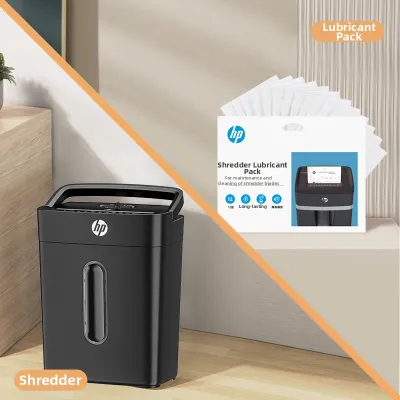
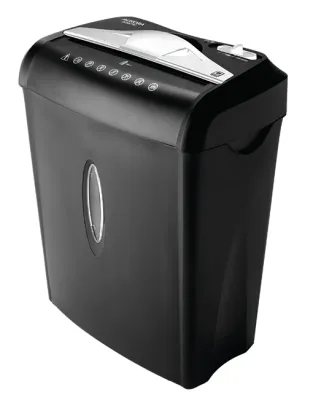
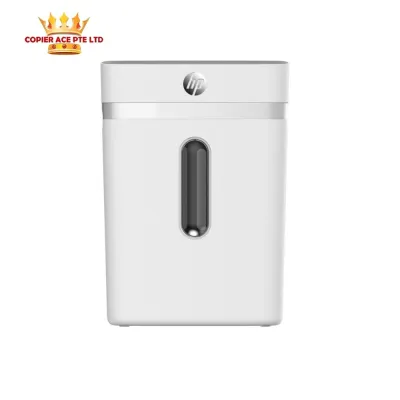
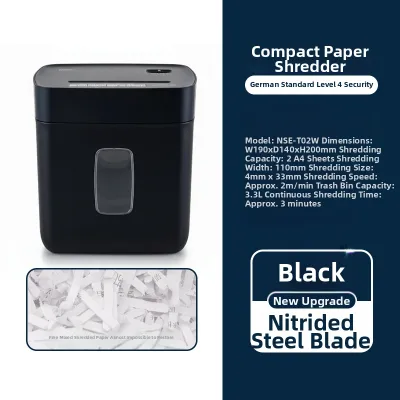
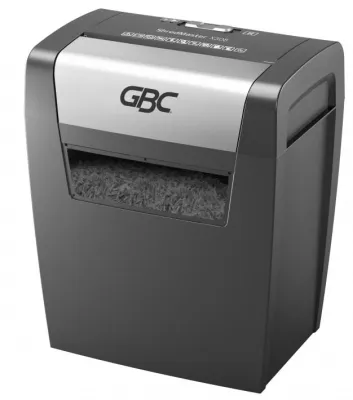
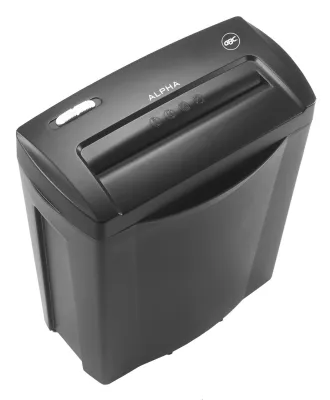
![[SG] [FREE SHIP] Manual Paper Shredder Mini Cutter Hand Crank Shred Office Destroy Private Confidential Documents](https://img.lazcdn.com/g/ff/kf/Scdcc162753a64816bee690cea4994db2h.jpg_400x400q80.jpg_.webp)
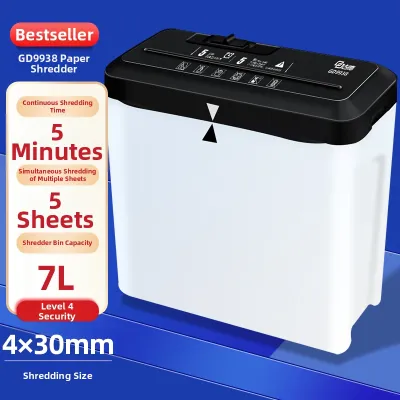
Prices are valid at publication and may change. Please refer to the product page for the latest price.
Matching Security Levels to Document Sensitivity
Matching the security level directly to the sensitivity of your documents helps you avoid overpaying for unnecessary performance or compromising your privacy.

Basic & General Office Use (P-1 to P-3)
Entry-level security ratings from P-1 to P-3 are designed for documents that do not contain personally identifiable information (PII) or proprietary business data. These levels are ideal for disposing of everyday junk mail, public notices, expired flyers, and general office drafts. A P-1 or P-2 shredder typically cuts paper into long, continuous vertical strips. While this makes the paper unreadable at a casual glance, the strips can easily be reassembled with basic patience. A P-3 shredder offers a slight step up by cutting paper into larger cross-cut segments. These entry-level machines are highly suitable for low-risk home environments, school classrooms, or communal office spaces where the primary goal is simply reducing waste volume rather than preventing targeted identity theft.
Sensitive Personal & Business Data (P-4 to P-5)
For standard household and corporate environments, P-4 and P-5 ratings represent the recommended baseline for secure document disposal. In Singapore, where businesses must strictly comply with the Personal Data Protection Act (PDPA), these security levels are essential for destroying documents containing sensitive customer or employee information. This includes bank statements from local institutions, Central Provident Fund (CPF) records, Inland Revenue Authority of Singapore (IRAS) tax assessments, medical files, payroll slips, and internal corporate memos. A P-4 or P-5 shredder cuts paper into tiny, confetti-like cross-cut or micro-cut particles. This level of destruction makes manual reconstruction virtually impossible and digital scanning reconstruction highly impractical, providing peace of mind for both families and SOHO (Small Office/Home Office) operators.
Highly Confidential & Classified Records (P-6 to P-7)
When dealing with high-stakes corporate, legal, or government data, P-6 and P-7 security levels are mandatory. These ultra-high-security shredders are built to protect trade secrets, patented research, military intelligence, and highly classified government records. A P-7 machine, for example, reduces a single sheet of A4 paper into thousands of microscopic, dust-like particles. Because of the extreme precision required to achieve this level of destruction, these machines are highly specialized. They often feature lower sheet capacities, require dedicated electrical circuits to prevent power overloads, and demand strict adherence to maintenance schedules to keep the complex cutting heads functioning correctly.
| Security Level | Cut Type | Particle Size (Approx.) | Suitable Document Examples |
|---|---|---|---|
| P-1 to P-2 | Strip-Cut | 5.8mm to 12mm strips | Junk mail, public notices, non-sensitive drafts |
| P-3 | Cross-Cut | ≤ 320 mm² particles | General business documents, non-confidential emails |
| P-4 | Cross-Cut | ≤ 160 mm² particles | Bank statements, payroll slips, standard corporate files |
| P-5 | Micro-Cut | ≤ 30 mm² particles | Medical records, financial audits, strategic business plans |
| P-6 to P-7 | High-Security Micro-Cut | ≤ 10 mm² down to ≤ 5 mm² | State secrets, patented research, military-grade intelligence |
How Cut Types Dictate Security and Performance
The physical cutting mechanism of a paper shredder directly dictates both its security rating and its daily performance. Strip-cut shredders are the fastest and simplest options, slicing paper vertically into long ribbons. Because they use simple parallel blades, they can process many sheets simultaneously and rarely jam, but they only provide P-1 or P-2 security. Cross-cut shredders use two interlocking rollers to cut paper both vertically and horizontally, creating small rectangular or diamond-shaped pieces. This mechanism balances speed, sheet capacity, and security, typically covering the P-3 to P-5 range. Micro-cut shredders represent the peak of physical destruction, utilizing intricate, highly aligned blade arrays to pulverize paper into tiny, illegible particles corresponding to P-6 and P-7 ratings.
Beyond security, the cutting mechanism heavily influences waste management and bin capacity. Strip-cut ribbons do not compress well; they tangle easily and create large air pockets, causing the waste bin to fill up rapidly even with a small number of shredded pages. In contrast, micro-cut and high-level cross-cut particles are incredibly dense and settle tightly at the bottom of the bin. This compression means a micro-cut shredder can hold significantly more shredded pages in the same physical bin volume, reducing how often you need to empty the machine.
Balancing Security With Daily Usability Specs
While finding the right DIN P-rating is crucial, ignoring secondary operational specifications can lead to significant frustration during daily use. Sheet capacity is one of the most critical daily specs to consider. A high-security P-5 micro-cut shredder might only be rated to handle 5 sheets of paper per pass, whereas a P-4 cross-cut shredder at a similar price point might easily swallow 15 to 20 sheets at once. If your workflow involves purging entire filing cabinets at the end of the fiscal year, a low sheet capacity will create a major bottleneck.
Continuous run time, or the machine’s duty cycle, is another vital factor. Shredder motors generate substantial heat, particularly when forcing paper through the dense blade configurations of high-security models. Most consumer and small-office shredders have a specified run time (for example, 10 minutes of continuous shredding followed by a 40-minute cool-down period). If you exceed this limit, the machine’s thermal overload protection will shut it down to prevent motor damage. Always match the continuous run time to your typical batch sizes.
Finally, pay close attention to media compatibility. Many documents are bound with staples or paper clips, and you may occasionally need to destroy expired credit cards, transit cards, or optical discs. While some robust shredders feature hardened steel blades that can effortlessly slice through staples and plastic cards, others will dull or chip if fed anything other than plain paper. Always consult the manufacturer’s user manual to verify what materials your specific model can safely handle.
Frequently Asked Questions (FAQ)
Can I shred credit cards and CDs in a standard paper shredder?
Standard paper shredders are optimized for paper fibers, and feeding dense plastics like credit cards or CDs can permanently damage the cutting cylinders and void your warranty. Many modern cross-cut and micro-cut models do include dedicated slots and reinforced blades for media destruction, but you must explicitly verify this feature in the manufacturer’s specifications before attempting to shred plastic.
Does a higher security level mean the shredder is more durable?
No, a higher DIN P-rating does not correlate with greater machine durability or a longer motor lifespan. The security level only indicates the final particle size of the shredded paper. A shredder’s durability is determined by its motor quality, internal gear construction (such as metal gears versus plastic gears), thermal protection systems, and how regularly you perform basic maintenance, such as oiling the blades with manufacturer-approved shredder oil.
How often should I empty the shredder bin to prevent jams?
You should always empty the waste bin before it reaches the manufacturer’s designated fill line or window. Letting the bin overfill allows shredded paper to accumulate and feed backward up into the cutting mechanism. This backup is a primary cause of severe paper jams, which can strain the motor, misalign the cutting shafts, and potentially damage the internal gears.
Community discussion
Share your experience or ask a question. Comments are reviewed before publication.