
Finding the right Oriented Polypropylene (OPP) bag size requires matching your product’s physical dimensions—width, length, and thickness—to the bag’s usable internal space. OPP bags are highly valued in Singapore for their high clarity and crisp texture, making them excellent for displaying stationery, apparel, and crafts. However, choosing a bag that is too small leads to split seams, while an oversized bag makes your items look unprofessional. By taking precise measurements of your items and accounting for the bag’s sealing flap, you can easily calculate the perfect fit for secure packaging.
Decoding OPP Bag Dimensions and Specifications
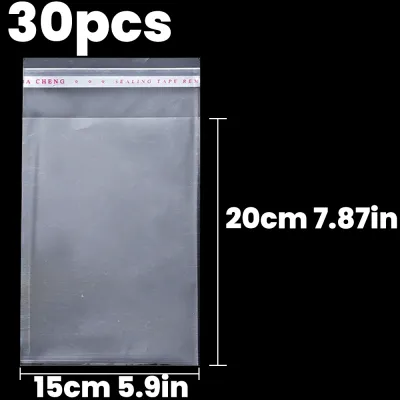
When browsing packaging supplies on an ecommerce platform, you will typically see OPP bag sizes listed as a set of two numbers, such as Width x Length. It is crucial to understand that the listed length often represents the total external length of the flat plastic sheet, which includes the adhesive sealing flap. If a bag is labeled as 10 cm x 15 cm with a 3 cm flap, the actual body of the bag is only 12 cm long. Always check the product description to confirm whether the listed length includes or excludes this flap.
Thickness is another vital specification that determines the durability and stiffness of the bag. This is usually measured in microns (micrometer, µm) or mils, where one mil equals approximately 25.4 microns. Standard lightweight OPP bags for light stationery or cards typically range from 25 to 30 microns, while heavier items require 40 to 50 microns or more to prevent splitting.
Products mentioned in this guide
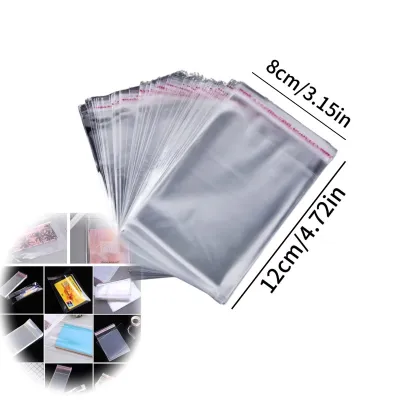
![[SG SELLER] Self Adhesive Clear OPP Transparent Packaging Poly Plastic Bag Retailer Clothes Sealing Wrap Plastic Storage](https://img.lazcdn.com/g/p/22be75670b3840eb6258305648fc2f8f.png_400x400q80.png_.webp)
Prices are valid at publication and may change. Please refer to the product page for the latest price.
You must also identify whether you need a flat bag or a gusseted bag. Flat OPP bags are ideal for two-dimensional items like postcards, art prints, and single stickers. Gusseted bags feature folded sides or bottoms that expand, making them the correct choice for three-dimensional products like baked goods, thick notebooks, or bulkier handmade crafts.
Measuring Your Products for Packaging
To find the minimum required bag size, you must first measure your product’s maximum dimensions using a standard ruler or measuring tape. For flat items like a single greeting card or a photograph, simply measure the exact width and length. If your item has any noticeable thickness, such as a stack of ten cards, you must measure that depth as well, as it will consume the bag’s width and length when inserted.

For bulky, three-dimensional, or irregularly shaped items, measure the widest point, the longest point, and the thickest point. Do not guess these dimensions, as even a discrepancy of a few millimeters can prevent a rigid item from sliding into a highly inelastic OPP bag.
If you plan to pack multiple units together, stack them exactly as they will be packaged before taking your measurements. Additionally, if you wrap your products in protective bubble wrap, tissue paper, or backing boards, measure the entire bundled package rather than the bare product. The added bulk of protective wrapping significantly increases the required bag size.
Calculating the Ideal Bag Size for a Secure Fit
Once you have the exact dimensions of your product, you can use a simple formula to calculate the minimum flat bag width and length. To find the required bag width, add the product’s width to its thickness, then add a clearance margin of at least 10 mm to 15 mm. This extra space ensures the item slides in smoothly without putting excessive stress on the side seams of the bag.
To calculate the required bag length, add the product’s length to its thickness, then add an additional 10 mm of clearance. If you are using a self-adhesive bag, ensure your calculated length matches the usable length of the bag, which excludes the adhesive flap. For example, if your product is 120 mm long and 15 mm thick, you need a usable bag length of at least 145 mm.
If your calculations show that a flat bag would require an excessively large width to accommodate a very thick item, it is time to switch to a gusseted bag. Gusseted bags distribute the volume more evenly, preventing the plastic from warping or pulling tight at the corners, which can ruin the presentation of your product.
Evaluating Thickness and Seal Types for Your Items
Selecting the right material thickness is essential to ensure your packages survive handling and transit without tearing. Lightweight items with soft edges, such as clothing or brochures, perform well in standard 30-micron bags. However, if your product has sharp corners, like acrylic keychains, metal pins, or hardback books, you should opt for a thickness of 40 to 50 microns to resist punctures.
You also need to choose between different closure styles based on your packaging workflow. Self-adhesive peel-and-seal flaps are highly convenient for quick packing, featuring a pre-applied adhesive strip protected by a removable liner. For a completely airtight or tamper-evident seal, open-top OPP bags can be sealed using a manual heat sealer, which melts the plastic edges together.
Before purchasing bulk quantities, always check the manufacturer’s specifications for seam strength and load limits. If you are packaging heavier items, look for bags with reinforced side seals, which feature a wider weld along the edges to prevent blowout during shipping.
Frequently Asked Questions (FAQ)
Can I use a standard OPP bag for heavy or sharp-edged products?
Standard thin OPP bags are generally not recommended for heavy or sharp-edged items because the material is highly rigid and prone to puncture propagation once nicked. If a sharp corner pierces the plastic, the entire side seam can easily split open under tension. For these items, verify if the manufacturer offers heavy-duty variants, or consider alternative packaging materials like cast polypropylene (CPP) or polyethylene (PE), which offer higher flexibility and impact resistance.
What is the difference between the listed bag length and the usable length?
The listed bag length on packaging labels often represents the total length of the plastic sheet, including the fold-over adhesive flap. The usable length is the actual depth of the pocket where your product sits, which is shorter than the total length. To avoid buying bags that are too short, subtract the flap length—typically 20 mm to 40 mm depending on the bag size—from the total listed length to find the true usable space.
Community discussion
Share your experience or ask a question. Comments are reviewed before publication.