
Choosing the right whiteboard for magnetic letter activities requires balancing surface durability with magnetic attraction. While many assume any magnetic board will hold plastic alphabet letters, the material of the writing surface plays a critical role in how well those letters stay in place. For most educational settings, preschools, and home learning environments, porcelain whiteboards offer the best overall performance, combining a highly scratch-resistant ceramic surface with a thin profile that allows for a strong magnetic hold. Melamine serves as a budget-friendly alternative but wears down quickly under heavy use, while premium glass boards present unique magnetic challenges that require specialized, high-strength magnets.
When selecting a board for interactive spelling or phonics exercises, the physical interaction between the board and the letters is just as important as how easily dry-erase markers wipe away. If the magnetic hold is too weak, letters will slide down or fall off entirely, disrupting the flow of a lesson. Understanding how different materials affect magnetic pull, scratch resistance, and long-term usability will help you make an informed investment for your classroom or study room.
How Surface Thickness Dictates Magnetic Hold
To understand why different whiteboards perform uniquely with magnetic letters, it is essential to look at the physics of magnetic attraction. Magnetic force does not pass through materials with uniform strength; instead, it decreases exponentially as the distance between the magnet and the receptive metal backing increases. In a whiteboard, the writing surface itself—whether plastic resin, ceramic enamel, or tempered glass—is non-magnetic. The actual magnetic pull is generated by a sheet of steel laminated directly behind this decorative writing layer.
Products mentioned in this guide
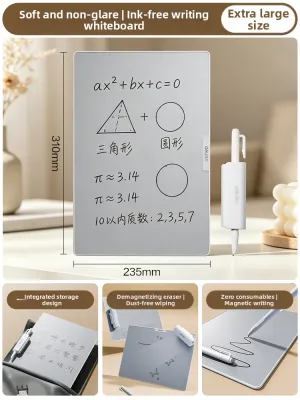
![[Ready Stock] A4 Compact Whiteboard White Board | Ultra Slim 1mm|Marker Erasable|Washable|Writing Board | Childrens Day](https://img.lazcdn.com/g/p/1b120a4258f810a5521ad4de86b022dd.jpg_400x400q80.jpg_.webp)
Prices are valid at publication and may change. Please refer to the product page for the latest price.
Therefore, the writing surface acts as a physical barrier, or “gap,” between the magnet on the back of your educational letter and the steel backing plate. A thicker barrier means a wider gap, which drastically reduces the magnetic flux reaching the steel. Standard educational magnetic letters typically utilize low-cost, flexible rubber magnets or small ceramic magnets. These magnets are designed with a very shallow magnetic field that is highly sensitive to distance.
The gauge, or thickness, of the steel backing layer also plays a critical role. A thicker, high-quality steel sheet provides a more robust path for the magnetic field to complete its circuit, resulting in a tighter, more secure hold. Conversely, a whiteboard with an ultra-thin steel backing or a painted tin sheet will offer weak magnetic attraction, even if the front surface material is thin. When weak letter magnets encounter a thick surface barrier and a thin steel backing, the letters simply cannot support their own weight and will slide downward.
Melamine Whiteboards: Budget-Friendly but Vulnerable to Wear
Melamine whiteboards are the most common budget-friendly option available in local stationery shops and online marketplaces. These boards are typically constructed by coating a thin layer of plastic melamine resin over a substrate of particleboard or medium-density fiberboard (MDF). To make the board magnetic, manufacturers insert a thin sheet of steel between the melamine layer and the wood backing. Because of their low production costs, melamine boards are highly accessible, often costing a fraction of the price of porcelain or glass alternatives.

However, the soft plastic resin surface of a melamine board is highly vulnerable to physical wear and tear, especially during active hands-on learning. When children repeatedly slide, drag, and reposition plastic magnetic letters, the hard edges of the letters can easily create micro-scratches on the surface. Dust, grit, and dried marker residue trapped underneath the letters act like sandpaper, accelerating this abrasive wear.
Over time, these micro-scratches compromise the integrity of the melamine surface. Dry-erase marker ink penetrates these tiny grooves, leading to permanent staining and “ghosting” that cannot be easily wiped away. Additionally, because budget melamine boards often utilize the thinnest possible steel backing to keep costs low, the magnetic hold is frequently mediocre. While a melamine board may suffice for low-frequency home tutoring or temporary setups where surface degradation is acceptable, it is rarely suitable for high-traffic classrooms or daily phonics drills.
Porcelain Whiteboards: Durable and Magnet-Friendly
Porcelain whiteboards, often referred to as ceramic steel boards, represent the gold standard for heavy-duty educational use. These boards are manufactured by fusing a thin layer of ceramic enamel onto a heavy-gauge steel sheet at temperatures exceeding 800 degrees Celsius. This high-temperature firing process molecularly bonds the ceramic to the steel, creating an incredibly hard, glassy surface that is highly resistant to physical damage.
Because the porcelain enamel layer is exceptionally thin, the physical gap between the magnetic letter and the steel backing is kept to an absolute minimum. This close proximity allows standard educational letters—even those with weak, flexible rubber backing—to grip the board with maximum force. Letters remain exactly where they are placed without sliding, tilting, or falling off, allowing teachers and students to focus entirely on the lesson.
In terms of durability, porcelain is virtually unmatched. The ceramic surface is highly scratch-resistant, meaning that the constant dragging and sliding of plastic letters will not leave unsightly marks or grooves. It is also completely non-porous, preventing dry-erase marker ink from penetrating the surface. Even after years of daily use and thousands of letter movements, a porcelain board will wipe clean to its original state without ghosting. For schools, tuition centres, and dedicated home-schooling spaces, the long-term durability and reliable magnetic performance of porcelain justify its higher initial cost.
Glass Whiteboards: Premium Durability with Magnetic Caveats
Glass whiteboards are highly favored in modern offices and premium home study spaces for their sleek, contemporary aesthetic and unmatched longevity. Constructed from tempered safety glass that is typically 4mm to 6mm thick, these boards feature a steel backing plate bonded to the rear of the glass. Glass is completely non-porous and impervious to scratching, staining, and ghosting, making it the easiest surface to clean and maintain over decades of use.
Despite these premium qualities, glass whiteboards present a significant physical challenge when used for magnetic letter activities. The 4mm to 6mm thickness of the tempered glass creates a massive physical barrier between the letter’s magnet and the steel backing. Standard educational magnetic letters, which rely on weak flexible rubber or small ceramic magnets, simply do not possess the magnetic field depth required to bridge this gap. If you attempt to use standard letters on a glass board, they will slide off instantly or fail to stick at all.
To successfully use magnetic letters on a glass whiteboard, you must use high-strength rare-earth (neodymium) magnets. This means standard plastic school letters must be retrofitted by gluing strong neodymium disc magnets to their backs, or you must source specialized letters designed specifically for glass boards. While this extra step resolves the magnetic hold issue, it adds to the overall cost and preparation time. If you are willing to make this adjustment, glass offers an exceptionally smooth, scratch-free surface, but it is not a direct, out-of-the-box solution for standard classroom letter sets.
Material Comparison for Magnetic Letter Activities
To help you decide which whiteboard material best suits your specific educational needs and budget, the table below summarizes how each option performs across key operational dimensions.
| Surface Material | Typical Gap Thickness | Scratch Resistance | Recommended Magnet Type | Long-Term Clarity |
|---|---|---|---|---|
| Melamine | Very Thin (1mm – 2mm) | Low (Scratches easily) | Standard Flexible / Ceramic | Low (Prone to ghosting) |
| Porcelain | Ultra-Thin (<1mm) | High (Highly scratch-resistant) | Standard Flexible / Ceramic | High (Stays pristine) |
| Glass | Thick (4mm – 6mm) | Extremely High (Impervious) | Rare-Earth (Neodymium) | Extremely High (Zero ghosting) |
As indicated by the comparison, while melamine offers an easy entry point for standard magnets, its low scratch resistance limits its lifespan. Porcelain provides the ideal balance, offering high scratch resistance and compatibility with standard magnets. Glass offers the ultimate in durability and clarity but demands a complete upgrade to high-strength rare-earth magnets to function effectively as a magnetic surface.
How to Verify Magnetic Compatibility Before Buying
Before purchasing a whiteboard for magnetic letter activities, it is crucial to verify its specifications to ensure it will support your intended use. First, always confirm that the board is explicitly labeled as “magnetic.” Some budget melamine boards and decorative glass boards are non-magnetic, lacking the necessary steel backing sheet entirely. Look for terms like “steel-backed,” “magnetic dry-erase,” or “porcelain-on-steel” in the product description.
Second, pay close attention to the thickness of the writing surface, especially when shopping for glass boards. If you plan to use standard, off-the-shelf educational letters, avoid any glass board unless you are prepared to purchase neodymium magnets separately. For porcelain boards, check that the backing is made of galvanized steel, which provides the most reliable magnetic attraction and prevents rust in humid climates.
If you are shopping at a local stationery store, the most reliable verification method is to bring a few of your own magnetic letters with you. Test them directly on the display models to observe how securely they hold. Check if the letters slide when the board is bumped or if they rotate out of alignment. If you are purchasing online, carefully read customer reviews regarding magnetic strength and check the retailer’s return policy so you can return the board if it does not provide a sufficient hold for your specific letter sets.
Frequently Asked Questions (FAQ)
Will dragging magnetic letters scratch a glass whiteboard?
Tempered glass is exceptionally hard and highly resistant to scratching from the smooth plastic edges of standard educational letters. However, dust, airborne grit, or tiny debris can easily become trapped between the magnet and the glass surface. When letters are dragged across the board, these trapped particles can act as an abrasive, potentially causing fine micro-scratches over time. To maintain a pristine surface, it is highly recommended to teach children to lift and place the letters rather than dragging them, and to wipe both the board and the backs of the letters regularly.
How can I improve the magnetic hold on my existing whiteboard?
If your current whiteboard has a weak magnetic hold, you can easily improve its performance without replacing the entire board. The most effective solution is to upgrade the magnets on the backs of your existing letters. You can purchase small, self-adhesive neodymium disc magnets and attach them directly over the existing weak rubber magnets. Alternatively, you can apply high-quality magnetic tape with a thicker, more powerful magnetic profile to the backs of the letters, ensuring they can bridge the gap to the steel backing more effectively.

Community discussion
Share your experience or ask a question. Comments are reviewed before publication.