
Matching a Smart Pack shipping bag to SingPost’s parcel size requirements requires understanding how flat bag dimensions translate into three-dimensional packed volumes. Because flexible poly mailers stretch, bulge, and shrink in length when filled, selecting the correct bag size is a matter of calculating your item’s thickness and comparing the final, sealed package against SingPost’s official tier limits. Doing this correctly prevents unexpected surcharges, delivery delays, or package rejections at the post office counter or posting box.
Navigating postal guidelines can be challenging, especially when dealing with flexible packaging that changes shape depending on what is placed inside. By learning how to calculate the volumetric impact of your items and verifying your packed mailers against official standards, you can streamline your shipping process. This guide provides a practical framework for selecting, packing, and measuring your shipping bags to ensure seamless delivery through Singapore’s postal network.
Identify Your Target SingPost Parcel Tier
SingPost categorizes mail and parcels into distinct tiers based on dimensions (length, width, and thickness) and weight. To ensure your package qualifies for your intended service, always verify the latest threshold limits on the official SingPost website before packing. Flexible shipping bags, often referred to as poly mailers or courier bags, are subject to strict thickness checks. A package that easily fits the length and width limits can still be rejected or bumped to a higher, more expensive tier if it exceeds the maximum thickness allowed for standard letterbox delivery.
Products mentioned in this guide
![[1/2/3/4 pcs] SingPost Smartpac Medium size - for using within Singapore only - Prepaid Packaging with Tracking](https://img.lazcdn.com/g/p/8f2c3c3994c2d6fb1e87feebed85f10b.jpg_400x400q80.jpg_.webp)
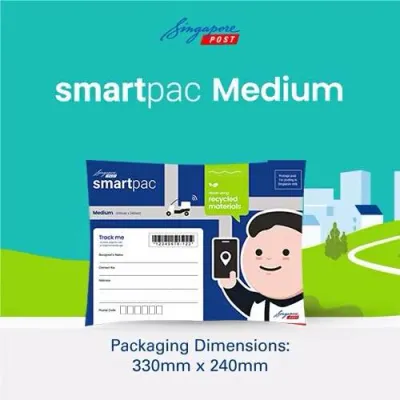
![[SINGPOST] MEDIUM smartpac - A postage-paid packaging for local delivery. Trackable via the SingPost mobile app.](https://img.lazcdn.com/g/p/3360d819ebee92c4900de5d10f98c2e8.png_400x400q80.png_.webp)
Prices are valid at publication and may change. Please refer to the product page for the latest price.
When measuring a flexible bag, SingPost considers the maximum dimensions of the package in its fully packed, sealed state—not its flat state. This means any bulging in the middle of the bag counts toward the total thickness. Standard parcels are typically designed to fit through standard Singapore residential letterboxes, which imposes a strict limit on thickness. If your item is bulky, rigid, or unevenly shaped, it may exceed these letterbox limits and require classification as an oversized parcel or a speedier courier tier, which involves different handling and pricing structures.
Choose the Right Smart Pack Bag for Your Item
Selecting the correct Smart Pack bag size starts with measuring your item’s three-dimensional dimensions: length, width, and height (or thickness). You cannot simply match an item’s flat length and width to the flat dimensions of a shipping bag. As a rule of thumb, when an item has thickness, it pulls the sides of the bag inward, reducing the available length and width. Additionally, if you plan to use bubble wrap, foam wrap, or cardboard inserts for protection, you must measure the item after it has been wrapped in these protective materials.

Smart Pack bags and generic poly mailers are labeled by their flat external dimensions. However, the actual usable space is always smaller. You must subtract the width of the side seams (usually a few millimeters on each side) and the length of the sealing flap (typically 4 to 5 centimeters) from the total flat length. For example, if a bag is labeled as 30 centimeters long, the usable length before folding the flap is closer to 25 or 26 centimeters. If your item is thick, you will need even more clearance to allow the bag to wrap around the sides of the item and still seal flat.
Material strength and thickness are also critical selection factors. Standard poly mailers come in various thicknesses, usually measured in microns. For lightweight items like clothing or soft textiles, a standard-thickness bag is sufficient. However, for heavier items, books, or products with sharp corners, you should opt for a heavy-duty, co-extruded polyethylene bag. A thicker material resists puncturing and tearing during transit, ensuring that the contents do not burst through the seams and alter the package’s shape or compromise its security.
When working with self-adhesive shipping bags, safety and handling are important. The adhesive strips on these bags are designed to be highly secure and permanent once applied. Keep the peel-off backing strips away from children and pets, as they can present a static cling or choking hazard. Additionally, ensure that the adhesive is applied to a clean, dry, and dust-free area of the bag to guarantee a secure bond that will not peel open during transit.
Measure and Verify the Final Packed Dimensions
Once your item is placed inside the Smart Pack bag and the adhesive strip is sealed, you must perform a final measurement check. Use a standard ruler or measuring tape to measure the package at its thickest, widest, and longest points. Do not measure along the flat edges if the center of the bag bulges outward; postal sorting machines and manual gauges measure the maximum envelope of the package, meaning any bulge determines the official thickness.
To minimize bulging and keep your package within letterbox-friendly limits, distribute the contents as evenly as possible before sealing the bag. For multiple small items, lay them flat side-by-side rather than stacking them on top of one another. Gently press out any excess air from the bag before pressing down the self-adhesive flap. Trapped air can turn a thin, compliant package into a puffy, oversized balloon that will fail the post office’s slot test.
If your item is highly irregular, heavy, or naturally thick, a flexible poly mailer might not be the most suitable choice. When a flexible bag is stretched to its limit, it becomes vulnerable to punctures and can easily exceed the maximum thickness threshold. In such cases, switching to a rigid cardboard mailer or a small corrugated box is highly recommended. A rigid container maintains a fixed, predictable shape, preventing the bulging that often leads to unexpected surcharges or rejections at the SingPost counter.
For those who frequently send items close to the thickness limit, keeping a physical slot gauge at home can be an invaluable tool. You can create a simple DIY gauge by cutting a slot of the exact maximum thickness allowed by SingPost into a piece of rigid cardboard. If your packed Smart Pack bag can slide through this slot easily without forcing or squeezing, it is highly likely to pass the official inspection at the post office without any issues.
Avoid Common Sizing Mistakes at the Post Office
One of the most common mistakes senders make is overstuffing a shipping bag to save on packaging costs. Overstuffing forces the flexible plastic to stretch, which drastically reduces the overall length and width of the package while ballooning the thickness. This distortion can easily push a package out of a lower-priced tier into a more expensive parcel category. If you have to force or stretch the plastic to close the bag, the bag is too small, and you should upgrade to the next size up.
Another frequent error is failing to account for the sealing flap margin. The adhesive strip is located on a flap that must be folded over the body of the bag to create a secure seal. If you calculate your item’s maximum length based on the total flat length of the bag including the open flap, you will find that the sealed package is too short, or that you cannot seal the bag securely without exposing the adhesive or leaving gaps at the corners. Always measure your item against the bag’s length excluding the flap.
Finally, always verify the total packed weight of your package before heading to the post office or dropping it into a posting box. Even if your Smart Pack bag fully meets the physical dimension requirements for a specific SingPost tier, exceeding the weight limit for that tier will result in a surcharge or require you to pay for a higher service level. Use a reliable digital kitchen scale or postal scale at home to check the weight, keeping in mind that the weight of the bag itself, the adhesive, and any internal protective wrapping must be included in the total.
Frequently Asked Questions (FAQ)
Can I fold a Smart Pack bag to make it fit a smaller SingPost tier?
Yes, you can fold over the excess material of a larger Smart Pack bag to make it fit a smaller, more compact size. However, you must ensure that the folded edges are taped down securely to prevent them from catching on automated sorting machinery. The final package must remain flat, even, and within the maximum thickness and weight limits of your target SingPost tier. Avoid creating thick, bulky folds that artificially increase the package’s thickness beyond the allowed limit.
Does SingPost measure the shipping bag when it is flat or fully packed?
SingPost measures all shipping bags and packages in their final, fully packed, and sealed state. Postal staff and automated sorting systems assess the package based on its maximum external dimensions, including any bulges, air pockets, or uneven surfaces. A bag that measures within the limits when flat can easily exceed those limits once filled with an item. Always measure your package at its thickest point after sealing to ensure compliance.

Community discussion
Share your experience or ask a question. Comments are reviewed before publication.