
Quick Answer: Condition-Based Recommendation
Choosing between a magnetic board and a whiteboard for teaching letters depends on your child’s age and developmental stage. For toddlers and early preschoolers (ages 2 to 4) who are just beginning to recognize shapes and letters, a magnetic board is often recommended. It allows them to physically handle three-dimensional letter tiles, supporting their developing pincer grasp and spatial awareness without the frustration of holding a pen.
Conversely, for older preschoolers and kindergarteners (ages 4 to 6) who are ready to transition from letter recognition to letter formation and handwriting, a standard whiteboard is a highly effective tool. It provides a smooth, reusable canvas for practicing pen control, stroke order, and spelling. For families seeking a long-term investment that adapts to multiple age groups or evolving skills, a 2-in-1 magnetic whiteboard offers a practical transitional solution, combining tactile magnetic play with dry-erase writing on a single surface.
Interaction and Motor Skills: Magnetic Pieces vs Marker Writing
The choice of board directly influences how a child develops fine motor skills during early literacy activities. Magnetic boards rely on physical interaction with three-dimensional objects. When a child picks up, rotates, and places a magnetic letter tile, they are actively practicing the pincer grasp—the coordination between the index finger and thumb. This tactile feedback is crucial for cognitive development, as young children learn about shapes and spatial relationships by physically manipulating objects. Moving letters around a magnetic surface helps build hand-eye coordination and spatial planning, allowing children to experiment with word construction before they have the physical strength or control to write.
Products mentioned in this guide
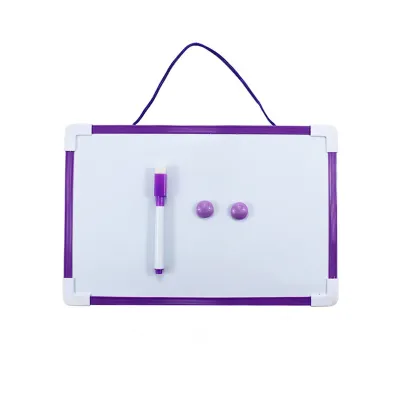
Prices are valid at publication and may change. Please refer to the product page for the latest price.

In contrast, using a whiteboard shifts the focus to penmanship and grip strength. Writing with a dry-erase marker requires a child to transition from a primitive palmar grasp to a mature tripod grasp. This action demands precise control over the small muscles in the hand and wrist. Unlike paper, which offers natural friction, the slick surface of a whiteboard requires greater muscle control to stop and start strokes accurately. Practicing letter formation on a whiteboard helps children master the mechanics of writing, such as maintaining consistent letter height, following a straight line, and understanding stroke sequence.
To determine which option is best for your current setup, perform a simple verification check of your child’s physical readiness. Observe how they interact with everyday objects. If your child struggles to hold a thick crayon or pencil comfortably and quickly tires when drawing, they will likely find a whiteboard frustrating for letter learning. In this case, starting with magnetic letters allows them to focus entirely on phonics and letter shapes. If they can already scribble with control and show an interest in tracing lines, introducing a whiteboard marker will help channel that interest into structured handwriting practice.
Maintenance, Cleaning, and Durability
Maintaining a clean and functional learning space is essential for keeping children engaged and ensuring the longevity of your educational tools. Whiteboards require regular upkeep to prevent a common issue known as ghosting, where dry-erase ink leaves permanent, faint stains on the surface. This is particularly common in humid environments, such as Singapore, where moisture in the air can cause ink to bond more quickly to low-quality whiteboard coatings. To prevent this, whiteboards must be erased promptly after use with a dedicated microfiber cloth or felt eraser. Additionally, dry-erase markers require constant supervision; young children often forget to replace marker caps, leading to dried-out tips and wasted supplies.
Magnetic boards offer a cleaner alternative regarding ink, but they present different maintenance challenges. While you do not have to worry about marker stains on walls or clothing, you must manage the physical pieces. Small magnetic letters are easily misplaced, especially in compact living spaces where pieces can slide under furniture or get mixed up with other toys. Keeping a dedicated storage bin or organizer box is necessary to keep the set complete. Furthermore, dust and oils from small hands can accumulate on both the board and the back of the magnets over time, reducing their magnetic grip. Regularly wiping down the board and the tiles with a damp cloth is required to keep the surface clean and hygienic.
Safety is a crucial consideration when managing these materials. Before introducing any magnetic board, perform a thorough safety check on the letter pieces. Ensure that the magnets are securely embedded or glued into the plastic or wood, as loose magnets pose a severe choking and ingestion hazard for young children. For whiteboards, always verify that the markers are certified non-toxic and low-odor. Standard industrial dry-erase markers can emit strong fumes that are unsuitable for small, enclosed study areas, so look for child-safe formulas specifically designed for home and classroom use.
Versatility and Learning Progression
As a child’s literacy skills grow, the educational tool you choose must adapt to support more complex learning tasks. Whiteboards offer virtually unlimited versatility. Because the surface is a blank canvas, it can transition seamlessly from basic letter tracing to spelling lists, sentence structure, and freeform drawing. Educators and parents can draw custom guidelines, dotted lines, or grid patterns to help children practice proper letter alignment. A whiteboard also supports multi-subject learning, allowing you to switch from phonics to mathematics or drawing games in seconds without needing any additional physical accessories.
Magnetic boards, while highly engaging, are inherently limited by the physical pieces available in your set. If your child wants to spell a word that requires three “e”s, but your set only includes two, the learning momentum can be interrupted. Expanding the educational scope of a magnetic board typically requires purchasing additional accessory sets, such as extra lowercase letters, numbers, punctuation marks, or themed magnetic pictures. This can increase the overall cost, with high-quality expansion sets often priced between S$15 and S$30, and require more storage space over time.
For those looking to maximize utility, hybrid options like magnetic whiteboards provide a versatile combination of both methods. These boards feature a steel backing coated with a dry-erase finish, allowing children to place magnetic letters and write with markers on the same surface. This combination supports advanced learning activities, such as placing a magnetic letter and then tracing its shape directly next to it, or using magnetic letters to build a word and then writing a sentence underneath. This hybrid approach ensures the board remains useful from toddlerhood well into primary school.
Decision Framework: Choosing the Right Board for Your Child
To make the final decision for your home or classroom, consider this structured framework based on your child’s age, developmental goals, and space constraints:
- Choose a magnetic board if: Your child is under 3 years old, is still developing basic hand-eye coordination, or shows frustration when trying to hold writing tools. This option prioritizes tactile play, letter recognition, and vocabulary building without the physical demands of writing.
- Choose a whiteboard if: Your child is 4 years or older, has developed a comfortable grip on crayons or markers, and is actively learning how to write their name, form letters, or spell short words. This provides a reusable, low-friction surface for repetitive handwriting practice.
- Choose a 2-in-1 magnetic whiteboard if: You want a single, versatile investment that grows with your child from toddlerhood to early primary school, or if you are teaching multiple children of different ages in the same household.
Before finalizing your purchase, verify your physical setup. Measure the available wall space or floor footprint in your study area. In compact apartments, a large easel might restrict movement, making a wall-mounted board or a portable lapboard a more practical choice. Additionally, check the dimensions of the board to ensure it is large enough for comfortable arm movements, and verify that all included accessories, such as erasers and letter tiles, meet local safety standards for your child’s age group.
Frequently Asked Questions (FAQ)
Can I use regular fridge magnets on a magnetic learning board?
While regular fridge magnets will stick to a magnetic learning board, they are generally not recommended for structured educational activities. Decorative fridge magnets often lack the standardized sizing, clear fonts, and color-coded designs (such as blue consonants and red vowels) that help children distinguish between different letter types. Furthermore, many household fridge magnets are made of heavy ceramic or glass materials, which can easily chip, break, or detach when dropped, creating sharp edges and serious choking hazards for young children. It is safer and more effective to use dedicated, child-safe educational magnetic letter sets.
What type of markers are safest for young children using whiteboards?
The safest markers for young children are those explicitly labeled as non-toxic, low-odor, and water-based. Look for products that carry recognized safety certifications, which indicate the materials have been evaluated for toxicological safety. Avoid standard permanent markers or industrial dry-erase markers, which contain strong solvents that can cause headaches or irritation in enclosed spaces. Additionally, choose markers with a washable formula to ensure that accidental stray marks on skin, clothing, or furniture can be easily cleaned with soap and water.
How do I remove stubborn marker stains from a whiteboard?
To remove stubborn stains or ghosting from a whiteboard, start with the gentlest method to protect the board’s surface coating. A practical, non-abrasive technique is to draw directly over the old stains with a fresh, dark dry-erase marker, wait a few seconds, and then wipe it away immediately with a clean microfiber cloth; the solvents in the fresh ink will help dissolve the old, dried pigment. If stains persist, check the manufacturer’s instructions before applying any liquids. Avoid using abrasive scrubbing pads or harsh household chemicals like acetone, as these can permanently strip the smooth dry-erase coating, making the board even more prone to staining in the future.
Community discussion
Share your experience or ask a question. Comments are reviewed before publication.