
Quick Answer: Which Notebook Handles Fountain Pens Better?
For standard, off-the-shelf editions, Leuchtturm1917 notebooks handle fountain pens significantly better than Moleskine notebooks. The primary driver behind this performance gap is the paper density and chemical treatment. Leuchtturm1917 classic notebooks utilize a heavier, more ink-resistant paper that prevents liquid ink from spreading or soaking through the page, making it a reliable choice for daily writing with fountain pens.
In contrast, Moleskine’s classic paper is lighter and highly absorbent, which often leads to severe ghosting and physical bleed-through when paired with wet inks or broader nibs. However, Moleskine notebooks can still perform acceptably if you restrict your writing tools to extra-fine or fine nibs filled with dry, well-behaved inks.
Ultimately, the ideal choice depends on your specific writing setup. While Leuchtturm1917 is the superior default option for fountain pen users, both brands offer specialized high-gsm collections designed for heavy ink loads that alter this baseline comparison.
Products mentioned in this guide
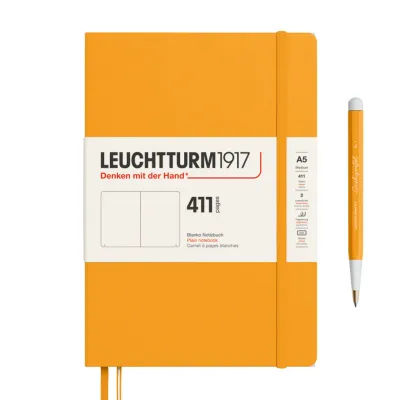
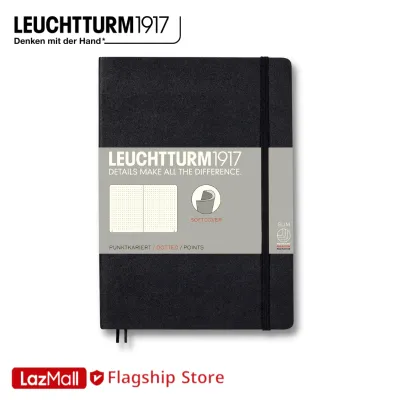
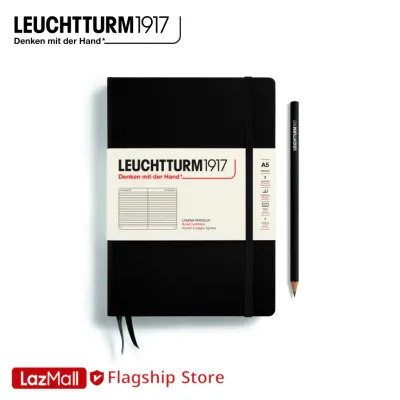
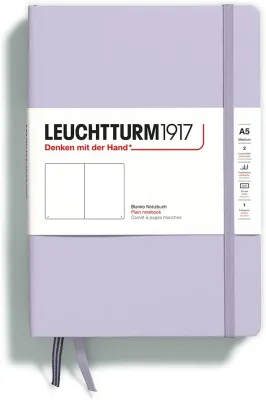
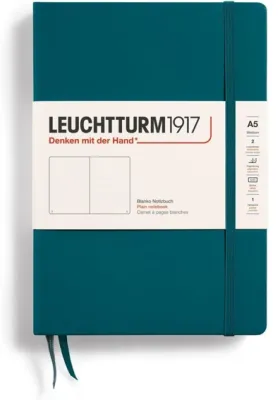
Prices are valid at publication and may change. Please refer to the product page for the latest price.
Paper Weight and Texture: What Drives Ink Behavior?
To understand why fountain pen ink behaves so differently on these two papers, you must look at the physical specifications of the sheets. Standard Leuchtturm1917 classic notebooks are constructed with 80 gsm (grams per square meter) paper. Classic Moleskine notebooks, on the other hand, use a lighter 70 gsm paper. This seemingly small 10 gsm difference represents a substantial increase in paper density, providing more physical fiber to absorb liquid ink before it saturates through to the reverse side.

Beyond raw weight, chemical sizing plays a critical role in ink control. Sizing refers to the chemical compounds applied to paper fibers during manufacturing to reduce absorbency. Unsized paper acts like a paper towel, drawing liquid rapidly via capillary action and causing lines to look fuzzy. Leuchtturm1917 applies a moderate surface and internal sizing that slows down ink absorption, keeping your written lines sharp, crisp, and true to your nib’s actual width.
Moleskine’s classic paper features lighter sizing, which makes it highly receptive to dry mediums like graphite and colored pencils, as well as standard ballpoint pens. However, when a wet fountain pen ink is introduced, this lack of heavy sizing allows the liquid to spread rapidly across the surface fibers. This spreading, known as feathering, turns a precise fine line into a thick, blurred stroke and causes the ink to sink deeply into the page.
The tactile texture, or “tooth,” of the paper also influences the writing experience. Leuchtturm1917 paper has a very slight texture that provides subtle tactile feedback to the hand, helping you control your pen strokes. Moleskine paper is exceptionally smooth and silky to the touch, which feels pleasant under a pen but can occasionally cause highly polished fountain pen nibs to skip or slide if the paper cannot grip the tipping material.
Before purchasing either brand, always check the product packaging or online specifications for the exact gsm of the specific notebook. Both manufacturers have expanded their catalogs to include specialized collections. For example, the Leuchtturm1917 120g Edition and Bullet Journal editions feature 120 gsm paper, while the Moleskine Art Collection offers heavy-duty options ranging from 120 gsm to 165 gsm designed specifically for sketching, mixed media, and heavy ink washes.
Real-World Ink Performance: Ghosting, Bleed-Through, and Dry Time
When evaluating a notebook for daily fountain pen use, you must balance how the paper handles ink penetration against how quickly the ink sets on the surface. These factors dictate whether you can write comfortably on both sides of a page and whether you will encounter frustrating smudges as you turn the sheets.
Ghosting and Bleed-Through
It is important to distinguish between ghosting and bleed-through, as they represent two entirely different paper behaviors. Ghosting, also known as show-through, occurs when the shadow of your writing is visible on the reverse side of the page, even though the ink has not physically penetrated the paper fibers. Because both Leuchtturm1917 and Moleskine use off-white or cream-colored paper, moderate ghosting is common in the standard editions of both brands. If you write with dark inks, you will likely see a faint silhouette of your text on the back of the page, which is generally acceptable if you do not mind a lived-in look.
Bleed-through is a much more severe issue where the ink physically saturates through the sheet, leaving dark spots or full lines on the reverse side and rendering it unusable. Moleskine’s classic 70 gsm paper is highly prone to bleed-through when used with medium, broad, or stub nibs, as well as with wet, highly saturated inks. The liquid quickly overwhelms the thin paper fibers, creating unsightly blotches on the next page.
Leuchtturm1917’s 80 gsm paper offers significantly better resistance to bleed-through. It easily handles extra-fine, fine, and moderate medium nibs without allowing the ink to break through to the back. However, it is not entirely bulletproof; if you use an exceptionally wet flex nib, a broad calligraphy pen, or highly lubricated inks that pool heavily, you may still experience minor pinpoint bleeding. For standard daily writing, however, the Leuchtturm1917 paper consistently allows you to utilize both sides of every leaf.
Ink Dry Time and Smudging
Paper performance always involves a trade-off between ink resistance and drying speed. Papers that are heavily sized to prevent bleed-through keep the liquid ink sitting on top of the page for a longer period. While this pool of surface ink preserves beautiful ink properties like shading and metallic sheen, it also drastically increases the risk of smudging if your hand brushes across the text.
Leuchtturm1917’s paper formulation strikes a practical, middle-ground balance. It resists feathering while allowing the ink to dry within a reasonable 10 to 20 seconds, depending on the wetness of your pen and the humidity of your environment. This moderate drying speed makes it highly functional for rapid note-taking in meetings or lectures, though left-handed writers who write over their text should still exercise caution.
Moleskine’s highly absorbent classic paper pulls the water content of the ink in almost instantly, resulting in exceptionally fast dry times. While this virtually eliminates smudging, the cost is a loss of ink character; you will rarely see any shading or sheen on Moleskine paper because the ink is immediately sucked into the core of the sheet.
To ensure compatibility with your specific pen and ink setup, always perform a small trial on an inconspicuous page, such as the back index or memo sheets. If you prefer using wet inks in either notebook, consider keeping a sheet of standard blotting paper or a clean piece of cardstock under your hand to absorb excess oils and prevent accidental smudges as you write.
Binding and Lay-Flat Ability: Writing Near the Gutter
Writing with a fountain pen requires a consistent, relaxed hand angle. Unlike ballpoint pens, which require vertical downward pressure to roll a metal ball, fountain pens rely on capillary action and light contact with the page. If a notebook resists staying open, the resulting curve near the center margin—known as the gutter—forces you to constantly adjust your wrist angle, which can cause the nib to skip, scratch, or lose ink flow.
Leuchtturm1917 notebooks are widely celebrated for their superior thread-bound construction. The notebook is assembled using small sewn booklets (signatures) that allow the spine to flex completely. When you open a Leuchtturm1917 hardcover, it lays remarkably flat on your desk, even on the very first and last pages. This flat surface ensures that your fountain pen nib maintains consistent contact with the paper across the entire width of the page spread, preventing hand fatigue.
Moleskine classic hardcovers also feature sewn bindings, but they are often bound with a stiffer adhesive and tighter spine reinforcement. This construction creates a spring-like tension that causes the notebook to pull inward or try to snap shut. Writing near the gutter of a Moleskine often requires you to physically hold the book down with your non-dominant hand or use heavy page clips. This constant physical resistance can disrupt your writing flow and make it difficult to maintain the delicate angle required for smooth fountain pen writing.
Quick Spec Comparison: Leuchtturm1917 vs Moleskine
The following table summarizes the key physical and performance specifications of the standard hardcover editions for both brands to help you identify the best fit for your writing habits.
| Feature | Leuchtturm1917 (Classic Hardcover) | Moleskine (Classic Hardcover) |
|---|---|---|
| Standard Paper Weight | 80 gsm | 70 gsm |
| Paper Color / Tone | Warm Cream / Ivory | Warm Cream / Ivory |
| Fountain Pen Compatibility | Good (Best with EF to M nibs) | Limited (Best with EF/F dry nibs) |
| Feathering Resistance | Moderate to High | Low |
| Bleed-Through Resistance | Moderate | Low |
| Average Dry Time | Moderate (10–20 seconds) | Fast (under 5 seconds) |
| Binding Style | Thread-bound, lays completely flat | Thread-bound, requires breaking in |
| Page Numbering | Pre-printed on every page | None |
| Index / Table of Contents | Included at the front | None |
| Dual Page Markers | Yes (Two ribbon bookmarks) | No (One ribbon bookmark) |
Note: Performance and physical specifications can vary depending on the specific collection, size, and regional release. Always verify the manufacturer’s stated paper weight (gsm) on the product label before purchasing to ensure it matches your writing medium.
Final Verdict: How to Choose Based on Your Ink and Nib
To make your final decision, evaluate your specific writing tools, ink preferences, and organizational needs using this practical selection framework.
Choose Leuchtturm1917 if:
- You use standard or wet fountain pens: If your collection includes medium (M), broad (B), stub, or flexible nibs, the 80 gsm paper will support the heavier ink flow without falling apart.
- You prefer saturated or premium inks: If you enjoy using rich, lubricated inks that show off shading or sheen, the sized paper will preserve these visual characteristics.
- You want built-in organization: The pre-printed page numbers, blank table of contents, and dual page markers are ideal for bullet journaling, indexing, and structured archiving.
- You write on flat surfaces: The flat-laying spine ensures an ergonomic writing experience from margin to margin without needing heavy page clips.
Choose Moleskine if:
- You write exclusively with fine, dry pens: If you use extra-fine (EF) or fine (F) nibs paired with dry ink formulations (such as standard iron gall or dry daily inks), the 70 gsm paper can handle your writing with minimal bleeding.
- You prefer rapid dry times: If you are a fast-paced note-taker or a left-handed writer who prioritizes instant ink absorption to prevent smudging over line crispness.
- You are buying specialized art editions: If you are purchasing from the Moleskine Art Collection or Watercolor series, which feature heavy-duty papers designed specifically to handle wet media.
Verify first if:
- You are purchasing limited editions or collaborations: Paper sizing and weight can occasionally vary from the standard classic lines in special releases. Always check the manufacturer's stated paper specifications to confirm the gsm before buying.
- You want absolute bleed resistance: If you plan to use extremely wet inks or large calligraphy nibs, standard paper in either brand may show minor bleeding. In this scenario, verify if the notebook is a specialized 120 gsm edition, which provides the maximum barrier against heavy ink pooling.
Frequently Asked Questions (FAQ)
Does Moleskine make fountain pen-friendly paper?
While the standard 70 gsm paper used in classic Moleskine notebooks is not ideal for fountain pens, the brand does manufacture options that handle wet ink well. The Moleskine Art Collection, including their sketchbooks and watercolor notebooks, features much heavier paper ranging from 120 gsm to 200 gsm. These specialized editions are heavily sized to withstand water washes, ink sketching, and heavy fountain pen use without feathering or bleeding.
Is Leuchtturm1917 paper completely bleed-proof for wet inks?
Standard 80 gsm Leuchtturm1917 paper is highly resistant to bleeding, but it is not completely bleed-proof under extreme conditions. If you use exceptionally wet pens, broad stub nibs, or highly saturated inks that lay down thick pools of liquid, you may still experience minor pinpoint bleeding on the reverse side. For absolute protection against heavy ink loads, look for the Leuchtturm1917 120g Edition or their official Bullet Journal editions, which utilize thick 120 gsm paper designed to handle heavy ink without any bleed-through.
Community discussion
Share your experience or ask a question. Comments are reviewed before publication.