
Selecting the right school supplies for your child in Singapore is often more complicated than simply picking an item off a shelf. When it comes to mathematics, a calculator is not just a tool for computation; it is a critical instrument that must align perfectly with the strict academic regulations set by the Ministry of Education (MOE) and the Singapore Examinations and Assessment Board (SEAB). The Casio fx-991EX is a highly popular scientific calculator known for its advanced features, but determining whether it is the right fit for your child depends heavily on their current grade level, subject stream, and future academic plans.
Understanding Calculator Rules for Each Grade Level in Singapore
The mathematical journey in Singapore’s education system is structured with clear milestones, and each stage comes with its own set of rules regarding technology in the classroom. In primary schools, calculators are introduced only at the Primary 5 and Primary 6 levels. However, these must be basic, non-scientific models. Introducing an advanced scientific calculator like the Casio fx-991EX at this stage is not permitted, as students must first master fundamental mental arithmetic and manual calculation methods before transitioning to more complex tools.
As students enter Lower Secondary (Secondary 1 and Secondary 2), they are introduced to scientific calculators. At this stage, students begin learning algebraic manipulation, basic geometry, and introductory statistics. While the fx-991EX is technically a scientific calculator, many schools prefer students to use simpler models during these foundational years. This ensures that students do not rely too heavily on advanced automated features to solve equations that they are supposed to learn to solve manually.
Products mentioned in this guide
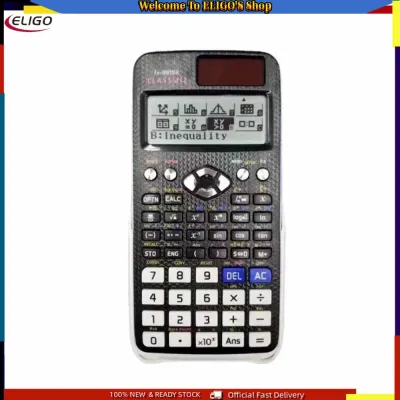
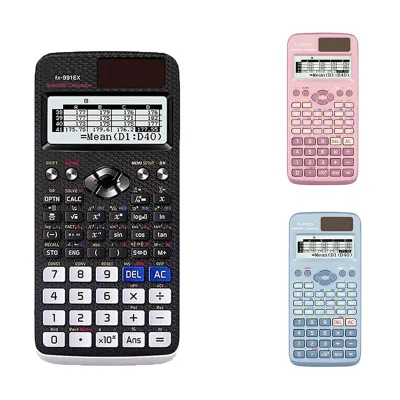
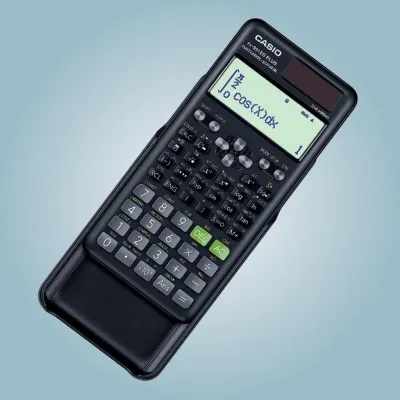
Prices are valid at publication and may change. Please refer to the product page for the latest price.
The transition to Upper Secondary (Secondary 3 to Secondary 5) is where the Casio fx-991EX truly becomes relevant. Students at this level typically split into Elementary Mathematics (E-Math) and Additional Mathematics (A-Math) pathways. The curriculum becomes significantly more demanding, introducing quadratic equations, complex trigonometry, and coordinate geometry. For these subjects, having a high-performance scientific calculator is highly advantageous, provided it is on the official approved list for national examinations like the GCE O-Levels and N-Levels.
For students progressing to Junior College (JC) or centralized institutes to pursue GCE A-Levels, the requirements shift once again. While a scientific calculator remains useful for science subjects like Physics and Chemistry, the H2 Mathematics syllabus explicitly mandates the use of a graphing calculator. Graphing calculators allow students to plot curves, analyze functions visually, and perform advanced statistical hypothesis testing. Consequently, while the fx-991EX can serve as a reliable secondary device, it cannot replace the graphing calculator required for JC mathematics.
How to Verify if the Casio fx-991EX is Exam-Approved
Before purchasing any calculator for high-stakes exams in Singapore, verification is an absolute necessity. The Singapore Examinations and Assessment Board (SEAB) maintains a strict register of approved calculator models that candidates are allowed to bring into the examination hall. This list is updated periodically to ensure that no student gains an unfair advantage through unauthorized programming or communication capabilities. Parents should visit the official SEAB website to check the exact model designation of the Casio fx-991EX.

When verifying the model, pay close attention to the specific suffix. Manufacturers frequently release updated versions of popular models, resulting in designations like “EX”, “CW”, or “ES Plus”. A minor variation in the model name can mean the difference between an approved device and one that is confiscated at the exam hall door. The fx-991EX ClassWiz series is widely recognized, but you must ensure that the exact unit you purchase matches the approved list down to the final letter.
In addition to national guidelines, individual schools in Singapore often establish their own internal rules. Mathematics departments in various secondary schools may recommend a specific model for the entire cohort. This standardization allows teachers to conduct lessons efficiently, as they can project the exact calculator interface on the screen and give uniform instructions on key sequences during lessons. Before making a purchase, always consult your child’s school booklist or reach out to their mathematics teacher to confirm if the fx-991EX is the preferred model for their class.
Finally, understand the physical verification process that occurs within schools. Prior to major examinations, schools conduct calculator registration exercises. Teachers inspect each device to ensure it is on the approved list, has not been modified, and contains no stored data. Once approved, a non-removable, tamper-evident sticker is applied to the calculator. If your child’s calculator lacks this official school sticker, they will not be permitted to use it during national exams, making early verification and registration vital.
Matching the fx-991EX Features to Your Child's Subjects
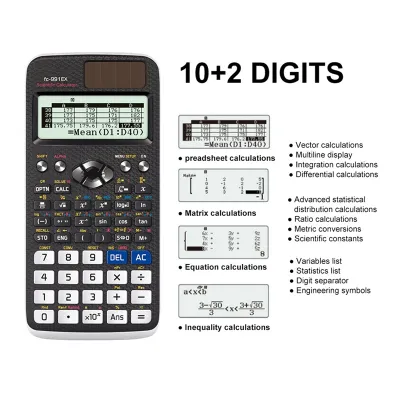
The Casio fx-991EX is equipped with a robust suite of features designed to handle complex mathematical operations. For Upper Secondary students taking Additional Mathematics, the calculator’s ability to solve quadratic, cubic, and simultaneous equations is incredibly beneficial. It allows students to quickly verify their algebraic solutions during practice, boosting their confidence and helping them identify calculation errors early in their revision process.
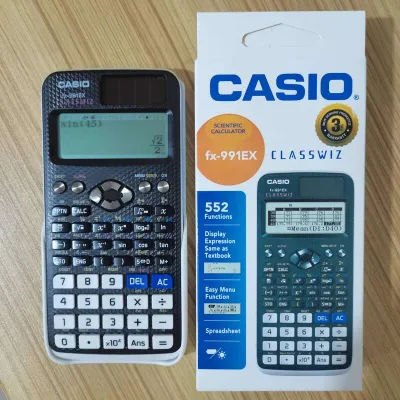
The display technology of the fx-991EX is another critical factor to consider. Featuring a high-resolution LCD screen, this model utilizes a natural textbook display format. This means that fractions, square roots, integration symbols, and matrices are displayed exactly as they are written in Singapore textbooks. For a student working under the tight time constraints of an exam, this clear visual representation minimizes the risk of input mistakes and misread answers, which are common pitfalls when using older, single-line displays.
For science subjects such as Physics and Chemistry, the calculator’s built-in scientific constants and metric conversion functions are highly practical. Students can quickly access standard physical constants without needing to memorize them or search through formula sheets. Additionally, the spreadsheet function and advanced statistical menus allow for efficient data analysis, which is particularly useful for the practical and data-based questions that frequently appear in modern science papers.
However, it is important to balance these advanced features against the student’s actual syllabus requirements. If your child is only taking Elementary Mathematics and does not plan to pursue pure sciences or advanced math, many of the fx-991EX’s features—such as matrix calculations and complex numbers—will go unused. In such cases, a simpler, more straightforward scientific calculator might offer a cleaner user interface with fewer distractions, allowing the student to focus entirely on the core functions they actually need.
When to Consider a Different Calculator Model
While the Casio fx-991EX is an excellent all-rounder, there are specific academic pathways where a different model is either required or highly recommended. The most obvious transition is the move to Junior College. If your child is planning to take H2 Mathematics, they will need to invest in an approved graphing calculator. Graphing calculators are significantly more expensive, often retailing for over S$150, and require a different set of operating skills. Purchasing the fx-991EX just before entering JC may result in unnecessary double spending.
Another scenario involves students who struggle with technology or find complex menus overwhelming. The fx-991EX features a multi-layered menu system to accommodate its vast array of functions. For some students, navigating these menus under exam pressure can cause anxiety. If your child prefers a simpler, more direct interface where every function is accessible with a single keystroke, a basic scientific calculator model might be a more supportive tool for their learning style.
Lastly, timing is a crucial factor when introducing a new calculator. If your child is already accustomed to a specific calculator brand or layout, switching to a different model like the fx-991EX right before major exams is not advisable. Developing muscle memory and familiarity with key placements takes time. Any transition to a new calculator should ideally occur at the start of the academic year, giving the student several months to integrate the tool into their daily homework and school assessments.
Frequently Asked Questions (FAQ)
Can my child use the Casio fx-991EX for O-Level Additional Mathematics?
To determine if the Casio fx-991EX is permitted for the GCE O-Level Additional Mathematics examination, you must cross-reference the model with the latest SEAB approved calculator list. Generally, non-programmable scientific calculators are allowed for this subject. However, any device brought into the exam hall must not possess external communication capabilities or programmable memory that allows the storage of custom formulas. Before the exam begins, invigilators will verify the model and ensure that any temporary memory has been cleared through a system reset.
Where is the best place to buy an authentic Casio fx-991EX in Singapore?
To ensure you are purchasing an authentic Casio fx-991EX with a valid local warranty, it is highly recommended to buy from established stationery retailers and official school bookshops, such as Popular Bookstore. These calculators typically retail between S$30 and S$45. When purchasing, always check the packaging for the official distributor’s holographic sticker and anti-counterfeit labels. Avoid buying from unverified sellers on online marketplaces, as counterfeit calculators may fail during critical exams or lack the precise calculation accuracy required for academic work.
Community discussion
Share your experience or ask a question. Comments are reviewed before publication.