
The Casio fx-991CW is not universally required for every secondary school grade in Singapore, but it becomes an invaluable tool as students transition to upper secondary levels. For Secondary 1 and 2 students, a basic scientific calculator is typically sufficient to handle introductory algebra and geometry. However, for Secondary 3 to 5 students—particularly those taking Additional Mathematics (A-Math) or preparing for their GCE O-Level and N-Level examinations—the advanced features of the fx-991CW, such as equation solvers and matrix calculations, make it a highly recommended upgrade. To make the right choice, parents should evaluate their child’s current academic stream, upcoming syllabus demands, and the official guidelines provided by their school.
How to Verify if the Casio fx-991CW is Required for Your Child
To determine whether your child needs the Casio fx-991CW, the first and most critical step is to consult the Singapore Examinations and Assessment Board (SEAB) approved calculator list. SEAB updates this list regularly to specify which calculator models are permitted in national examination halls. Using a model that is not on this official list can result in the device being confiscated during major exams, so verifying the exact model number is non-negotiable.
Next, examine the school-specific booklist distributed at the end of the academic year or during registration. Schools in Singapore customize their stationery requirements based on their chosen teaching pace and curriculum focus. If a school requires the fx-991CW, it will be explicitly listed under the mathematics section of the booklist, often alongside a note indicating whether it is compulsory or optional.
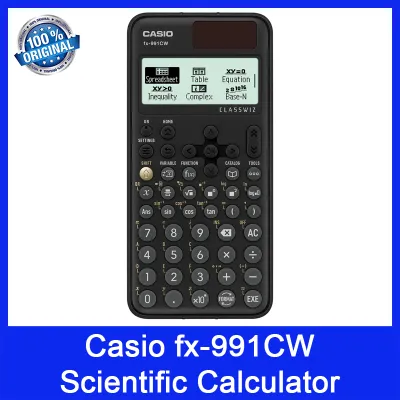
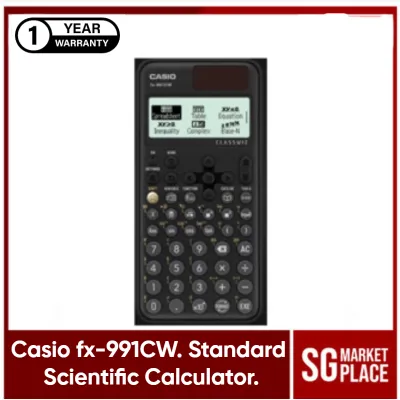
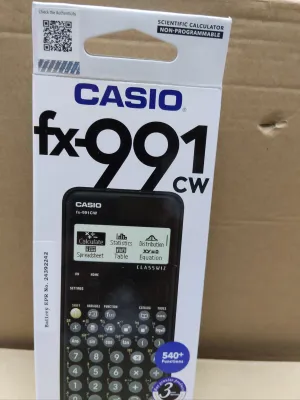
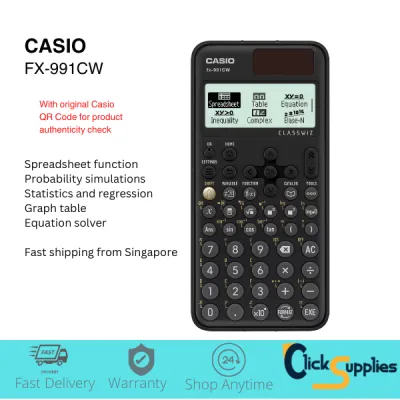
Products mentioned in this guide
![[SG] Casio FX-991CW Scientific Calculator](https://img.lazcdn.com/g/p/745ed9953df9d943d3785ff0da12a48c.png_400x400q80.png_.webp)
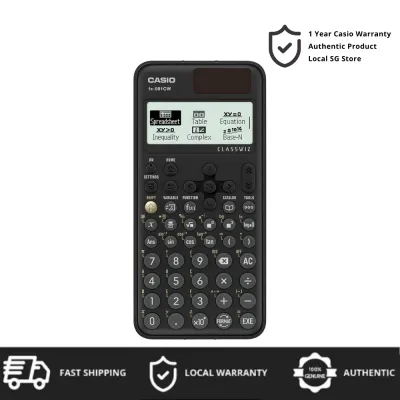
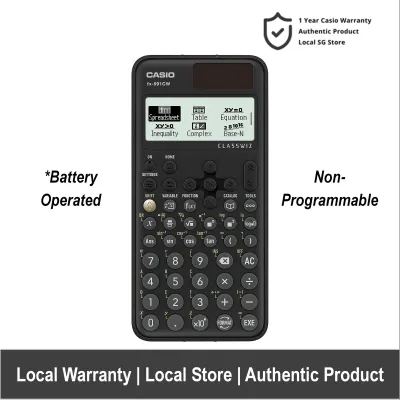
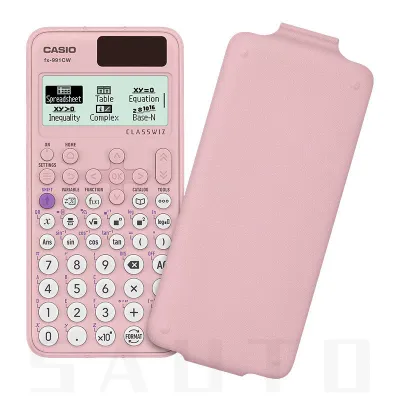
Prices are valid at publication and may change. Please refer to the product page for the latest price.
You should also consider your child’s academic stream, such as Express, Normal (Academic), or Normal (Technical). Students in the Express and Normal (Academic) streams who take Additional Mathematics will face complex algebraic equations and calculus concepts that benefit greatly from advanced scientific calculators. Conversely, students in streams with a more practical math focus may find that their lower-secondary scientific calculator remains perfectly adequate throughout their secondary school journey.
Understanding Calculator Needs Across Secondary School Levels
During the lower secondary years (Secondary 1 and 2), the mathematics syllabus focuses on building foundational skills in arithmetic, basic algebra, and introductory geometry. Students learn to manipulate simple algebraic expressions, solve linear equations, and calculate areas and volumes. For these topics, a standard scientific calculator with basic trigonometric and logarithmic functions is more than sufficient, meaning there is rarely an immediate need to purchase an advanced model like the fx-991CW at the start of Secondary 1.

The transition to upper secondary (Secondary 3 to 5) introduces a significant jump in mathematical complexity. Students encounter advanced topics such as quadratic equations, simultaneous equations with multiple variables, vectors, probability distributions, and calculus. Standard calculators often lack the processing power or the specific functional modes required to solve these complex problems efficiently, which can slow students down during timed assessments.
This transition point is where an advanced scientific calculator becomes a critical asset. For national exams like the O-Levels and N-Levels, speed and accuracy are paramount. An advanced calculator allows students to verify their manual algebraic solutions quickly, check matrix calculations, and compute statistical distributions without performing tedious manual expansions, reducing the risk of careless calculation errors under exam pressure.
Evaluating the fx-991CW Features Against the Math Syllabus
The Casio fx-991CW features a redesigned ClassWiz menu interface that departs from the traditional button-heavy layouts of older models. Instead of memorizing complex key combinations, students navigate options using an intuitive, icon-based menu system. While this modern interface simplifies access to advanced functions, it does introduce a brief learning curve for students who are accustomed to older calculator layouts from primary school.
In terms of syllabus alignment, the fx-991CW offers several advanced functions that directly support upper secondary topics. Its equation solver can handle quadratic, cubic, and simultaneous linear equations with up to four variables, which is highly beneficial for both E-Math and A-Math. Additionally, the calculator includes advanced statistical distribution calculations—such as normal and binomial distributions—which are essential components of the upper secondary statistics syllabus.
The physical design of the fx-991CW also offers practical advantages in a classroom setting. It features a high-resolution display that presents mathematical formulas, fractions, and square roots exactly as they appear in textbooks. This natural textbook display helps students avoid input errors and makes it easier to read complex multi-line calculations during high-stress exam conditions.
Decision Guide: Upgrade, Keep, or Wait?
If your child already owns a functioning scientific calculator, do not rush to replace it immediately. Check the model number against the SEAB approved list to ensure it is permitted for national exams. If the current calculator is approved and your child is still in lower secondary, keeping the existing device is the most practical and cost-effective decision, as it allows them to focus on mastering basic mathematical concepts first.
An immediate upgrade to the fx-991CW is highly recommended if your child is entering Secondary 3 and has opted for Additional Mathematics. The sheer volume of complex algebraic and trigonometric problems in the A-Math syllabus makes the advanced features of the fx-991CW highly advantageous. Upgrading at the start of Secondary 3 also gives your child two full years to become completely familiar with the new menu layout before they sit for their national exams.
If you remain unsure, the safest approach is to wait until the school math teacher provides explicit instructions. Teachers often coordinate calculator purchases at the beginning of the school year, sometimes organizing bulk purchases through the school bookshop to secure better rates. Waiting for the teacher’s guidance ensures you buy the exact model preferred for classroom demonstrations, preventing any compatibility issues during lessons.
Frequently Asked Questions (FAQ)
Can students use older Casio models like the fx-991EX for national exams?
Whether older models like the Casio fx-991EX can be used depends entirely on their current status on the SEAB approved calculator list. While the fx-991EX was widely popular, SEAB reviews and updates its list of permitted devices annually. Parents and students must visit the official SEAB website to cross-reference the exact model number before the exam season begins, as using an unlisted or deregistered model is strictly prohibited in the exam hall.
Are graphing calculators allowed in Singapore secondary school math exams?
Graphing calculators are generally not allowed in standard Singapore secondary school mathematics examinations, including the GCE O-Level and N-Level papers. These national exams restrict students to approved scientific calculators that do not have graphing, programmable, or symbolic manipulation capabilities. Graphing calculators are typically introduced later, during Junior College (JC) for GCE A-Level mathematics, so purchasing one during secondary school is unnecessary unless specifically mandated by a niche integrated programme (IP) syllabus.
Community discussion
Share your experience or ask a question. Comments are reviewed before publication.