
Finding the right study cards in Singapore involves balancing paper quality, format, and portability to match your academic workload. Whether you are preparing for national exams like the O-Levels and A-Levels, or tackling dense university modules, the physical tools you use to study can significantly impact your active recall efficiency. The ideal study cards are those that accommodate your preferred writing instruments without bleeding, fit seamlessly into your daily routine, and organize your notes logically. By evaluating key physical characteristics such as paper weight, ruling styles, and binding methods, you can select cards that enhance your revision sessions rather than hinder them.
Active recall and spaced repetition are highly effective learning techniques, but their success relies heavily on the usability of your study materials. Cards that tear easily, smudge under high humidity, or are too bulky to carry can disrupt your study momentum. This guide provides a comprehensive framework to help you evaluate and select the best study cards available in Singapore, ensuring your exam preparation is as streamlined and productive as possible.
Core Criteria for Selecting Study Cards
Selecting the right study cards requires a clear understanding of how you plan to use them. The first major consideration is the trade-off between portability and writing space. If you find yourself studying during your daily commute on the MRT or bus, compact cards that fit easily in one hand are highly advantageous. Conversely, if your revision is primarily desk-bound at home or in a library, larger cards offer the expansive canvas needed for complex diagrams, multi-step mathematical proofs, or detailed historical timelines.
Products mentioned in this guide
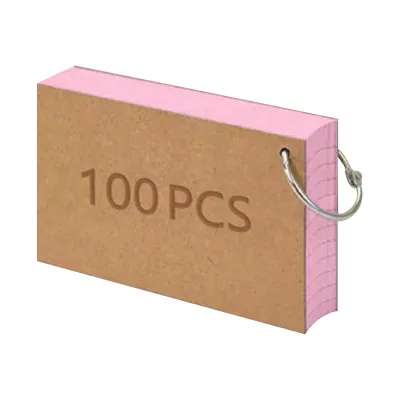
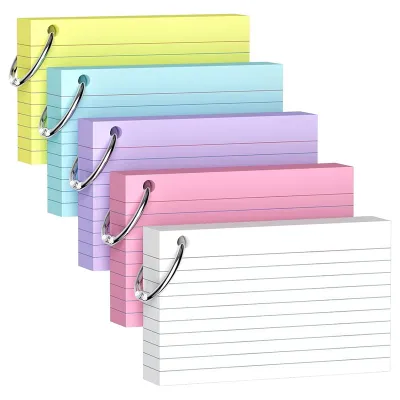
![[OKLIFE. SG]Multicolor Blank Study Flashcards with Metal Loose Leaf Ring Kraft Paper Index Note Cards for Vocabulary](https://img.lazcdn.com/g/p/c5075bf2423d08c5c61275447d8742db.jpg_400x400q80.jpg_.webp)
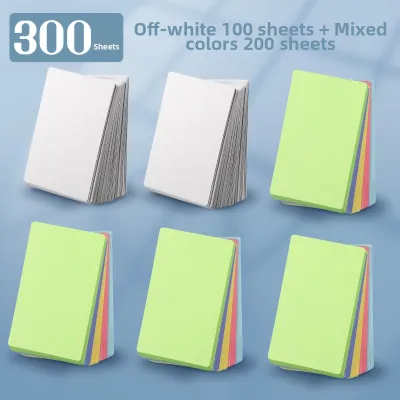
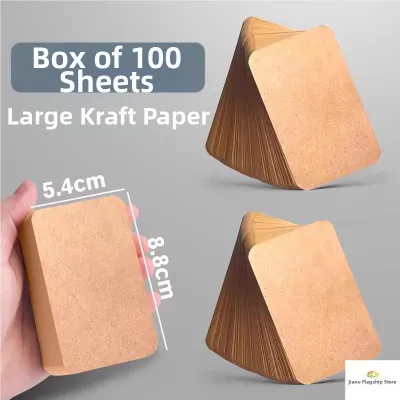

Prices are valid at publication and may change. Please refer to the product page for the latest price.
Binding mechanisms play a critical role in how you organize and access your study decks over time. Ring-bound cards are exceptionally secure, keeping your notes in a fixed sequence and preventing individual cards from getting lost in your bag. However, the physical rings can sometimes obstruct your hand while writing, especially near the margins. Loose-leaf cards offer complete freedom of movement, allowing you to shuffle, reorder, and lay out multiple cards side-by-side on a desk. The trade-off is that loose cards require a dedicated storage solution, such as an index card box or a heavy-duty elastic band, to prevent them from scattering.
Adhesive-bound card pads represent a middle ground, allowing you to keep your notes bound like a notebook until you are ready to tear them out for active study. This format is excellent for keeping a clean archive of your notes before transitioning them into active flashcard decks. However, once detached, these cards must be managed as loose-leaf sheets, requiring a secondary organization system to maintain their utility.
Ruling options significantly influence cognitive load and visual structure. Lined cards are the traditional standard, providing clear horizontal guides that keep text-heavy definitions and explanations neat and legible. Grid or graph rulings are highly beneficial for maintaining alignment when drawing diagrams, chemical structures, or mathematical matrices. Blank cards offer a completely unrestricted space, which is ideal for visual learners who prefer mind mapping, sketching, or using spatial layouts to represent connections between concepts without the visual noise of pre-printed lines.
Comparing Study Card Sizes and Formats
Physical dimensions dictate how much information you can capture on a single card and how easily you can carry it. Standard paper sizes provide a reliable reference point when shopping. A7 cards (approximately 74mm x 105mm) are highly pocketable and excellent for quick, single-concept drills such as vocabulary words, chemical symbols, or simple formulas. Their small footprint makes them easy to slip into a pocket or a small pencil case, encouraging quick study sessions during short breaks.

For more detailed notes, A6 cards (approximately 105mm x 148mm) offer a balanced compromise. This size provides enough space to write a term, its definition, and a brief example sentence or a small supporting diagram without feeling cramped. The classic 3×5 inch (76mm x 127mm) index card remains a popular standard worldwide, fitting perfectly into standard filing boxes and offering a familiar, versatile layout for general note-taking and systematic filing.
When choosing between pre-punched and unpunched cards, consider your preferred review method. Pre-punched cards are designed to be held together by metal or plastic binder rings, allowing you to flip through them like a small book. This format is highly customizable, as you can easily open the ring to insert new cards, remove mastered topics, or reorder your deck. Unpunched cards are better suited for desktop sorting systems, such as the Leitner box method, where cards are physically categorized into different compartments based on how well you remember the information.
For highly complex subjects that require layered explanations, fold-over or multi-panel cards offer a unique physical advantage. These cards feature a crease or a fold-out flap that physically conceals the answer or a sub-step of a process. By manually unfolding the card to reveal the hidden information, you create a physical barrier that prevents your eyes from accidentally scanning ahead, thereby reinforcing the cognitive effort required for true active recall.
Matching Card Styles to Specific Subjects
Different academic disciplines demand different note-taking structures, making it essential to match your card style to the subject matter. For languages and humanities, lined cards are generally the most effective choice. When memorizing vocabulary, grammar rules, or literary quotes, the horizontal lines help maintain consistent handwriting size and alignment. This is particularly important when writing complex scripts, such as Chinese characters or Tamil script, where stroke precision and legibility are paramount for accurate recall.
Mathematics and physical sciences benefit immensely from grid or dot-grid cards. The structured vertical and horizontal lines of a grid card provide essential guidance for plotting coordinate geometry, drawing organic chemistry molecules, or aligning columns of numbers in accounting and physics equations. Using grid cards helps prevent spatial distortion, ensuring that your diagrams remain accurate representations of the concepts you are trying to master.
For subjects that require synthesizing large volumes of narrative information, such as history, geography, or literature, larger card formats like A5 or 4×6 inches are highly recommended. These larger canvases allow you to construct chronological timelines, map out character relationships, or outline essay structures on a single card. To manage the high volume of information, consider using cards with color-coded borders or backgrounds to categorize different historical eras, geographical regions, or literary themes, which aids visual retrieval during high-pressure exam preparation.
When studying professional certifications or complex legal case studies, blank cards can be used to create highly customized visual summaries. Without the constraints of lines or grids, you can draw flowcharts, decision trees, and conceptual maps that mirror the logical flow of a legal argument or a business process. This freeform layout encourages you to process the information deeply as you decide how to represent it visually on the card.
Evaluating Paper Quality and Usability
To ensure your study cards can withstand daily handling and heavy ink usage, you must evaluate their paper quality using observable criteria. The most reliable indicator of paper thickness and durability is the weight, measured in grams per square meter (gsm). Standard copy paper typically ranges from 70 to 80 gsm, which is highly susceptible to ink ghosting and bleed-through. For study cards, look for a minimum weight of 100 gsm, while weights between 120 gsm and 150 gsm are ideal for double-sided writing with heavy ink.
Surface texture, or tooth, significantly affects both writing comfort and the longevity of your notes. Smooth, coated papers allow gel pens, rollerballs, and fineliners to glide effortlessly across the surface, reducing hand fatigue during long writing sessions. However, coated papers often suffer from slower ink drying times, which can lead to smudging, particularly in Singapore’s humid climate. Uncoated, slightly textured papers absorb ink much faster, reducing the risk of smudges, but they can cause fine-tipped pens to drag or feather, and may pill or tear if subjected to heavy erasing.
To verify pen compatibility and paper performance, always perform a simple swatch test on a single card before committing to writing out an entire syllabus. Use your preferred study tools—such as gel pens, ballpoints, fineliners, and highlighters—to write a few lines on the card. Observe how quickly the ink dries to determine if it is prone to smudging during rapid card flipping. Flip the card over to check for ghosting, where the outline of the writing is visible on the reverse side, and bleed-through, where the ink physically penetrates the paper fibers, rendering the back of the card unusable.
Additionally, test the erasability of the paper if you frequently use pencils or erasable gel pens. Write firmly on a corner of the card and attempt to erase it completely. Observe whether the paper fibers pill, tear, or leave a permanent grey shadow. High-quality cardstock should allow for clean erasing without compromising the structural integrity of the paper, ensuring that your cards remain neat and reusable throughout your revision cycle.
Building Your Study Card Shortlist and Purchasing Strategy
Before heading out to purchase study cards, compile a strict requirements checklist based on your specific study needs. Define your target card size, preferred ruling style, binding mechanism, and the total quantity required for your subjects. Having a clear plan prevents impulse purchases of decorative but impractical stationery that may not fit your filing system or accommodate your writing style.
Visiting local brick-and-mortar stationery stores in Singapore is highly recommended for a physical inspection of paper quality. Many local retailers display open samples of notebooks, index cards, and ring-bound pads. Take this opportunity to feel the thickness of the cardstock, test the stiffness of the paper, and inspect the durability of metal or plastic binding rings. Physical inspection ensures that you do not accidentally purchase flimsy paper that behaves more like standard copy paper than durable cardstock.
When shopping on online marketplaces or ecommerce platforms, read the product specifications carefully rather than relying solely on promotional images, which can often distort the actual scale of the items. Pay close attention to the listed dimensions in millimeters or inches and the paper weight in gsm. Cross-reference user-uploaded photos and reviews to see how the cards look in real-world settings, looking for feedback regarding actual paper thickness, packaging quality, and whether the cards arrive with bent corners or damaged rings.
Finally, consider the long-term cost and availability of refills if you choose a proprietary ring-bound or binder system. Opting for standard sizes like A7, A6, or 3×5 inches ensures that you can easily source replacement cards from various local retailers and online platforms without being locked into a single brand’s ecosystem. This open compatibility makes it much easier to maintain your study system throughout your academic journey.
Frequently Asked Questions (FAQ)
How can I prevent ink from smudging on my study cards?
To prevent ink from smudging on your study cards, match your pen selection to the paper’s surface characteristics. If you are using smooth, coated cardstock, opt for quick-drying gel pens or low-viscosity ballpoint pens that set rapidly on the surface. Allow adequate drying time before flipping the card or stacking it in a deck, especially in humid environments where moisture can prolong drying times. Additionally, place a clean sheet of scrap paper or a plastic guard sheet under your hand while writing to protect adjacent cards from friction and natural skin oils, which can cause ink to smear.
Are digital flashcard apps a complete replacement for physical study cards?
Digital flashcard apps offer excellent convenience and automated spaced repetition scheduling, but they are not a complete replacement for physical study cards. The physical act of handwriting notes on paper engages different cognitive pathways, enhancing spatial memory and conceptual understanding in ways that typing on a screen cannot replicate. Furthermore, physical cards eliminate the digital distractions and screen fatigue associated with prolonged device use during intense study blocks. A hybrid approach is often optimal, where you use physical cards for deep conceptual learning and initial memorization, and digital apps for quick, on-the-go reviews of large vocabulary databases.
Community discussion
Share your experience or ask a question. Comments are reviewed before publication.