
Selecting the right whiteboard notebook depends heavily on a student’s academic stage, daily routine, and motor skills. For primary school students, the priority lies in physical resilience, compact sizes like A5, and low-effort erasing mechanisms that support early handwriting practice without causing frustration. These younger learners benefit most from durable, tear-proof pages that can withstand heavy handling in busy classrooms.
In contrast, secondary school students require larger formats like B5 or A4 to accommodate complex mathematical equations, scientific diagrams, and extensive revision notes. Their academic workload demands specialized page templates—such as dot grids or Cornell layouts—alongside seamless digital scanning compatibility for archiving notes before erasing them. While younger children need a tactile, forgiving tool for repetitive practice, older students require a high-capacity, structured system that integrates smoothly with their digital study workflows.
Key Features to Check Before Buying
Before purchasing a whiteboard notebook, parents must carefully evaluate several physical and technical specifications on the product packaging to ensure it meets the demands of a school environment.
Products mentioned in this guide
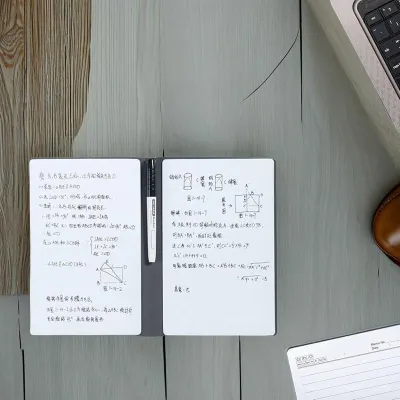
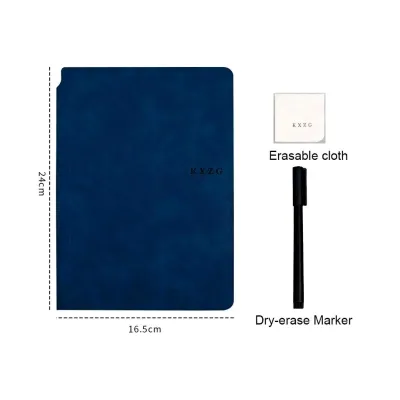
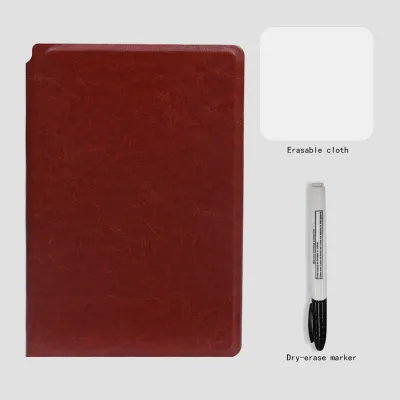
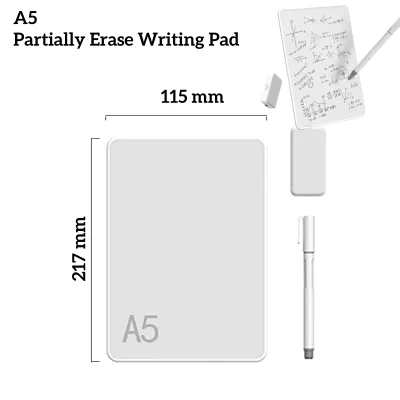
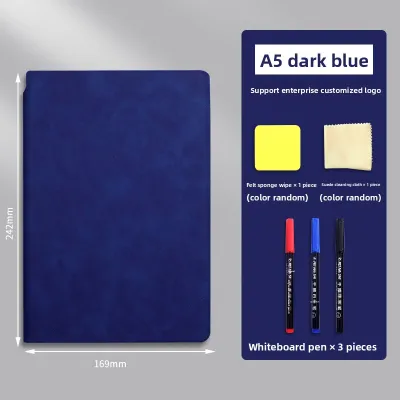
Prices are valid at publication and may change. Please refer to the product page for the latest price.
Page Size and Binding
The physical dimensions of the notebook directly impact how easily it fits onto a student’s desk and inside their school bag. Standard A5 notebooks are highly portable and ideal for the compact, shared desks often found in primary school classrooms. B5 and A4 sizes offer significantly more surface area, which is essential for secondary school subjects that require multi-step problem-solving or detailed sketching.
The binding style also dictates usability. Spiral-bound notebooks are highly practical because they can fold back a full 360 degrees, saving precious desk space and allowing the book to lie completely flat. Book-bound or thread-sewn alternatives offer a more traditional feel but may require constant pressure to keep open, which can be distracting during fast-paced lessons.
Surface Quality and Coating
The longevity of a reusable notebook depends entirely on the quality of its page coating. Most high-quality options utilize synthetic paper made from polyethylene terephthalate (PET) or specialized laminated paperboard. Synthetic PET pages are exceptionally durable, waterproof, and highly resistant to tearing, making them excellent for long-term use.
Parents should look for manufacturer labels that specify the expected lifespan of the reusable coating, often rated by the number of write-and-erase cycles. A high-quality surface should resist “ghosting”—the faint, stubborn ink shadows left behind after erasing—even when ink has been left on the page for several weeks.
Erasability and Pen Compatibility
Different reusable notebooks utilize distinct erasing technologies, and choosing the wrong one can lead to permanent damage. Dry-erase surfaces allow quick corrections with a simple felt eraser or dry cloth, but the ink can smudge easily if a hand brushes across the page. Wet-erase surfaces require a damp microfiber cloth to clear, offering excellent smudge resistance once the water-soluble ink dries completely.
Friction-erase systems rely on heat-sensitive gel ink that disappears when rubbed with a specialized silicone eraser tip. This method provides a clean, dust-free erasing experience that closely mimics traditional pencil and paper. Always verify the manufacturer’s official pen compatibility list before buying, as using standard permanent markers or incorrect gel pens will ruin the reusable surface permanently.
Best Features for Primary School Students
Primary school students are still developing their fine motor skills and organizational habits, meaning their stationery must be exceptionally forgiving and easy to use.

Compact and Lightweight Formats
Younger children often carry heavy school bags filled with textbooks, lunchboxes, and water bottles. Opting for a compact A5 or B6 whiteboard notebook helps minimize physical strain while fitting comfortably onto small classroom desks. These smaller sizes allow young hands to write comfortably from edge to edge without stretching or adopting awkward postures.
Durability and Handling
In a bustling primary school classroom, stationery is frequently dropped, bent, and stuffed haphazardly into backpacks. Whiteboard notebooks for this age group must feature thick, tear-resistant synthetic pages and heavy-duty, flexible plastic covers. Rounded corners are highly recommended, as they prevent sharp edges from poking fingers and stop the pages from dog-earing over time. Waterproof covers also provide vital protection against accidental water bottle leaks in school bags.
Low-Effort Erasing
Younger students can easily become frustrated if erasing mistakes requires excessive physical pressure or complex multi-step processes. For primary schoolers, look for dry-wipe or highly responsive wet-wipe surfaces where ink lifts away with minimal effort. This allows children to independently correct spelling mistakes, practice times tables, or draw diagrams without needing assistance from a teacher or parent, boosting their confidence and learning autonomy.
Best Features for Secondary School Students
As academic demands intensify in secondary school, students transition from basic skill practice to heavy note-taking, structured revision, and digital organization.
Larger Formats and Specialized Templates
Secondary school subjects like chemistry, physics, and advanced mathematics require ample space to map out complex formulas, molecular structures, and coordinate grids. A4 or B5 whiteboard notebooks provide the necessary canvas for these detailed tasks. Furthermore, plain white pages are rarely sufficient for older students; instead, look for notebooks featuring dot grids, graph grids, or Cornell note-taking templates to help keep structured notes organized and legible.
Digital Integration and Archiving
Because secondary school students must retain their notes for end-of-year examinations, they cannot simply erase their work without saving it first. Many modern reusable notebooks feature companion mobile applications that allow students to scan, crop, and upload their pages directly to cloud storage services. Look for notebooks designed with high-contrast page borders, corner alignment markers, or integrated QR codes, which help scanning apps quickly capture clear, legible digital copies of handwritten notes.
High-Capacity and Multi-Subject Use
A secondary student’s daily schedule involves moving between multiple subjects, making a single, high-capacity notebook highly desirable. Look for whiteboard notebooks that offer at least 30 to 50 reusable pages, or those equipped with movable plastic dividers. This allows students to allocate specific sections of a single notebook to different subjects, reducing the overall weight of their school bags while keeping all their revision materials in one organized place.
How to Build Your Final Shortlist
Once you have identified the key features your child needs, use this practical checklist to narrow down your options before making a purchase.
Verify School Policies
Before investing in a whiteboard notebook, consult your child’s school guidelines or subject teachers. Some schools strictly require traditional paper exercise books for homework submissions so teachers can physically grade and archive assignments. Whiteboard notebooks are best utilized as personal study tools, draft pads, or revision aids rather than formal hand-in books. Additionally, ensure that the permitted pen colors and types align with classroom rules.
Assess Consumable Availability
A reusable notebook is only useful if you have the correct writing instruments to use with it. Specialized erasable pens, water-soluble fine-liners, and replacement silicone erasers can wear out or run dry over a school term. Before finalizing your choice, check if these specific consumables are readily available at local stationery shops in Singapore or on major online marketplaces. Opting for a brand with widely distributed, affordable ink refills prevents the notebook from becoming obsolete mid-semester.
Calculate Total Cost of Ownership
While a standard paper notebook might only cost S$1 to S$3, a high-quality whiteboard notebook typically ranges from S$15 to S$45 upfront. To determine the true value, calculate the total cost of ownership over a school year. Factor in the initial price of the notebook, the cost of specialized replacement pens (usually S$2 to S$4 each), and the frequency of use. If your child uses the notebook daily for drafting, brainstorming, and revision, the long-term savings on paper and the environmental benefits make it a highly cost-effective investment.
Frequently Asked Questions (FAQ)
Can I use any whiteboard marker on a reusable notebook?
No, you should never use standard dry-erase whiteboard markers on a reusable notebook unless the manufacturer explicitly states it is safe to do so. Standard whiteboard markers are designed for large, non-porous wall boards and typically feature thick tips and highly pigmented, alcohol-based inks that can permanently stain or strip the delicate coating of a notebook page. Always check the product packaging and strictly use the recommended water-soluble fine-liners, friction-erasable gel pens, or proprietary markers specified by the manufacturer.
How do I remove ghosting or stubborn ink stains?
To safely remove stubborn ink shadows or ghosting, gently wipe the page with a microfiber cloth slightly dampened with clean water. If the stains persist and the manufacturer’s guidelines permit, you can apply a tiny drop of isopropyl alcohol or specialized whiteboard cleaning fluid to a soft cloth and wipe the surface gently. Never use abrasive sponges, household detergents, or sharp scraping tools, as these will permanently scratch and destroy the protective reusable coating on the pages.
Community discussion
Share your experience or ask a question. Comments are reviewed before publication.