
Choosing the correct size of transparent courier bags (often sourced locally as 透明袋子) requires calculating the three-dimensional volume of your product rather than relying on flat dimensions. Selecting an incorrect size leads to split seams, wasted material, or elevated shipping costs. By understanding how to measure your products and matching them to the right bag specifications, you can optimize your packaging workflow and ensure your items arrive safely.
Decoding Specifications for Your Transparent Courier Bags (透明袋子)
When sourcing transparent shipping bags, understanding how manufacturers list dimensions is the first step to avoiding packing errors. Typically, dimensions are presented as Width x Length (W x L). A critical detail to verify is whether the stated length includes or excludes the self-adhesive sealing flap. This flap generally adds an extra 3 to 5 centimeters to the total physical length of the bag, but it cannot be used to hold the product itself. If a supplier lists a bag as 25 x 35 cm, you must confirm if the usable packing length is actually 30 cm with a 5 cm flap, or if the total length is 35 cm plus the flap.
Thickness is another essential specification that dictates the bag’s performance and is measured in microns (µm) or mils. For standard e-commerce shipping, transparent bags generally range from 40 to 80 microns in thickness. A thickness of 40 to 50 microns is highly flexible and lightweight, making it ideal for soft, non-abrasive goods. Bags measuring 60 to 70 microns offer a balanced standard for general retail items, while anything above 80 microns is considered heavy-duty, providing superior tear resistance for heavier or sharp-edged items.
Products mentioned in this guide

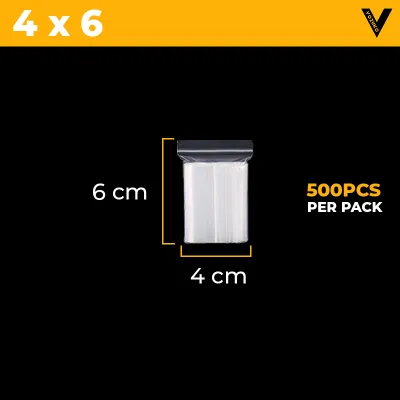
Prices are valid at publication and may change. Please refer to the product page for the latest price.
To ensure consistent quality, always verify these parameters against the manufacturer’s official specification sheets. Avoid relying on subjective marketing terms like “premium grade” or “heavy-duty,” as these lack standardized definitions across different suppliers. Requesting technical data sheets ensures you receive the exact material density required for your products.
For standard e-commerce operations shipping lightweight, non-fragile items, minor variations in thickness—such as a difference of 2 or 3 microns—will have a negligible impact on performance. You do not need to overpay for ultra-thick specifications if your product mix consists of soft, low-risk items. Focusing on the correct dimensional fit will yield much greater cost savings and packing efficiency.
Matching Bag Dimensions to Your Product Categories
Different product categories impose unique physical demands on packaging materials. A bag that works perfectly for a flat notebook will fail when stuffed with a bulky knit sweater. Grouping your inventory into distinct categories allows you to apply targeted sizing rules.

Apparel and Soft Goods
Garments and textiles are highly compressible, but they also trap a significant amount of air when folded. When calculating the required bag size, you must account for this loft and the expansion of the fabric. Placing a thick garment into a bag that is too narrow forces the plastic to stretch tightly, putting immense pressure on the side seals.
- Folded Volume: Compress the folded garment manually to measure its true height, as trapped air will escape during the packing process but will initially resist sealing.
- Expansion Allowance: Add at least 3 to 5 centimeters of extra width to the bag's dimensions to accommodate the fabric's thickness without overstretching the seams.
Stationery, Books, and Flat Items
Rigid, flat products like notebooks, planners, and art prints require a very snug fit to prevent shifting during transit. If a flat item slides around inside an oversized bag, its edges can repeatedly strike the bag’s seams, leading to splits. However, the rigidity of these items means they have no flexibility to squeeze into tight openings.
- Snug Width Fit: Select a bag width that is only 1 to 2 centimeters wider than the item itself to keep it securely centered and minimize sliding.
- Corner Protection: Check the sharpness of the item's corners. Hardcover books with sharp edges can easily puncture thin 40-micron transparent films, so opt for a minimum thickness of 60 microns to prevent corner blowouts.
Small Hard Goods and 3C Accessories
Compact, non-flexible items such as charging cables, phone cases, and small tools often have irregular shapes. These products do not compress, meaning their maximum physical boundaries dictate the minimum bag size.
- Maximum Extents: Measure the absolute longest, widest, and thickest points of the item, treating any protruding parts as the baseline for your calculations.
- Movement Control: Keep the fit relatively snug to prevent heavy items from sliding and gaining momentum, which can easily puncture the plastic or burst the seals if the package is dropped.
Fragile Items Requiring Extra Padding
When shipping delicate items that require protective wrapping like bubble wrap, foam sheets, or corrugated cardboard inserts, your bag calculations must change entirely. The protective layers add significant bulk that must be accommodated by the outer courier bag.
- Post-Wrap Measurements: Wrap the item completely in its protective padding first, then measure the final length, width, and height of the wrapped bundle.
- Tension Relief: Add an extra 5 to 8 centimeters to both the width and length of the post-wrap measurements. This ensures the wrapped bundle slides in easily without placing tension on the bag's heat-sealed edges, preventing transit blowouts.
Physical Features to Verify Before Bulk Ordering
Before committing to a large inventory order of transparent shipping bags, obtaining physical samples is crucial for quality control. Testing these samples under real-world conditions helps prevent costly packing delays and customer complaints.
First, inspect the self-adhesive strip thoroughly. The adhesive should be applied evenly across the sealing flap without gaps or clumps. Peel back the release liner to ensure it removes cleanly in one smooth motion without tearing or leaving static-charged residue that clings to your hands. In tropical, humid climates like Singapore’s, verify that the adhesive remains highly tacky and does not slip or bleed onto the outer surface of the bag when exposed to ambient warehouse temperatures.
Next, examine the heat-sealed side edges of the bag. Strong side seals are the foundation of a reliable courier bag. Gently pull the two sides of the bag apart at the seams to check for uniformity and strength; the plastic should stretch slightly before the weld fails. If the seam splits immediately with minimal force, the manufacturing temperature was likely too low, indicating a high risk of bursting during postal transit.
Finally, assess the visual clarity and tactile stiffness of the material. High-quality transparent bags should offer excellent clarity with minimal haze or glare, allowing barcodes and shipping labels inside to be scanned easily. If you plan to use bags with pre-printed warning labels or custom branding, rub the printed areas firmly with your thumb to check for smudge resistance and print clarity.
How to Measure and Test Your Packaging Setup
To eliminate guesswork, implement a standardized measurement formula and testing protocol in your packing workflow. This systematic approach ensures you order the most cost-effective bag size for every product line.
To find the minimum bag width required for a three-dimensional product, use this simple formula: Bag Width = Product Width + Product Thickness + 2 cm (for clearance). To find the minimum usable length, use: Bag Length = Product Length + Product Thickness + 2 cm (for clearance). Remember that the total bag length purchased must also include the length of the adhesive flap (typically an additional 3 to 5 cm). Use a standard caliper or rigid ruler to measure the product’s thickest point accurately.
Before placing a bulk order, purchase a small, mixed sample pack containing various standard sizes. Have your packing team test these sizes with your actual inventory. Observe how easily the items slide into the bags and how quickly the sealing liners can be peeled. A bag that is too tight slows down fulfillment speeds, increasing labor costs.
Once packed, simulate standard transit conditions to validate your choice. Drop the packed sample from a height of one meter onto a hard surface several times, and shake it vigorously to mimic postal sorting machines. If the seams hold, the adhesive remains sealed, and no punctures occur, you have found the optimal size and thickness combination for your product.
Frequently Asked Questions (FAQ)
How much extra space should I leave for the self-adhesive seal?
The self-adhesive sealing flap typically requires 3 to 5 centimeters of clear, unobstructed space to fold over and adhere securely to the body of the bag. Always confirm with your supplier whether their advertised bag length includes this flap or represents only the usable packing area.
Are transparent courier bags suitable for shipping liquids?
Standard transparent courier bags are not designed to contain leaks or act as primary waterproof barriers. If you are shipping liquids, they must first be sealed in a leak-proof primary container, ideally placed inside a secondary sealed plastic bag, before being packed into the transparent courier bag.
Community discussion
Share your experience or ask a question. Comments are reviewed before publication.