
Selecting the right protractor for your child depends on matching the tool’s physical design to their school grade and developing motor skills. In the early primary years, children focus on recognizing basic shapes and right angles, meaning they rarely need a technical measuring tool. As they progress to upper primary, the curriculum introduces precise angle measurements, requiring a clear, reliable protractor that helps them distinguish between acute, obtuse, and reflex angles without causing visual confusion.
By understanding the specific geometry concepts taught at each grade level, you can avoid purchasing a tool that is either too complex for a beginner or too basic for an older student. The ideal protractor should serve as an intuitive bridge between abstract mathematical concepts and hands-on drawing tasks, keeping frustration to a minimum during homework and school examinations.
Understanding Math Requirements Across Primary Grades
During the lower primary years, typically from Primary 1 to Primary 3, the mathematics curriculum focuses heavily on spatial awareness and basic shape recognition. Children learn to identify flat shapes, count sides and vertices, and recognize right angles in their everyday environment. At this stage, students do not measure angles in degrees, so a standard protractor is not required. Instead, teachers often use paper folding or simple, colorful angle finders to help children understand whether an angle is larger or smaller than a corner of a sheet of paper.
Products mentioned in this guide
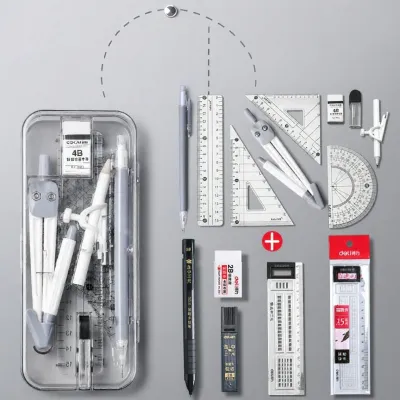
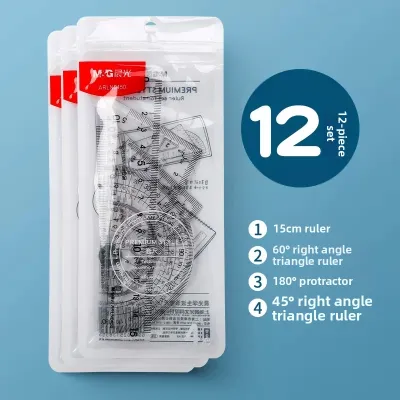
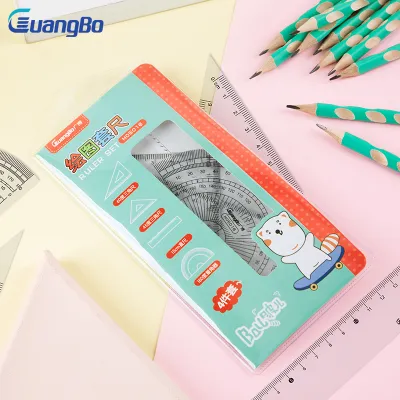
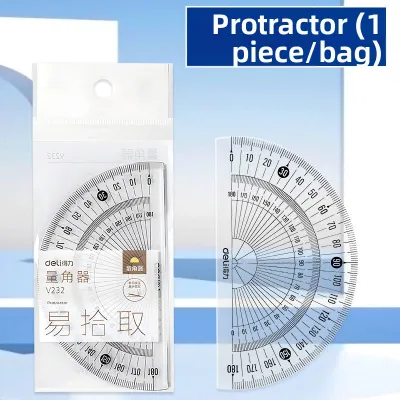
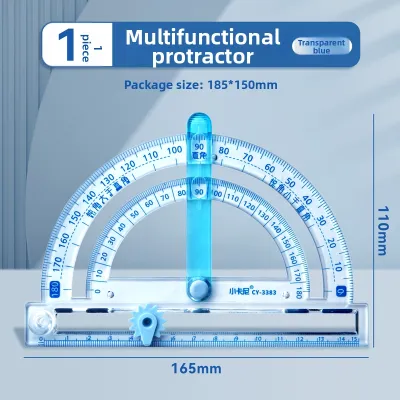
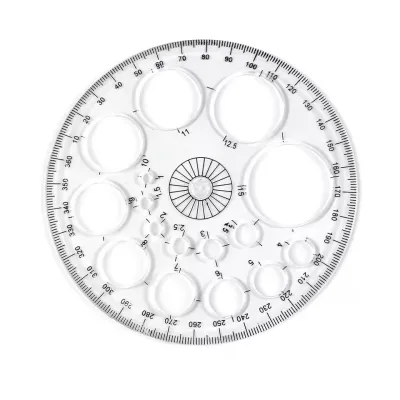
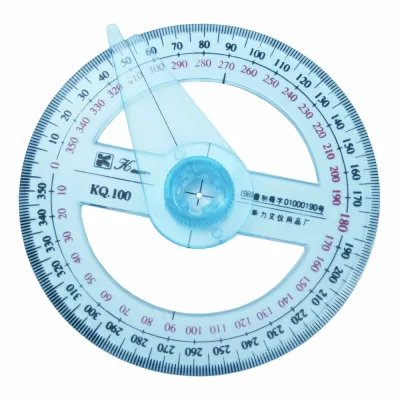
Prices are valid at publication and may change. Please refer to the product page for the latest price.
As students transition into Primary 4, the formal study of angles begins in earnest. This is the stage where the protractor becomes an essential item on the school stationery list. Students are introduced to the concept of degrees as a unit of measurement and learn to measure and draw angles up to 180 degrees. They must learn how to align the baseline of the protractor with one arm of an angle and read the correct scale to find the measurement. This requires a tool with clear, easy-to-read markings that do not overwhelm a child who is still mastering the difference between acute and obtuse angles.
In Primary 5 and Primary 6, the geometric challenges increase as students study the properties of triangles, parallelograms, rhombuses, and trapeziums. They are required to find unknown angles using geometric properties and draw complex figures with high accuracy. In national examinations, a minor drawing error of just two degrees can result in a loss of marks. Consequently, upper primary students require a highly precise, stable measuring instrument. The focus shifts from a forgiving, simplified learning aid to a professional-grade student protractor that ensures absolute accuracy.
Essential Protractor Features for Young Learners
When evaluating protractors for primary school students, size is one of the most critical factors. A standard 10-centimeter (4-inch) protractor is generally the most suitable size for young learners. It fits comfortably within small hands and aligns perfectly with the scale of diagrams found in standard primary school workbooks. A larger 15-centimeter protractor might seem easier to read, but it often extends past the edges of workbook pages or collides with the binding, making it difficult for a child to keep the tool perfectly flat.

Material durability is another key consideration for active school environments. Protractors made from shatter-resistant, flexible plastics are highly recommended for younger students. These tools can withstand being dropped on classroom floors, stuffed carelessly into schoolbags, or bent inside pencil cases without snapping. In contrast, rigid acrylic protractors offer excellent transparency and scratch resistance but are prone to cracking or shattering into sharp, hazardous pieces when subjected to rough handling.
Visual clarity directly impacts how easily a child can read measurements without straining. Look for a protractor with high-contrast, crisp black markings printed on a completely transparent background. Some student-friendly models feature color-coded zones or highlighted lines at key angles like 45, 90, and 130 degrees to help students orient the tool quickly. The center point—the vertex alignment mark—must be unmistakable. A protractor with a small physical hole or a distinct crosshair at the center makes it much easier for a child to position a pencil tip accurately on the vertex of the angle.
Ergonomic features can greatly assist children who are still developing their fine motor skills. Some protractors designed specifically for kids feature a small raised handle, a textured center grip, or a central knob. This physical addition allows small fingers to hold the tool firmly against the paper, preventing it from slipping or rotating while they draw a line. If a protractor constantly slides during use, a child may quickly become frustrated and lose confidence in their drawing abilities.
Matching Protractor Shapes and Scales to Motor Skills
Parents must choose between a 180-degree half-circle protractor and a 360-degree full-circle protractor. For almost all primary school students, the 180-degree half-circle version is the standard and most practical choice. It aligns naturally with the straight baselines of textbook exercises and is much easier for a beginner to orient. A 360-degree protractor is useful for measuring reflex angles, but the double-sided scale and circular shape introduce a high level of visual clutter that can easily confuse a child who is still learning the basics of angle measurement.
Scale configuration is another common source of confusion for young learners. Most standard protractors are dual-scale, meaning they feature an inner scale running from 0 to 180 degrees from left to right, and an outer scale running in the opposite direction. While versatile, this design frequently leads to “mirror errors,” where a student reads a 60-degree acute angle as 120 degrees because they looked at the wrong scale. For absolute beginners in Primary 4, a single-scale protractor or one with highly distinct, color-contrasted inner and outer scales can significantly reduce these reading errors.
The thickness and edge design of the protractor also play a subtle but vital role in drawing accuracy. A protractor that is too thin can warp over time, causing the edges to lift slightly off the paper. When this happens, the tip of a pencil can easily slip underneath the edge, resulting in a curved or inaccurate line. A slightly thicker protractor with a clean, beveled edge provides a solid, reliable guide for the pencil. This is particularly important when students use soft 2B pencils, which are standard in many primary schools for optical answer sheets and drawing tasks.
To verify the quality of a protractor before purchasing, you can perform a few simple checks in the stationery store. Place the protractor on a flat surface and press down on the edges to ensure it does not rock or warp. Run your thumb firmly over the printed markings; high-quality scales are often etched or printed with durable, scratch-resistant ink that will not smudge or rub off with daily use. If the markings feel raised and peel away easily under a fingernail, the scale is likely to wear off quickly in a crowded pencil case.
Pre-Purchase Checklist for School Compliance and Daily Use
Before buying a protractor, it is essential to ensure the tool complies with school guidelines and fits seamlessly into your child’s daily routine. Many schools have strict stationery requirements, especially for upper primary students preparing for national examinations. Reviewing these details beforehand can save you from having to purchase a replacement tool later in the school year.
Use this practical checklist to verify your selection:
- School Syllabus Compliance: Ensure the protractor does not feature printed mathematical formulas, conversion tables, or distracting stencils, as these are often prohibited in examination halls.
- Pencil Case Compatibility: Measure your child's pencil case or geometry tin. A standard 10-centimeter protractor fits easily into most cases, whereas a larger or oddly shaped tool may end up loose in their schoolbag, leading to scratches and damage.
- Transparency Check: Verify that the plastic is completely clear and free of heavy tints or large opaque logos that could block the student's view of the lines underneath.
- Safety and Materials: Look for rounded corners and smooth, non-sharp edges. Check the packaging to ensure the plastic is non-toxic and free from harmful phthalates, which is important for tools undergoing prolonged skin contact.
- Pencil Fit: Test whether the tip of a standard wooden pencil or a 0.5mm/0.7mm mechanical pencil fits comfortably into the center alignment hole or notch without getting stuck.
Protractors are highly affordable stationery items, typically ranging from S$1 to S$5 depending on the material and brand. Rather than buying the cheapest option available, investing a small amount more in a shatter-resistant, highly transparent tool with a clear center point will provide your child with a reliable instrument that supports their mathematical development throughout their primary school years.
Frequently Asked Questions (FAQ)
Should I buy a full-circle or half-circle protractor for a beginner?
A half-circle (180-degree) protractor is highly recommended for beginners. Primary school mathematics curricula introduce angles using straight baselines, which align naturally with the flat edge of a half-circle protractor. A full-circle (360-degree) protractor contains twice as many numbers and lines, which increases the cognitive load on a child and often leads to confusion when they are trying to identify basic acute and obtuse angles.
How do I clean a cloudy plastic protractor without ruining the markings?
To clean a cloudy plastic protractor, wash it gently with lukewarm water and a drop of mild dishwashing soap, using your fingers or a soft microfiber cloth to wipe away dirt and finger oils. Avoid using abrasive scrubbing pads, hot water, or alcohol-based cleaning solvents. These harsh methods can scratch the transparent plastic or dissolve the printed ink markings, rendering the scale unreadable.
Community discussion
Share your experience or ask a question. Comments are reviewed before publication.