
Choosing the right crochet hook size requires matching the physical diameter of your yarn with a hook shaft of compatible millimeter thickness, then adjusting that pairing based on your project’s structural needs and personal tension. While yarn manufacturers print recommended hook sizes on their packaging, these suggestions are merely baseline estimates calculated for average tension on flat, basic stitches. The final decision depends on whether you need a dense, rigid fabric that holds its shape or a loose, flowing drape that moves naturally. By understanding how hook dimensions interact with different fiber weights, you can systematically select the perfect tool to achieve consistent, professional results.
To make an informed choice, you must first understand how yarn thickness and hook sizing systems correspond. This guide explains how to interpret yarn labels, adjust hook sizes for specific projects, and use a test swatch to verify your tension before starting your next piece.
Understanding Yarn Weights and Hook Sizing Systems
Yarn weights are standardized categories established by the craft industry to group yarns of similar thicknesses together, ranging from lace weight (Category 0) up to jumbo (Category 7). Within each category, however, actual yarn diameters can still vary slightly depending on the fiber blend, spinning method, and ply count. For example, a rustic, loosely spun wool categorized as medium weight (Category 4) may behave quite differently on your hook than a tightly spun mercerized cotton of the same category. Understanding these subtle variations within standard classifications is the first step toward mastering your stitch gauge.
Products mentioned in this guide
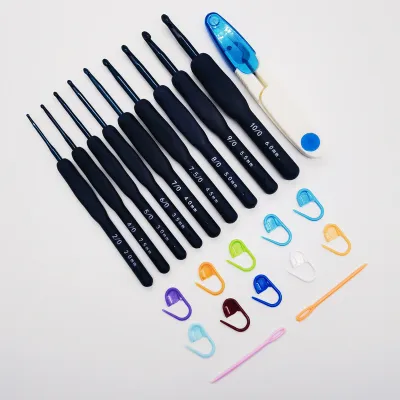
Prices are valid at publication and may change. Please refer to the product page for the latest price.
To accommodate these varying thicknesses, crochet hooks are manufactured in a wide range of sizes, but the labeling systems can be confusing. In the United States, hooks are designated by letters and numbers, such as G-6 or H-8, while the United Kingdom and Canada historically used a reverse numbering system where larger numbers indicated smaller hooks. Because of these regional variations and inconsistencies between brands, you should always rely on the metric millimeter measurement stamped on the hook shaft. The metric size represents the exact diameter of the hook’s shaft, which is the only universal standard for determining loop size.
The physical relationship between the yarn diameter and the hook shaft is straightforward but critical. The shaft is the straight area of the hook located between the throat and the thumb grip, and its diameter determines the inner circumference of every loop you pull through. If the shaft is too narrow for the yarn, the hook cannot easily catch the fibers, leading to split yarn, snagging, and an overly dense, rigid fabric. Conversely, if the shaft is too wide, the loops will be excessively large, resulting in a floppy, structurally weak fabric with uneven gaps.
Reading Yarn Labels for Baseline Hook Recommendations
Before beginning any project, the yarn label serves as your primary source of technical information. Most commercial yarn bands feature a standardized grid or icon system that displays the yarn’s weight category alongside a recommended hook size. This recommendation is typically presented in both metric millimeters and regional sizing systems, such as “5.0 mm (U.S. H-8).” This suggested size is determined by the manufacturer’s testing team to produce a balanced, standard fabric that is neither too stiff nor too loose.

In addition to the recommended hook size, the label provides a gauge square diagram, which is essential for predicting your project’s final dimensions. This diagram typically illustrates a 10 cm by 10 cm square and lists the expected number of stitches and rows that a standard crocheter will produce within those dimensions using the recommended hook. For instance, a label might state that a 5.0 mm hook will yield 13 single crochet stitches and 14 rows within a 10 cm square. This data gives you a clear benchmark to measure your own stitching style against.
However, it is vital to remember that these manufacturer recommendations are a tested baseline, not an absolute rule. They do not account for your unique physical grip, the specific stitch pattern of your design, or environmental factors. In warm, humid climates like Singapore’s, natural fibers like cotton can absorb ambient moisture, which alters how smoothly the yarn glides over the hook and can subtly change your natural tension. Therefore, treat the label’s suggestion as a starting point from which you will make deliberate adjustments.
Adjusting Hook Sizes for Different Project Types
Intentionally deviating from the yarn label’s recommended hook size is a powerful technique used to control the drape and structure of your finished fabric. For projects that require structural integrity, shape retention, or minimal gaps, you should size down from the recommended hook. For example, when crocheting amigurumi (stuffed toys), baskets, or structured bags, sizing down by 0.5 mm to 1.5 mm creates a tight, dense fabric. This prevents the stuffing from showing through the stitches and ensures the item maintains its shape under daily use.
On the other hand, projects that require movement, flexibility, and softness call for sizing up. When making wearables such as summer tops, shawls, cardigans, or lightweight blankets, you want the fabric to flow and drape elegantly rather than standing stiffly. Sizing up by 1.0 mm to 2.0 mm larger than the label’s recommendation creates larger, looser loops. This open stitch structure allows the yarn fibers to bloom and move freely, resulting in a comfortable, breathable garment that conforms to the body.
Your personal crocheting style and the physical material of the hook also influence how you should adjust your sizing. If you naturally hold your yarn tightly, you may need to systematically use a hook that is 0.5 mm larger than recommended to avoid hand fatigue and tight, unyielding stitches. The material of the hook shaft plays a role as well; slick metal hooks like polished aluminum allow yarn to slide with minimal friction, which can loosen your tension, while matte materials like bamboo, wood, or certain plastics grip the yarn more, naturally tightening your stitches.
Crocheting and Measuring a Gauge Swatch
The only way to guarantee that your hook and yarn pairing will yield the correct project dimensions is to crochet and measure a gauge swatch. To begin, do not simply chain the exact number of stitches listed on the pattern’s gauge statement; instead, aim to create a swatch that is at least 15 cm by 15 cm. This ensures you have a large, stable area of fabric to measure, free from the distorted and uneven stitches along the outer edges. Use the exact yarn, hook, and stitch pattern specified in your project instructions, as different stitch structures occupy space differently.
Once your swatch is complete, lay it completely flat on a hard, level surface under good lighting. Do not stretch, pull, or pin the fabric, as this will artificially distort the stitch measurements and lead to inaccurate calculations. If you plan to wash the final item, it is highly recommended to wash and dry the swatch first—a process known as blocking—as fibers often relax, shrink, or bloom when wet, permanently altering the gauge.
To measure the swatch, place a rigid ruler or a specialized gauge measuring frame across the center of the fabric. Count the number of individual stitches horizontally across a 10 cm span, making sure to count any partial stitches at the ends of your measurement. Next, align your ruler vertically and count the number of rows within a 10 cm height. Compare these numbers directly to the gauge specified in your pattern to determine your next step.
If your swatch contains more stitches and rows per 10 cm than the pattern requires, your stitches are too small and your tension is too tight. To correct this, switch to a larger hook size (for example, moving from a 4.0 mm to a 4.5 mm hook) and crochet a new swatch. If your swatch has fewer stitches and rows than required, your stitches are too large and loose. In this case, switch to a smaller hook size (such as moving from 4.0 mm to 3.5 mm) to tighten the fabric structure.
Troubleshooting Tension and Fabric Drape Issues
Even if your stitch count matches the pattern’s gauge, you may still encounter physical discomfort or undesirable fabric textures that require troubleshooting. Physical signs of poor tension matching often manifest during the crocheting process itself. If you experience hand fatigue, wrist cramping, or notice that the yarn squeaks as you pull it through the loops, your tension is excessively tight or your hook is too small for the yarn’s friction level. Conversely, if your stitches look sloppy, uneven, or sag under their own weight, your hook is likely too large.
To resolve these issues, you must balance your natural stitching habits with your tool selection. If you are a naturally tight crocheter, do not attempt to force a looser grip, as this can disrupt your rhythm and cause physical strain. Instead, let the tool do the work by choosing a larger hook size or selecting a slicker hook material, such as polished aluminum, to reduce drag. If you are a naturally loose crocheter, try using a smaller hook or a material with more surface grip, such as bamboo or wood, to slow down the yarn glide and bring more consistency to your loops.
There are times, however, when a yarn and hook pairing simply cannot be saved by adjustments. If you size down to eliminate gaps but the resulting fabric becomes as stiff as cardboard, or if you size up to improve drape but the stitches lose all definition and structural integrity, you have reached a stopping condition. This indicates that the yarn weight or fiber content is fundamentally incompatible with the project’s design. When this occurs, it is best to stop and select a different yarn weight or fiber blend entirely rather than continuing to struggle with mismatched tools.
Frequently Asked Questions (FAQ)
Can I use a different hook size than the yarn label suggests?
Yes, you can and often should use a different hook size than the label suggests. The manufacturer’s recommendation is merely a baseline for average tension on basic stitches. You should adjust your hook size up or down depending on whether your project requires a dense, rigid structure (like amigurumi) or a loose, flowing drape (like a wearable shawl), as well as to compensate for your personal tight or loose crocheting style.
Does hook material affect stitch tension?
Yes, the material of your crochet hook directly affects stitch tension by introducing different levels of surface friction. Smooth metal hooks, such as polished aluminum, allow yarn to slide quickly and easily, which often results in looser, faster stitching. Wooden, bamboo, and plastic hooks have more surface grip, which slows down the yarn glide and can naturally tighten your tension, making them excellent choices for slippery yarns or loose crocheters.
What if my gauge is correct but the fabric feels too stiff?
If your stitch count matches the pattern’s gauge but the fabric lacks drape, the yarn fiber itself may be too rigid, or the stitch pattern may naturally produce a dense structure. You can try washing and blocking your swatch to see if the fibers soften and relax. If the fabric remains too stiff, you may need to switch to a slightly larger hook to improve the drape, keeping in mind that this will increase the overall dimensions of your finished project.
Community discussion
Share your experience or ask a question. Comments are reviewed before publication.