
Selecting the right scientific calculator for a student in Singapore is a decision governed by academic stage, syllabus requirements, and strict national examination guidelines. While primary school students only require basic calculators for specific papers, secondary and junior college students must transition to advanced scientific or graphing models. The ideal purchase is one that aligns perfectly with the Singapore Examinations and Assessment Board (SEAB) regulations while matching the specific curriculum demands of the student’s level.
Determining Calculator Needs for Primary, Secondary, and JC
In Singapore, calculators are introduced in Primary 5 and Primary 6 for Mathematics Paper 2. At this stage, students do not need a scientific calculator. In fact, scientific calculators are generally not allowed in the Primary School Leaving Examination (PSLE). Instead, a simple, non-scientific four-operation calculator with square root and percentage keys is the standard. This ensures students continue to develop their mental calculation and heuristic problem-solving skills in Paper 1 without relying on advanced pre-programmed functions.
The transition to Secondary 1 marks the official entry into the world of scientific calculators. The secondary school mathematics syllabus (covering Express, Normal Academic, and Normal Technical tracks) introduces algebraic manipulation, trigonometry (sine, cosine, tangent), logarithms, and statistical analysis. Students require a reliable scientific calculator that can handle multi-step fraction calculations, trigonometric ratios, and basic statistical data entry (such as finding the mean and standard deviation). This tool will accompany them all the way through their GCE O-Level or N-Level examinations.
Products mentioned in this guide
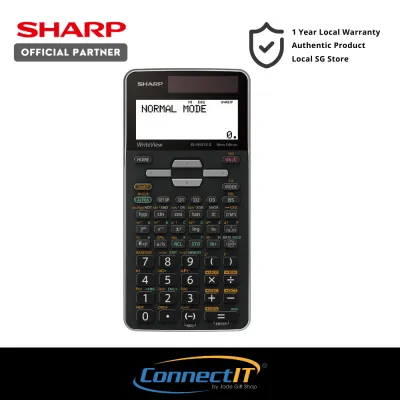
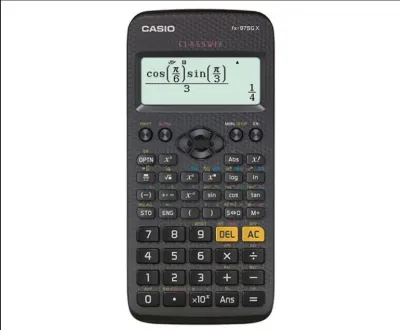
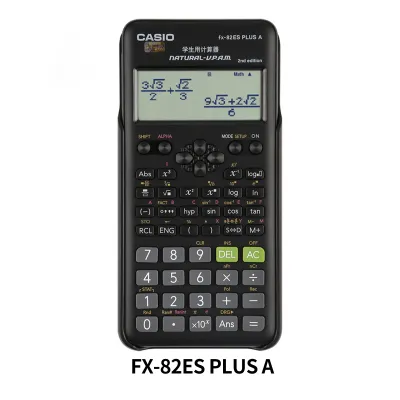
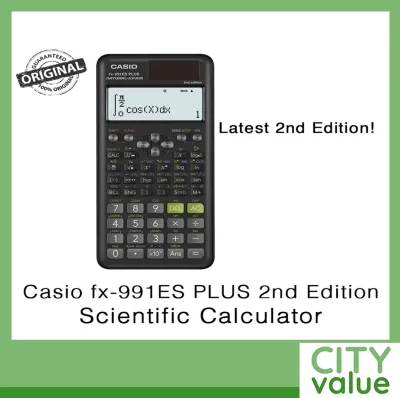
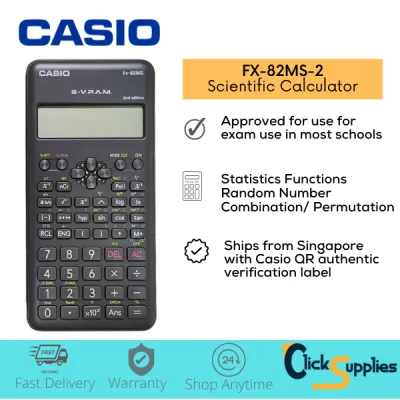
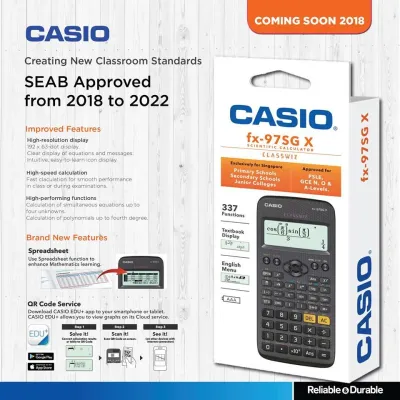
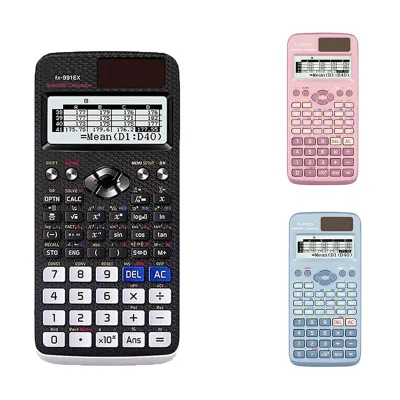
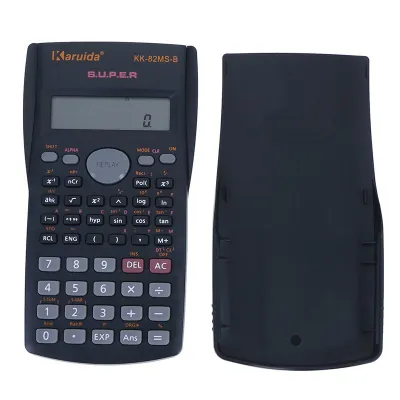
Prices are valid at publication and may change. Please refer to the product page for the latest price.
For students progressing to Junior College (JC) to study H1 or H2 Mathematics, the requirements shift dramatically. The A-Level curriculum demands the use of a graphing calculator (GC) for complex numbers, matrix operations, calculus (differentiation and integration), and advanced probability distributions. However, even with a graphing calculator, keeping a standard scientific calculator is highly recommended. Many students use their trusted secondary school scientific calculator as a secondary device during exams for quick, non-graphical calculations, saving time and battery power.
Ensuring Exam Compliance with SEAB Regulations
The most critical factor when buying a calculator in Singapore is ensuring it is approved by the Singapore Examinations and Assessment Board (SEAB). SEAB maintains a strict list of approved calculator models for national examinations, including the PSLE, GCE N-Level, O-Level, and A-Level. Using an unapproved model in an exam hall is a serious breach of regulations and can result in the device being confiscated or the student being penalized. Parents must always cross-reference any potential purchase with the latest official SEAB list online.

In addition to buying an approved model, the physical device must be registered and labeled. Schools in Singapore conduct regular calculator registration exercises, usually before major examinations. During these sessions, teachers verify the model and apply a specialized, tamper-evident SEAB approval sticker or label to the back of the calculator or its slide cover. Students must ensure this sticker remains intact and legible throughout their school years. If a sticker peels off or becomes damaged, the student must bring the device to their school’s general office or subject teacher for re-verification and re-labeling.
The restrictions on calculator features are highly specific to prevent unfair advantages. Banned features on standard scientific calculators include Computer Algebra Systems (CAS), which can symbolically solve algebraic equations, and programmable memory that allows students to store notes, formulas, or text. Graphing capabilities are also strictly prohibited on scientific calculators used for O-Level and N-Level exams. Understanding these boundaries helps parents avoid purchasing high-end, programmable models marketed for university use, which are illegal in Singapore’s secondary school exam halls.
Comparing Core Features and Display Technologies
When evaluating scientific calculators, the display technology is one of the most noticeable differences between entry-level and advanced models. Traditional models use a standard dot-matrix or two-line display, which shows fractions as linear expressions (using a “L” shaped symbol) and limits the visibility of complex formulas. Modern advanced models feature a Natural Textbook Display (often referred to as natural write or write-view). This technology displays fractions, exponents, surds, and integrals exactly as they are written in textbooks, significantly reducing input errors and making it easier for students to spot mistakes in their working.
Power source reliability is another key consideration for long-term school use. Calculators are typically powered either by a single battery (such as an AAA or a button cell) or a dual-power system combining solar panels with a battery backup. Dual-power models are highly recommended for students. The solar panel powers the device under classroom and exam hall lighting, while the battery only kicks in under low-light conditions. This dual setup ensures the calculator is highly unlikely to run out of power mid-exam, providing peace of mind during high-stakes papers.
Ergonomics and physical durability play a major role in a student’s daily efficiency. A good scientific calculator should have keys with clear tactile feedback, allowing students to type quickly without double-pressing or missing characters. The layout should be intuitive, with frequently used functions like fractions, square roots, and negative signs easily accessible. Color-coded shift and alpha keys help students quickly identify secondary functions printed above the main keys. A sturdy slide-on hard cover is also essential to protect the screen and keys from damage inside a crowded school bag.
Different syllabus tracks require specific mathematical capabilities. For instance, secondary students taking Additional Mathematics (A-Math) benefit greatly from calculators that include equation solvers (for quadratic and cubic equations) and inequality solvers. Basic models might only handle standard arithmetic and trigonometry, whereas advanced classroom models can perform matrix calculations, vector operations, and complex number arithmetic. Ensuring the calculator’s feature set matches the specific demands of the student’s subjects prevents the need for a premature upgrade.
| Feature Category | Standard Models | Advanced Classroom Models |
|---|---|---|
| Display Type | Standard line display | Natural Textbook Display |
| Power Source | Battery only | Dual (Solar + Battery) |
| Key Layout | Basic scientific functions | Ergonomic with color-coded shift keys |
| Advanced Math | Basic statistics | Calculus, matrices, complex numbers |
Table Title: Feature Comparison Matrix for Student Needs
Aligning with School Booklists and Teacher Preferences
Before purchasing a scientific calculator, parents should always consult the official school booklist provided at the end of the academic year or during orientation. Schools in Singapore often recommend a specific model for the entire cohort. This recommendation is not arbitrary; it is chosen to ensure uniformity in the classroom. When every student uses the same model, teachers can give step-by-step instructions on how to access specific functions, change modes, or input data during lessons, preventing individual students from falling behind.
Using the school’s preferred model also simplifies troubleshooting. If a student encounters an error message or struggles to find a statistical function, the teacher or a classmate can quickly assist them. If a student brings a unique or uncommon model to class, they may have to spend valuable time reading the manual independently to figure out how to perform standard operations. Aligning with the class standard fosters a smoother learning experience and ensures the student can focus on the mathematical concepts rather than the device’s interface.
Many schools organize bulk purchases of approved calculators through their bookshops or authorized vendors at the start of the school year. Participating in these bulk purchases is often highly advantageous. Not only do they sometimes come with a slight discount, but they also ensure the device is 100% compliant with school requirements and comes with a valid local warranty. Additionally, some school vendors handle the SEAB registration and labeling process directly, saving parents and students an extra step.
Final Pre-Purchase Checklist and Authenticity Checks
To ensure a smooth purchase, parents should follow a strict checklist. First, cross-reference the exact model number, including any specific letter suffixes, with the current SEAB approved list. Manufacturers often produce multiple variations of a calculator model (such as “MS”, “ES Plus”, or “CW”), and only specific versions may be approved for use in Singapore exams. A single letter difference in the model suffix can mean the difference between an exam-legal device and an unauthorized one.
Counterfeit electronics are a persistent issue, especially when purchasing from unauthorized online sellers or third-party marketplaces. To avoid buying a fake calculator, which may have faulty programming, incorrect mathematical outputs, or poor build quality, always inspect the packaging and the physical device. Genuine calculators from reputable brands typically feature high-quality printing, crisp screen displays, and holographic authenticity stickers on the packaging. Purchasing from established local stationery shops, department stores, or official brand stores on ecommerce platforms is the safest way to guarantee authenticity.
Finally, verify the local warranty terms and return policies before completing the transaction. A standard manufacturer’s warranty in Singapore usually covers electronic defects for one to three years. Keep the physical receipt and the warranty card in a safe place. It is also wise to check if the calculator comes with its protective slide cover, as replacement covers can be difficult to purchase separately. A robust warranty and a reliable return policy provide essential protection against unexpected hardware failures during the school term.
Frequently Asked Questions (FAQ)
Can my child use a graphing calculator for O-Level or A-Level exams?
Graphing calculators are strictly prohibited for standard GCE O-Level and N-Level mathematics examinations in Singapore. For these exams, students must use an approved scientific calculator. However, for GCE A-Level examinations, graphing calculators are not only permitted but are a compulsory requirement for H1 and H2 Mathematics papers. Always check the specific subject syllabus issued by SEAB for your child’s exam year to confirm the exact calculator requirements for each paper.
How long should a scientific calculator last through secondary school?
A high-quality, dual-powered scientific calculator is highly durable and can easily last the entire four to five years of secondary school, and often well into tertiary education. To maximize its lifespan, students should always keep the protective slide cover on when the device is not in use to protect the LCD screen from pressure and scratches. Regularly check the battery compartment for any signs of corrosion, especially if the calculator has been stored in a humid environment or left unused during long school holidays.
What should I do if the calculator breaks right before an exam?
If a calculator malfunctions or breaks immediately before a national exam, the student should inform their school’s exam committee or subject teacher as soon as possible. Schools typically maintain a small pool of spare, approved scientific calculators that can be loaned to students in emergencies. If purchasing an emergency replacement from a local shop, parents must double-check that the new device is on the SEAB approved list and immediately seek a teacher’s assistance to have the official SEAB approval sticker applied before entering the exam hall.
Community discussion
Share your experience or ask a question. Comments are reviewed before publication.