
Applying a top coat is the definitive final step in Gunpla building, transforming bare, toy-like polystyrene plastic into a finished, professional-looking scale model. For beginners in Singapore, navigating the vast array of protective clear coats can be daunting, especially given the local tropical climate and limited indoor workspace options. The ideal beginner-friendly top coat must balance ease of application, safety, and chemical compatibility with underlying paints or decals. By focusing on water-based acrylic formulas and convenient application methods, first-time builders can achieve a clean, protective finish without the risk of melting plastic or inhaling harsh solvent fumes. This guide outlines how to select, verify, and safely apply the right top coat for your Gunpla projects.
Core Criteria for a Beginner-Friendly Top Coat
Selecting your first top coat requires understanding how different chemical formulas behave on plastic models. The primary factor for any beginner is toxicity and the associated ventilation requirements. Hobby top coats generally fall into two categories: water-based (often labeled as aqueous or acrylic) and solvent-based (typically lacquers). Water-based acrylic formulas are highly recommended for beginners because they emit significantly fewer volatile organic compounds (VOCs) and have a very mild odor. This makes them far more suitable for Singapore’s typical high-density residential living spaces, such as HDB flats, where dedicated, highly ventilated workshops are rarely available. Solvent-based lacquers, while offering a highly durable finish, release intense fumes that require active spray booths and heavy-duty organic vapor respirators to use safely.
Application forgiveness is another critical trait to look for in a starter top coat. A forgiving formula possesses excellent self-leveling properties, meaning the liquid naturally flattens out as it dries to eliminate minor pooling, brush marks, or uneven spray patterns. The drying speed also plays a major role in your success. The top coat should dry quickly enough to prevent airborne dust from settling on the wet surface, yet slowly enough to allow the microscopic paint droplets to merge smoothly. If a top coat dries too quickly mid-air—a common issue with aggressive solvents in warm environments—it creates a rough, sandpaper-like texture on the model rather than a smooth, uniform finish.
Products mentioned in this guide
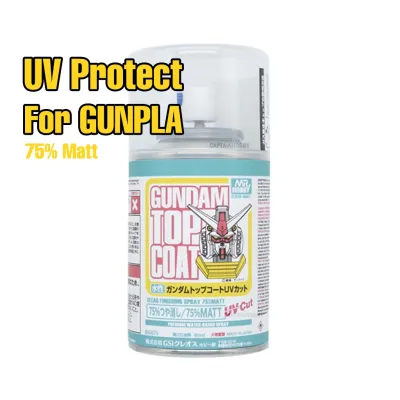
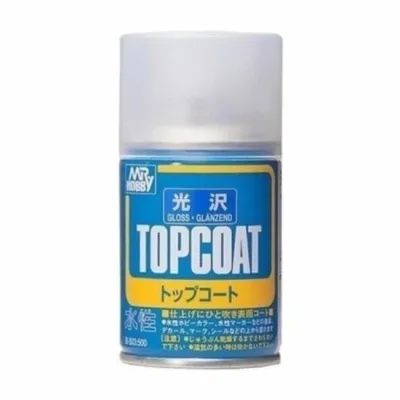
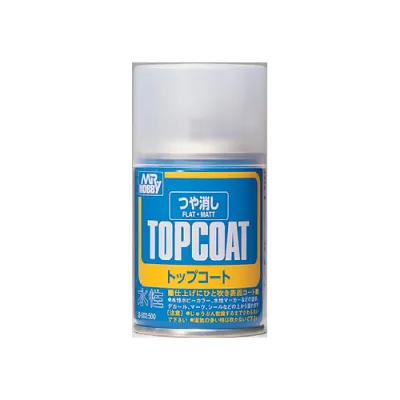
Prices are valid at publication and may change. Please refer to the product page for the latest price.
Finally, you must consider chemical compatibility with your underlying work. Gunpla models often feature a mix of materials, including bare polystyrene plastic, acrylic or enamel paints, panel line accent colors, and delicate water-slide decals. The top coat acts as a protective barrier, but if the solvent in the top coat is too aggressive, it will reactivate and dissolve the layers underneath. Water-based acrylic top coats are chemically mild, meaning they can be safely applied over almost any paint type and will not melt or distort delicate decals. Conversely, lacquer-based top coats are highly aggressive and can easily ruin hours of panel-lining and decaling work if applied too heavily.
Comparing Application Formats for First-Time Builders
Before purchasing a top coat, you must decide on the application format that best fits your budget, workspace, and comfort level. Aerosol spray cans are the most popular and practical entry point for absolute beginners. They require zero initial investment in specialized machinery like compressors or airbrushes and are ready to use right out of the cap. However, spray cans present unique control challenges; they release paint at a fixed, high pressure, which can easily lead to over-application and pooling if your hand movement is too slow. Additionally, the cost per milliliter is relatively high, and the propellant inside the can is highly sensitive to ambient temperature and humidity—a critical factor in Singapore’s tropical climate.

Brush-on formulas offer an exceptionally accessible and cost-effective alternative. Applying a top coat with a traditional hand brush eliminates the risk of overspray entirely, making it a quiet, virtually fume-free option that you can easily do at a standard study desk. The primary challenge with this format is avoiding visible brush strokes. To succeed, builders must use a high-quality, soft-bristled flat brush and select a top coat specifically formulated with strong self-leveling agents, applying multiple thin coats rather than one thick layer. Brush-on application is particularly well-suited for small, individual parts or spot-protecting specific decals without coating the entire model.
Airbrush systems provide the absolute highest level of control, paint atomization, and cost efficiency over time, but they are generally excluded from beginner starter recommendations. An airbrush setup requires a significant upfront financial investment in a compressor, airbrush gun, moisture trap, and cleaning station. It also demands a steep learning curve regarding paint thinning ratios, pressure settings, and meticulous disassembly cleaning after every session. For a first-time builder simply looking to finish their first few kits, the complexity of an airbrush can distract from the core hobby experience, making it an upgrade path rather than a starting point.
Evaluating Top Coat Options and Retailers in Singapore
It is vital to distinguish dedicated scale-model hobby lines from general-purpose craft or hardware store varnishes. Industrial clear sprays found in hardware stores are formulated for wood, metal, or heavy-duty outdoor plastics. These products often utilize highly aggressive solvents and thick binders that can instantly melt, warp, or craze the delicate polystyrene and ABS plastics used in Gunpla kits. Hobby-grade top coats are specifically engineered to lay down in micro-thin layers that preserve the sharp panel lines and molded details of scale models. Investing in dedicated hobby brands ensures that the chemical composition is safe for your model’s plastic.
When sourcing top coats in Singapore, visiting specialized brick-and-mortar hobby shops—often located in central shopping hubs or neighborhood retail plazas—allows you to inspect the physical product labels directly. Alternatively, authorized online storefronts operated by established local hobby distributors provide a reliable way to ensure product authenticity. Avoid purchasing unbranded or suspiciously cheap clear coats from general online marketplaces, as counterfeit or improperly stored pressurized cans can pose safety hazards and ruin your models. Local hobby shops also offer the advantage of knowledgeable staff who can confirm if a specific can is water-based or solvent-based.
Before making a purchase, carefully read the product packaging to confirm three critical specifications: the finish type, the solvent base, and the application medium. Look for terms like ‘Aqueous’ or ‘Water-Based’ to ensure chemical safety. For the finish, ‘Matt’ or ‘Flat’ will remove the plastic toy sheen and provide a realistic, military-style look; ‘Gloss’ is ideal for metallic finishes or preparing a smooth surface for decals; and ‘Semi-Gloss’ offers a subtle, realistic sheen. Ensure the label explicitly states compatibility with plastic models.
Essential Application and Safety Checks for Beginners
Before spraying, ensure the model’s surface is completely free of dust, fingerprints, and plastic sanding debris. A clean, dry makeup brush or a compressed air duster is excellent for clearing out panel lines. Crucially, check the local weather conditions. In Singapore, outdoor relative humidity frequently exceeds 80%. Spraying in high humidity traps moisture under the atomized paint particles, resulting in a ruined, cloudy white finish known as ‘frosting.’ Aim to spray indoors in a climate-controlled room with a dehumidifier, or outdoors only on dry, clear days when the humidity is lower.
Even mild water-based spray cans release fine particulate mists that should not be inhaled. Always wear a well-fitting particulate respirator (such as an N95 mask) when spraying. Work in a space with active cross-ventilation—for instance, near an open window with an exhaust fan blowing outward, or on an open-air balcony. Protect your surrounding workspace with a cardboard spray box or newspaper, and wear disposable nitrile gloves to prevent skin contact with the wet mist and to avoid leaving fingerprints on the freshly coated parts.
Knowing when to stop is the key to saving a model from permanent damage. If you observe the top coat beginning to pool in corners, run down flat surfaces, or cause underlying panel lines to bleed, halt application immediately. If the surface begins to turn a milky, semi-opaque white instead of drying clear, this is a sign of moisture entrapment. Stop spraying, move the model to a dry, warm environment, and allow it to cure completely before attempting any corrective measures.
Frequently Asked Questions (FAQ)
Can I use standard hardware store clear coats on Gunpla?
No, using standard hardware store clear coats on Gunpla is highly risky. These industrial-grade sprays are formulated with aggressive solvents designed to adhere to tough surfaces like metal or treated wood. When applied to the delicate polystyrene and ABS plastics of a Gunpla kit, these solvents can chemically attack the plastic, causing it to soften, warp, craze, or lose its crisp molded details. Additionally, hardware sprays apply a much thicker layer of varnish, which can easily clog fine panel lines and ruin the scale appearance of your model.
How to Fix a Cloudy or Frosted Matte Finish
A cloudy or frosted finish is usually caused by high humidity trapping moisture within the drying top coat. To fix this, first allow the frosted coat to dry and cure completely for at least 24 hours. In many cases, applying a very light, thin coat of a gloss top coat over the frosted area can help melt and level the microscopic rough texture, restoring clarity. If the frosting is severe, you can gently polish the affected surface with an ultra-fine sanding sponge (3000-grit or higher) or use a mild acrylic paint remover on a cotton swab to carefully wipe away the damaged layer before re-coating in a low-humidity environment.
Do I Need to Top Coat Every Single Gunpla Part?
You do not need to top coat every single part of your Gunpla, especially internal frame pieces that are completely hidden from view once the armor is assembled. Focus your time and materials on the visible outer armor panels, weapons, and shields. Applying a top coat is highly recommended for areas with water-slide decals or dry-transfer markings, as it seals them against peeling and physical wear. Additionally, if you have applied panel lining or weathering effects, a top coat is essential to lock these details in place and protect them from rubbing off during posing.
Community discussion
Share your experience or ask a question. Comments are reviewed before publication.