
Quick Answer: Which Stretch Film Fits Your Workflow?
Choosing the right stretch film wrap is a critical decision for optimizing your warehouse operations, securing transit loads, and managing packaging budgets. The choice between hand stretch film and machine stretch film depends primarily on your daily pallet volume and whether you have automated wrapping machinery.
If your facility packages fewer than 10 to 15 pallets per day, hand stretch film offers a highly flexible, low-cost entry point that requires no specialized machinery. Conversely, if your daily output exceeds 15 pallets, or if you require highly consistent containment force for heavy loads, transitioning to machine stretch film and automated equipment is the most efficient path forward. Ultimately, the correct choice requires verifying your physical workspace, labor capacity, and equipment compatibility before committing to a bulk purchase.
Core Differences in Design and Application
To make an informed purchasing decision, you must first understand the fundamental physical and operational distinctions between hand and machine stretch film wrap formats. While both materials serve the same ultimate purpose—stabilizing and protecting palletized goods—their roll dimensions, core designs, and material formulations are engineered for entirely different application methods.
Products mentioned in this guide
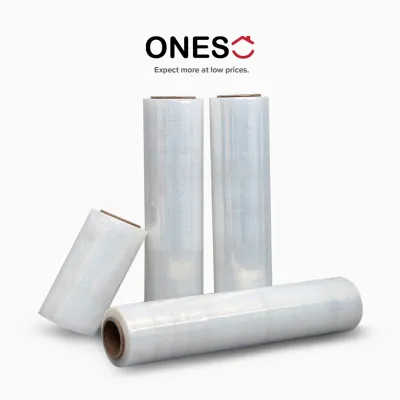
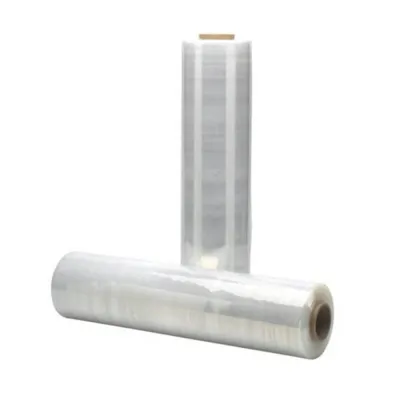
![[SG Stock] Stretch Film | Heavy Duty Shrink Wrap Packaging | Pallet Wrap | Cling Wrap | Furniture Wrap | 2.5/3kg](https://img.lazcdn.com/g/p/7c4636ed40f09d680825c6d01a74b8f8.png_400x400q80.png_.webp)
![[Min Purchase 2] Stretch Film Roll (1.7kg/2.25kg/2.9kg)](https://img.lazcdn.com/g/p/e15d654393b1fff820cb5c811ccccfd6.png_400x400q80.png_.webp)
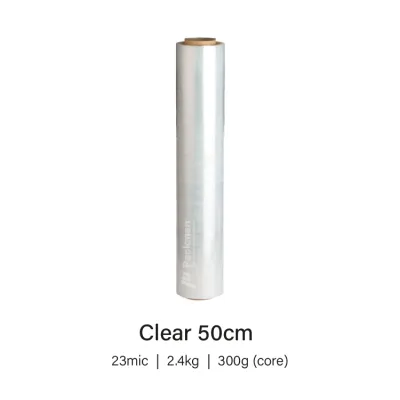
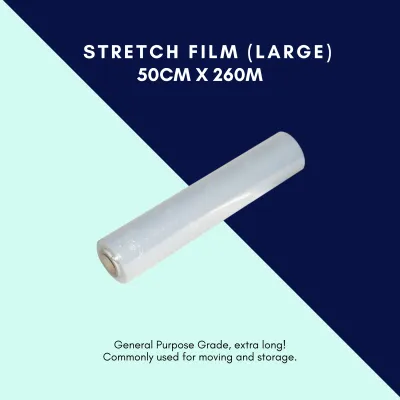
Prices are valid at publication and may change. Please refer to the product page for the latest price.

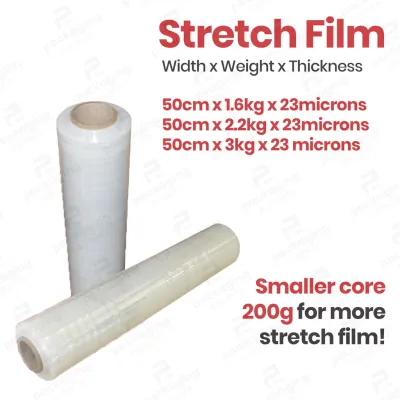
Roll size and weight represent the most immediate physical differences. Hand stretch film rolls are specifically designed for manual handling by warehouse personnel. These rolls typically weigh between 1.5 kg and 4 kg, featuring a manageable width of 400 mm to 500 mm. This lightweight profile ensures that operators can lift, carry, and walk with the roll for extended periods without immediate physical exhaustion. Machine stretch film rolls, on the other hand, are industrial-scale products. They generally weigh between 11 kg and 18 kg, with roll widths often starting at 500 mm. These heavy rolls are physically impossible to apply manually and must be loaded onto mechanical dispensers or automated wrapping carriages.
Core sizes and dispensing mechanisms also vary to accommodate these different handling methods. Hand rolls often feature extended cardboard cores that act as built-in handles, or they are designed to slide onto simple, lightweight manual dispensers. The inner core diameter is typically 2 inches or 3 inches. Machine rolls almost universally utilize a heavy-duty 3-inch inner core designed to lock securely into the motorized pre-stretch carriages of automated wrapping machinery, ensuring the roll remains stable under high rotational speeds.
Furthermore, the material formulation and pre-stretch capabilities of these films are highly distinct. Machine stretch films are engineered using advanced resin blends that allow them to withstand extreme tension. When fed through an automated wrapper’s pre-stretch carriage, these films can be stretched by 150% to over 300% of their original length before being applied to the pallet. Hand stretch films are formulated for manual application, where human physical strength limits the practical stretch ratio to approximately 50% to 100%. Attempting to manually stretch a standard film to machine-level tension is physically impossible for an operator and will result in loose, unstable loads.
Key Factors for Choosing Your Stretch Film Wrap
Selecting the ideal stretch film wrap requires a balanced evaluation of your daily operational demands, physical infrastructure, and workforce.
Packaging Volume & Speed
Your daily packaging output is the most reliable indicator of which film type you need. Manual wrapping is highly flexible and requires zero setup time, making it suitable for small-scale operations, retail backrooms, or decentralized shipping stations. However, when your daily pallet count rises, the time spent manually walking around pallets can create a severe bottleneck in your dispatch workflow. Automated systems using machine film can wrap a pallet in a fraction of the time, keeping pace with high-speed production lines and ensuring that your shipping department can meet tight delivery schedules.
Equipment Requirements
Using machine stretch film requires a capital investment in wrapping machinery, such as turntable wrappers, rotary arm wrappers, or horizontal orbital wrappers. If your facility lacks this machinery and does not have the budget or floor space to install it, hand stretch film remains your default option. You must also verify that any machine film you purchase matches the specific tension, carriage size, and roll width specifications of your existing equipment.
Labor & Ergonomics
Manual pallet wrapping is physically demanding work that requires operators to walk backward while bending and stretching to apply film to the bottom and top of a load. Over time, this repetitive motion can lead to physical fatigue or strain. Transitioning to machine wrapping shifts the operator’s role from physical labor to machine setup and monitoring, which can improve workplace safety and reduce physical strain.
Film Specifications
Both hand and machine films come in various thicknesses (gauges), cling levels, and puncture resistance profiles. Heavy, sharp, or irregular loads require a film with high puncture resistance and a thicker gauge to prevent tearing during transit. When selecting a film, you must match these specifications to your specific load profiles, ensuring the film can secure the cargo without snapping under tension.
Evaluating Total Cost and Material Yield
Evaluating the financial impact of your stretch film wrap choice requires looking beyond the initial purchase price of a single roll. While a roll of hand stretch film has a lower upfront cost than a massive machine roll, its material yield is significantly lower. Because manual application cannot achieve the high pre-stretch ratios of automated machinery, you end up using more physical film material to secure each pallet. This can lead to higher long-term material consumption and increased waste.
Machine stretch film, when paired with a pre-stretch carriage, maximizes the yield of every roll. By stretching the film before it is applied to the pallet, the machine uses less raw material to achieve the same or superior load containment. This high yield can offset the higher initial cost of the machine rolls over time, especially in high-volume environments.
However, you must also factor in the total cost of ownership, which includes the initial purchase or leasing cost of the wrapping machinery, ongoing equipment maintenance, electricity consumption, and labor hours. To find your break-even point, you can use a simple evaluation checklist:
- Calculate daily material usage: Track how many rolls of hand film you consume per week versus the estimated yield of machine film.
- Assess labor costs: Calculate the hours spent manually wrapping pallets versus the time required to load and operate a machine.
- Obtain local supplier quotes: Request pricing for both hand and machine rolls from local distributors to compare the cost in S$ per roll.
- Factor in equipment depreciation: Amortize the cost of a wrapping machine over its expected operational lifespan to see if the material savings justify the capital expenditure.
Final Decision Framework: Hand vs. Machine
To finalize your purchasing decision, use this structured framework to align your operational realities with the correct stretch film wrap format.
Choose Hand Stretch Film if:
- Your facility wraps fewer than 10 to 15 pallets per day.
- You package highly irregular, inconsistent, or fragile loads that require delicate, manual tension adjustments.
- Your warehouse floor space is limited, or you operate across multiple decentralized packing stations.
- You want to avoid upfront capital expenditures on automated machinery.
Choose Machine Stretch Film if:
- Your daily packaging volume consistently exceeds 15 to 20 pallets.
- You require uniform, repeatable containment force to prevent load shifting during transit.
- You want to optimize material yield and reduce plastic waste through mechanical pre-stretching.
- You aim to reduce physical labor demands and improve ergonomic safety in your shipping department.
Verify First if:
- You are planning a transition from manual to automated wrapping; always consult your machinery manual to verify compatible roll widths, maximum outer diameters, and core sizes.
- You are unsure of film performance; request sample rolls from your supplier to test puncture resistance and cling on your actual product loads before placing a bulk order.
Frequently Asked Questions (FAQ)
Can I use machine stretch film on a hand dispenser?
It is highly discouraged to use machine stretch film on a manual hand dispenser. Machine rolls are significantly heavier and wider than hand rolls, making them extremely difficult and unsafe for an operator to lift, hold, and maneuver manually. Additionally, machine films require high tension to stretch properly, which cannot be achieved through manual pulling, resulting in poor load containment and wasted material.
How do I determine the right film gauge for my loads?
Determining the correct film gauge depends on the weight, shape, and vulnerability of your palletized loads. Light, uniform boxes typically require a thinner gauge (such as 12 to 15 microns), while heavy, irregular, or sharp-edged loads demand a thicker, high-performance gauge (such as 20 to 23 microns or more) to prevent punctures. Always check the manufacturer’s specification sheets and conduct a test wrap to verify that the chosen gauge provides adequate containment without tearing.
Is pre-stretched hand film a viable middle ground?
Yes, pre-stretched hand film is an excellent middle ground for operations that want to improve manual wrapping efficiency without investing in machinery. This film is pre-stretched during manufacturing, meaning it requires much less physical effort from the operator to apply and achieve proper tension. While it does not offer the extreme stretch ratios or speed of a true machine-applied film, it significantly reduces physical strain and material waste compared to standard hand stretch film.
Community discussion
Share your experience or ask a question. Comments are reviewed before publication.