
Choosing the right stretch film is a critical decision for any warehouse, logistics hub, or business that regularly ships palletised goods. The choice between hand stretch film and machine stretch film directly impacts your packaging speed, labor costs, load stability, and overall material expenses. While both materials serve the same fundamental purpose of securing goods for transport, they are engineered differently to suit distinct operational scales and equipment setups.
To make the right purchase, you must evaluate your daily shipping volume, the physical space available in your facility, and your budget for packaging equipment. Hand stretch film offers immediate flexibility and low upfront costs for smaller operations, whereas machine stretch film provides unmatched consistency and long-term material savings for high-volume setups. Understanding how these two options compare across key operational metrics will help you select the most efficient and cost-effective solution for your business.
Key Differences in Application and Equipment
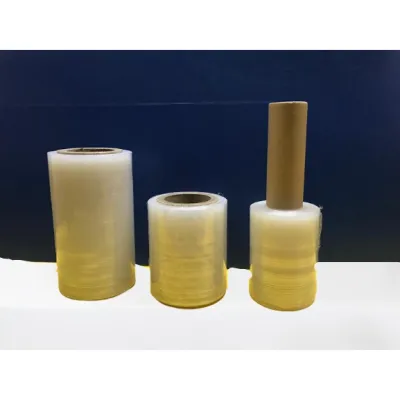
The primary distinction between hand and machine stretch film lies in how they are applied to a load. Hand stretch film is designed for manual application, meaning warehouse operators wrap the pallets by hand. This process typically involves using lightweight handheld dispensers or simple plastic core inserts that allow the roll to spin as the operator walks around the pallet. Because this method relies entirely on human physical effort, the film must be easy to handle and manipulate without requiring excessive force.
Products mentioned in this guide
![[Min Purchase 2] Stretch Film Roll (1.7kg/2.25kg/2.9kg)](https://img.lazcdn.com/g/p/e15d654393b1fff820cb5c811ccccfd6.png_400x400q80.png_.webp)
![🏅[CHEAPEST] Stretch Film/ Shrink Wrap / Cling Wrap /Pallet wrapping /Moving Supplies/pallet Wrap/Pallet wrapping](https://img.lazcdn.com/g/p/c69357eb04f4e35ac9ee2d124f108fda.jpg_400x400q80.jpg_.webp)
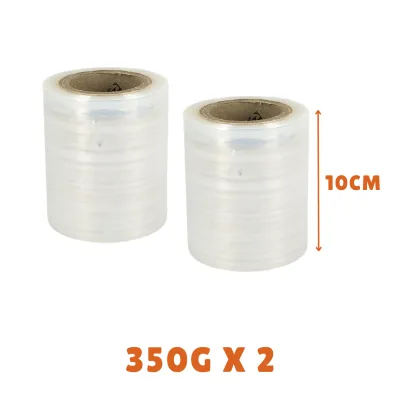
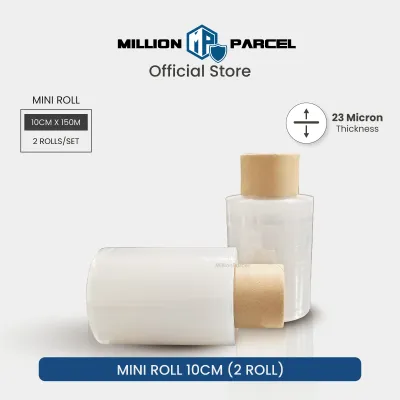
Prices are valid at publication and may change. Please refer to the product page for the latest price.
In contrast, machine stretch film is engineered specifically for automated or semi-automated packaging machinery. These machines, which include turntable wrappers, rotary arm wrappers, and orbital wrapping systems, apply the film with mechanical precision. The machinery controls the tension, wrap pattern, and speed, ensuring that every pallet is wrapped with identical consistency. This automated process allows for much higher tension levels than a human operator could physically achieve or sustain over a work shift.
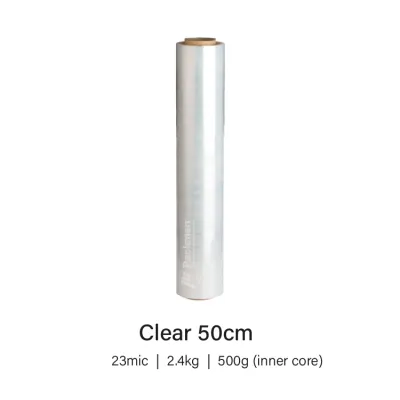
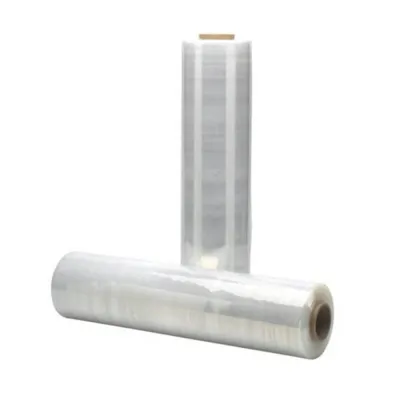
These differing application methods dictate the physical characteristics of the rolls. Hand stretch film rolls are designed to be lightweight and portable, typically weighing between 1.5 kg and 4 kg so that workers can carry and use them without rapid fatigue. They usually feature a 2-inch or 3-inch core diameter and shorter roll lengths, often ranging from 250 to 500 metres. Machine stretch film rolls are significantly larger and heavier, often weighing between 11 kg and 18 kg, with standard 3-inch cores designed to fit securely onto the mechanical mandrels of wrapping machines. These rolls contain much longer lengths of film, frequently exceeding 1,500 metres, which minimises the need for frequent roll changes during high-volume operations.
Matching Film Type to Your Packaging Volume
Determining which film type to buy requires a realistic assessment of your daily or weekly palletising volume. For businesses with low-volume, seasonal, or highly irregular shipping schedules, hand stretch film is almost always the most practical choice. If your team wraps fewer than 15 pallets per day, the time spent manually wrapping is relatively low, and the physical demand on your staff remains manageable. Manual wrapping also excels when dealing with highly irregular, non-uniform, or fragile loads that require careful, customized handling during the wrapping process.

When your packaging volume scales up to a consistent daily flow of 15 or more pallets, manual wrapping quickly becomes a bottleneck, making machine stretch film the logical step forward. High-volume operations require the speed and predictability that only automated wrapping can provide. A semi-automatic turntable wrapper can secure a pallet in a fraction of the time it takes a worker to do so manually, allowing your team to process shipments faster and meet tight delivery windows.
Space constraints are another critical factor, particularly for businesses operating in compact warehouses, flatted factories, or multi-storey ramp-up facilities in Singapore. Industrial space is highly optimized, and dedicating floor space to a permanent piece of machinery like a turntable wrapper may not always be feasible. If your warehouse floor is tightly packed or if you need to wrap pallets in different areas of the facility, hand stretch film offers the ultimate mobility. Hand rolls can be carried directly to the pallet, requiring zero dedicated floor space. Conversely, if you have the physical space to accommodate a wrapping machine, integrating machine film can streamline your layout by establishing a centralized, highly efficient packaging station.
Comparing Load Stability and Film Specifications
To ensure your goods arrive at their destination undamaged, you must evaluate how film specifications affect load stability. The most significant technical difference between the two film types is their pre-stretch capability. Machine stretch films are manufactured using advanced resin formulations that allow them to be stretched mechanically by 150% to over 300% of their original length before being applied to the pallet. This pre-stretching process activates the film’s elastic memory, causing it to constantly try to shrink back to its original size, which creates an incredibly tight, secure hold around the load.
Hand stretch films have much lower pre-stretch capabilities, typically limited to 50% to 100%. Because human operators cannot apply the immense physical force required to stretch high-performance films to their limit, hand films are designed to release easily from the roll with moderate tension. Some hand films are “pre-stretched” during manufacturing, meaning they are already stretched close to their limit on the roll, allowing workers to apply them with minimal physical effort while still achieving decent load containment.
When purchasing, you must also consider film thickness, commonly measured in microns. Hand films generally range from 15 to 23 microns, with thicker gauges selected for heavy, sharp, or irregular loads that require high puncture resistance. Machine films are available in a wider variety of specialized gauges, including ultra-thin high-performance films that use advanced multi-layer technology to provide the same puncture resistance as thicker traditional films but at a lower material weight. When reviewing manufacturer specifications, pay close attention to cling properties—which ensure the film sticks to itself and not the product—as well as tear resistance and UV protection if your pallets will be exposed to sunlight during outdoor storage or transit.
Cost, Labor, and Efficiency Trade-offs
The financial decision to choose hand or machine stretch film involves balancing immediate upfront costs against long-term operational expenses. Hand stretch film requires virtually no initial capital investment; you only need to purchase the rolls and a few inexpensive manual dispensers. This makes it highly attractive for startups, small businesses, or operations with limited capital budgets. However, the ongoing cost per pallet wrapped with hand film is typically higher because of lower material yield and higher labor costs.
%0A Machine stretch film requires a significant upfront capital expenditure, as you must purchase or lease a wrapping machine, which can range from several thousand S$ for basic semi-automatic models to much more for fully automated inline systems. Despite this initial cost, the long-term savings can be substantial. Because wrapping machines pre-stretch the film mechanically, they use significantly less material to secure each pallet compared to manual wrapping. This high material yield reduces your plastic consumption, lowers your cost per pallet, and minimizes packaging waste, supporting environmental sustainability goals.
Labor efficiency and workplace safety are also major parts of the equation. Manual pallet wrapping is physically demanding and repetitive. Workers must walk backward in circles while bending down and reaching up, which poses ergonomic risks, including back strain and dizziness. Over time, these physical demands can lead to slower wrapping speeds, inconsistent load tension, and potential workplace injuries. Automating the process with machine stretch film eliminates these ergonomic hazards, improves workplace safety, and frees up your warehouse staff to focus on higher-value tasks like inventory management or order picking.
Final Decision Framework for Your Setup
To finalize your purchasing decision, use this conditional framework to determine which stretch film type aligns with your current and future operational needs.
Choose hand stretch film if your setup meets the following conditions:
- Your packaging volume is low, typically under 15 pallets per day.
- Your warehouse space is highly constrained, requiring a mobile packaging solution.
- Your loads are highly irregular, fragile, or vary constantly in shape and size.
- You want to avoid upfront capital expenditures on machinery.
Choose machine stretch film if your setup meets these conditions:
- You wrap more than 15 to 20 pallets daily on a consistent basis.
- You want to reduce material waste and lower your long-term cost per wrapped pallet.
- You need to improve workplace ergonomics and reduce the physical strain on your warehouse staff.
- You have dedicated floor space to accommodate a semi-automatic or automatic wrapping machine.
Before making any purchase, always perform a “Verify First” step. If you are buying machine stretch film, check your wrapping machine’s manual to verify its specific requirements. You must confirm the maximum roll width, the allowable outer roll diameter, the core size (usually 3 inches), and the machine’s pre-stretch ratio. Buying a film with a pre-stretch rating that does not match your machine’s capabilities can lead to frequent film breakages, tension issues, or poor load containment.
Frequently Asked Questions (FAQ)
Can You Use Hand Stretch Film on a Machine?
Using hand stretch film on an automated wrapping machine is highly discouraged and usually results in poor performance. Hand stretch films are manufactured with different resin formulations and are much thinner and less elastic than machine-grade films. Because automated wrapping machines apply high mechanical tension and pre-stretch forces, hand film is highly likely to snap, tear, or puncture almost immediately when loaded onto a machine. This leads to frequent machine stoppages, wasted material, and increased frustration for your operators.
Additionally, hand stretch film rolls are physically incompatible with most wrapping machines. Hand rolls have smaller roll diameters, shorter lengths, and sometimes smaller core sizes (such as 2-inch cores) that will not fit securely onto the standard 3-inch mandrels of industrial wrapping equipment. Even if you manage to mount the roll, the machine’s tension settings will quickly overwhelm the film. For safe, efficient, and consistent packaging, always match your film type to the specific application method and equipment in your warehouse.
Community discussion
Share your experience or ask a question. Comments are reviewed before publication.