
Selecting the right stretch film roll is a critical decision for any warehouse or shipping operation. The choice between hand stretch film and machine stretch film directly impacts packaging efficiency, material costs, and load safety during transit. While both films secure palletized goods, they are engineered for entirely different application methods, workflows, and operational scales.
To determine which type fits your needs, you must evaluate your daily shipping volume, load characteristics, and equipment budget. Hand stretch film is designed for manual application, offering maximum flexibility and zero equipment costs for low-volume or highly varied packaging environments. Machine stretch film is formulated for automated wrapping systems, providing superior material yield, consistent containment force, and significant long-term cost savings for high-volume operations. Understanding these physical and mechanical differences will help you optimize your packaging workflow and protect your bottom line.
Core Differences Between Hand and Machine Stretch Film
The physical structure of a stretch film roll is tailored specifically to its application method. Hand stretch film rolls are engineered with human ergonomics in mind, typically weighing between 1.5 kg and 4 kg so operators can handle them throughout a shift without excessive physical strain. Their width usually ranges from 400 mm to 500 mm, with core diameters of 50 mm or 76 mm to fit standard manual dispensers. In contrast, machine stretch film rolls are designed exclusively for mechanical handling, weighing between 12 kg and 17 kg. They feature a standard 76 mm core that slides onto the mandrel of an automated wrapping machine, accommodating much larger roll diameters and longer lengths to minimize roll changes.
Products mentioned in this guide
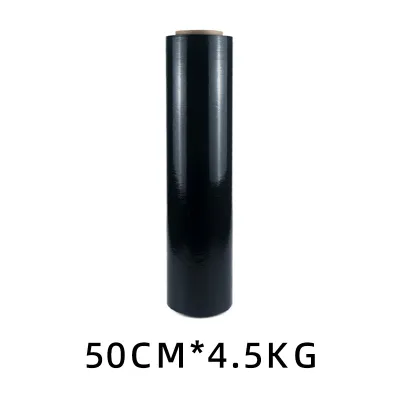
![[Min Purchase 2] Stretch Film Roll (1.7kg/2.25kg/2.9kg)](https://img.lazcdn.com/g/p/e15d654393b1fff820cb5c811ccccfd6.png_400x400q80.png_.webp)
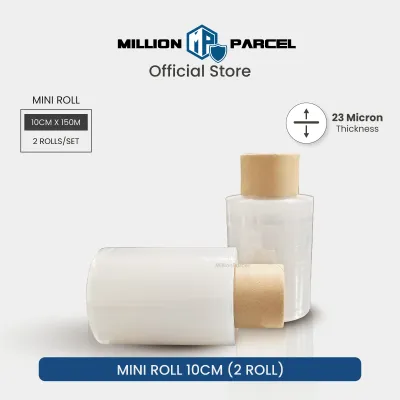
![[Min 2] Stretch Film Bundle Wrap Roll 100mm](https://img.lazcdn.com/g/p/4b21646cda65084b74bbdf9269999803.jpg_400x400q80.jpg_.webp)
Prices are valid at publication and may change. Please refer to the product page for the latest price.
The mechanical properties of the plastic resins also differ. Machine stretch film is formulated to withstand the intense forces of mechanical pre-stretch systems, which can stretch the film by 200% to over 300% before application. This requires specialized, high-performance resins that resist tearing under extreme tension. Hand stretch film is designed for manual stretching, which typically reaches only 50% to 150% capacity under human strength, relying entirely on the operator’s physical effort to create tension.
The application process represents two completely different operational approaches. Manual wrapping requires an operator to walk backward around a pallet, bending down to secure the base and reaching up to cover the top. Automated wrapping utilizes a motorized carriage that moves vertically while the pallet rotates on a turntable or a rotary arm circles the load, ensuring precise, repeatable tension and consistent film application without physical exertion.
Matching the Film to Your Packaging Volume
Aligning your choice of stretch film roll with your daily packaging volume is essential for maintaining an efficient and cost-effective workflow. For operations wrapping fewer than 15 pallets per day, hand stretch film is almost always the most practical choice. At this volume, the manual process is easily integrated into daily tasks, and the low throughput does not justify the capital investment required for automated wrapping machinery. Manual wrapping also offers unmatched flexibility for highly irregular, unstable, or lightweight loads, as an operator can adjust tension and wrapping patterns on the fly to protect delicate items.

Once daily throughput exceeds 15 to 20 pallets, manual wrapping quickly becomes an operational bottleneck. High-volume warehouses and manufacturing facilities require the speed and consistency of machine wrapping to maintain continuous product flow. An automated wrapping machine secures a pallet in a fraction of the time it takes an operator, allowing staff to focus on staging, labeling, and loading tasks rather than spending hours wrapping pallets by hand.
Ergonomic limits and staff fatigue are critical factors when evaluating manual wrapping over extended shifts. Walking backward in circles while bending and stretching puts significant physical strain on an operator’s back, shoulders, and wrists, increasing the risk of repetitive strain injuries. As fatigue sets in during a long shift, the quality of manual wrapping inevitably declines, leading to inconsistent tension and poorly secured loads that are vulnerable to shifting during transit.
Comparing Cost, Efficiency, and Material Yield
Evaluating the financial trade-offs between hand and machine stretch film requires looking beyond the initial cost of the rolls. The primary benefit of hand stretch film is the absence of upfront equipment costs, requiring only the film rolls and inexpensive manual dispensers to begin wrapping immediately. However, relying on manual wrapping for larger volumes leads to higher long-term material costs. Because human operators cannot physically stretch the film to its maximum capacity, they use substantially more plastic by weight to secure each pallet, resulting in low material yield and increased waste.
Investing in an automated wrapping machine requires an upfront capital expenditure, which can represent a notable investment in S$ for a basic semi-automatic turntable to much higher amounts for fully integrated systems. Despite this initial cost, machine wrapping delivers a rapid return on investment through dramatic material savings. A machine’s pre-stretch carriage mechanically elongates the film before application, turning one meter of film on the roll into three or more meters of usable wrap on the pallet, significantly lowering your film cost per pallet in S$.
In addition to material savings, machine wrapping provides superior load containment consistency and labor efficiency. A machine applies the exact same tension, overlap, and number of wraps to every pallet, ensuring uniform protection that meets strict shipping standards. Manual wrapping is inherently variable, as the tension applied depends entirely on the operator’s physical strength and stamina at any given moment, which can lead to loose loads and costly transit damage.
Essential Specifications to Verify on the Roll
To ensure compatibility and optimal performance, it is crucial to verify several key physical and performance specifications on the manufacturer’s label before purchasing a stretch film roll. The first specification to check is the micron thickness, which must match the weight and profile of your loads. Light, uniform loads under 400 kg can typically be secured with a thinner film of 12 to 15 microns, while heavy, unstable, or sharp loads over 800 kg require a thicker film of 20 to 23 microns or more to prevent punctures and tears.
You must also verify the roll width, total length, and core diameter to ensure physical compatibility with your existing dispensing equipment. Hand rolls are commonly 400 mm to 500 mm wide and feature shorter lengths, typically 300 to 500 meters, to keep the roll weight manageable for manual use. Machine rolls are standardly 500 mm wide but feature much longer lengths, often 1,500 to 2,500 meters, to minimize the need for frequent roll changes during high-volume operations. Core diameter is equally critical; hand dispensers usually require 50 mm or 76 mm cores, while machine wrappers almost exclusively use a 76 mm core.
Finally, review the film’s tack and puncture resistance indicators provided by the manufacturer. Tack determines how well the film layers stick to each other to create a secure seal, and you should verify whether the film features one-sided or two-sided cling. One-sided cling is highly recommended for warehouse environments, as it prevents adjacent pallets from sticking together and tearing when they are loaded onto delivery trucks. Puncture resistance is equally vital, especially if you are wrapping pallets with sharp wooden edges, metal parts, or irregular profiles that could easily pierce standard film.
Decision Framework: Which Roll Fits Your Operation?
To finalize your purchasing decision, evaluate your current operational constraints, budget, and future growth plans. Choose hand stretch film rolls if your facility processes a low volume of pallets daily, your warehouse space is limited, or your loads vary widely in shape, size, and weight. This manual approach keeps your overhead costs to a minimum and provides the ultimate flexibility to adapt to changing packaging requirements without relying on specialized machinery.
Choose machine stretch film rolls if your business handles a high volume of pallets daily, your loads are relatively uniform, and you already utilize or plan to invest in an automated wrapping machine. Transitioning to machine wrapping will optimize your material yield, reduce labor costs, and ensure consistent, high-quality load containment that protects your products throughout the supply chain.
If your business is in a transitional phase or experiences seasonal spikes in volume, a mixed workflow may be the most efficient solution. You can utilize an automated wrapping machine for your standard, high-volume product lines while keeping a stock of hand stretch film rolls and manual dispensers on hand for irregular loads, oversized items, or overflow packing stations. Before making any purchase, always verify that the film specifications, including thickness, width, and core size, align perfectly with your operational equipment to avoid costly downtime and material waste.
Frequently Asked Questions (FAQ)
Can I use a hand stretch film roll on a machine wrapper?
No, you should not use a hand stretch film roll on an automated machine wrapper. Hand rolls are physically too light, have much shorter lengths, and often feature core sizes that are incompatible with a machine’s mandrel. Furthermore, hand stretch films are not formulated to withstand the high pre-stretch forces applied by mechanical carriages; attempting to use them on a machine will cause the film to snap repeatedly, leading to operational downtime, machine errors, and significant material waste.
How should I store stretch film rolls to preserve their elasticity?
To preserve the elasticity, cling, and overall performance of your stretch film rolls, you should store them vertically in a cool, dry warehouse environment away from direct sunlight and extreme heat. Prolonged exposure to ultraviolet (UV) light and temperatures exceeding 30 degrees Celsius can degrade the plastic resins, causing the film to become brittle, lose its tack, or fuse together on the roll, making it difficult to unwind and apply effectively.
Community discussion
Share your experience or ask a question. Comments are reviewed before publication.