
Choosing the right paper cutter machine is a critical decision for any office, classroom, or creative studio. The correct tool not only ensures clean, professional edges but also dramatically improves workflow efficiency and user safety. Conversely, using an unsuitable cutter can lead to ruined materials, jagged edges, and potential physical hazards. To make an informed choice, you must evaluate your typical daily volume, the level of precision your projects demand, and the physical space available in your workspace.
Understanding the Core Cutting Mechanisms
To select the ideal paper cutter machine, it is essential to understand how each type operates. The physical design of the blade and the way it contacts the paper dictate the machine’s capacity, precision, and suitability for different tasks.
The classic guillotine utilizes a lever-action mechanism featuring a long, slightly curved blade attached to a pivot handle. As you lower the handle, the blade shears against a stationary metal edge embedded along the side of the base board. This action creates a swift, clean cut across the entire length of the paper using downward manual force. Because the blade cuts the entire length simultaneously, it is highly efficient for slicing through multiple sheets of standard paper in a single, fluid motion.
Products mentioned in this guide
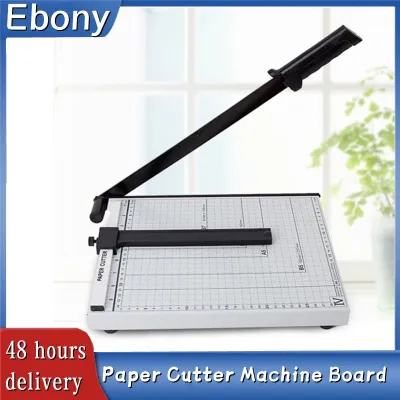
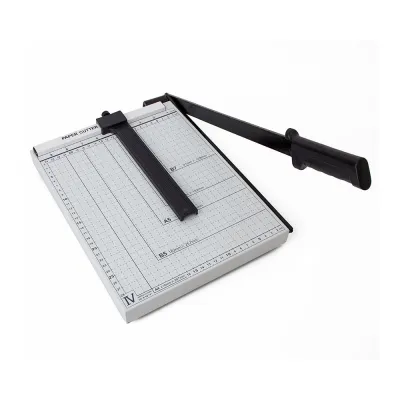
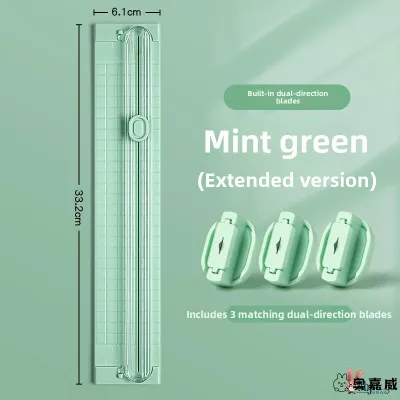
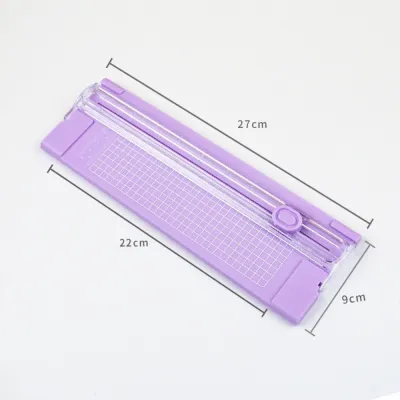
Prices are valid at publication and may change. Please refer to the product page for the latest price.
A rotary trimmer operates using a sliding circular blade enclosed within a plastic carriage. This carriage slides along a rigid metal guide rail positioned above the cutting bed. As you slide the carriage across the rail, the circular blade rolls and shears the paper against a metal strip on the base. This rolling action applies downward pressure directly at the point of contact, minimizing paper shifting and allowing for bidirectional cutting. This mechanism is highly favored for projects that require exact measurements and perfectly smooth edges.
For high-volume tasks, a manual stack cutter employs a heavy-duty press mechanism designed to slice through thick reams of paper. These machines feature a heavy, vertical blade that is lowered using a long lever or a hand wheel to maximize mechanical advantage. Before the blade descends, a mechanical clamp is tightened down onto the stack of paper to compress it and prevent any shifting. This robust design allows the machine to slice through hundreds of sheets of paper at once with minimal physical effort from the operator.
Comparing Capacity, Precision, and Material Limits
Evaluating the technical boundaries of each cutter type is crucial to ensure the machine can handle your specific media without sustaining damage or producing poor-quality cuts.

Sheet capacity is highly dependent on paper weight, which is measured in grams per square meter (GSM). A paper cutter machine rated for 15 sheets of standard 80 GSM copier paper will handle significantly fewer sheets of 250 GSM cardstock. Overloading a cutter beyond its rated capacity can dull the blade prematurely, misalign the cutting arm, or produce jagged, uneven edges. Always check the manufacturer’s maximum specifications on the product label to ensure your typical media falls within the safe operating limits.
Cut precision and edge quality vary significantly between the shearing action of a guillotine and the rolling slice of a rotary blade. Rotary cutters excel at high-precision tasks because the blade is locked onto a rigid track, preventing the blade drift that can occur with guillotines. Guillotines, while fast, can occasionally pull the top sheets of a stack slightly forward during a cut—a phenomenon known as “paper draw.” For projects where a fraction of a millimeter matters, such as trimming photographs or preparing professional marketing materials, the scoring slice of a rotary blade is superior.
Material versatility is another critical factor to consider before purchasing. While standard office paper is easily managed by all three types, materials like laminated sheets, thick chipboard, plastic films, or photographs require specific blade properties. Some rotary cutters offer interchangeable blades for perforating or waving, while heavy-duty stack cutters can handle dense cardstock but may crush delicate, thin materials. Always verify the approved material list on the product label to ensure the blade is compatible with your media.
Matching the Cutter to Your Daily Workflow
Aligning your primary daily tasks with the most efficient and practical cutter type will optimize your productivity and ensure a smoother workflow.
For high-volume office environments, print shops, or mailrooms, a manual stack cutter or a heavy-duty guillotine is the most practical investment. These machines are designed to process large volumes of documents quickly, allowing you to cut entire booklets, thick stacks of flyers, or bulk mailings in a single stroke. This high-capacity processing dramatically reduces labor time and ensures consistent dimensions across large production runs.
In classrooms, crafting studios, and design agencies, a rotary trimmer offers the control and safety needed for intricate, small-batch, or mixed-media work. Teachers preparing classroom materials, scrapbooking enthusiasts, and graphic designers working with photos benefit from the ability to see the exact cutting line through a transparent guide rail. The enclosed blade design also makes rotary trimmers a safer option in environments where children or multiple users are present.
For general administrative tasks and occasional office use, a standard desktop guillotine provides the best balance of speed, footprint, and cost. It is ideal for quick, everyday tasks like trimming laminated signs, cutting down oversized documents, or preparing presentation materials. A standard guillotine is easy to set up, requires minimal maintenance, and can be stored away conveniently when not in use.
Safety Features and Workspace Requirements
Before finalizing your purchase, it is essential to consider the physical footprint of the machine and the safety mechanisms required for your specific environment.
The workspace footprint of a paper cutter machine can impact its usability in tight office spaces. A guillotine requires a clear swing radius for the lever arm to move up and down safely, meaning you cannot place other items close to the right side of the machine. A rotary trimmer has a flat, linear track that requires no vertical clearance, making it easier to store in shallow drawers or tight shelving units. Manual stack cutters are heavy, semi-permanent fixtures that require a dedicated, sturdy table capable of supporting their weight and resisting the leverage applied during operation.
Essential safety mechanisms must be verified in the product manual to prevent accidents during use. Look for guillotines equipped with a secure blade lock that keeps the arm down when not in use, as well as a protective finger guard running along the cutting edge. Rotary cutters inherently protect users by enclosing the circular blade within the carriage, exposing it only when pressed down against the cutting rail. For manual stack cutters, ensure the model features a safety latch that prevents the heavy blade from falling accidentally and a robust clamp that keeps hands far from the cutting zone.
Maintenance and blade replacement requirements vary by model and should be factored into your decision. Over time, all blades dull and require attention to maintain clean cuts. Check the product manual to determine if the blade can be easily replaced by the user or if it requires professional sharpening or servicing. Many rotary trimmers feature simple, drop-in replacement cartridges, whereas guillotine blades are often designed to self-sharpen through use but may eventually require complete replacement of the assembly.
Decision Framework: Which Paper Cutter Machine Fits Your Needs?
To finalize your decision, use this conditional framework to match your specific constraints and requirements to the correct paper cutter machine.
Choose a guillotine if you need a balance of speed and moderate stack capacity for standard office paper. This type is ideal for quick, straight cuts on everyday documents, laminated signs, and presentation materials where extreme precision is not the primary concern.
Choose a rotary trimmer if precision, edge quality, and cutting diverse materials like photos or crafts are your priorities. This option is perfect for detailed trimming, scrapbooking, and working with delicate or laminated media that require a perfectly smooth, unfrayed edge.
Choose a manual stack cutter if you regularly process high-volume, thick reams of paper and have the space for heavy equipment. This heavy-duty machine is necessary for print shops, large offices, and schools that need to cut hundreds of sheets simultaneously.
Verify first if your specific media, such as corrugated board, thick chipboard, or non-paper materials, exceeds standard paper cutter limits. Cutting materials that are too dense or thick for your machine can damage the blade and void the warranty, requiring specialized industrial equipment instead.
Community discussion
Share your experience or ask a question. Comments are reviewed before publication.