
Selecting the right airbrush spray booth for a small apartment or Housing & Development Board (HDB) flat in Singapore requires balancing space constraints, ventilation limits, and noise management. Because high-density living spaces place neighbors in close proximity, venting paint fumes safely and keeping operational noise to a minimum are just as important as finding a unit that fits on a compact desk. A portable, foldable airbrush spray booth equipped with a flexible exhaust hose and a multi-stage dry filter system generally offers the most practical solution for hobbyists working in these tight environments.
By focusing on physical dimensions, window compatibility, and noise-dampening setups, you can enjoy airbrushing model kits, crafts, or miniatures without compromising your indoor air quality or disturbing your household. Evaluating your specific workspace layout and understanding how different booth features perform under apartment conditions will help you make an informed decision.
Assessing Your Space and Ventilation Constraints
Before purchasing an airbrush spray booth, you must carefully evaluate the physical layout of your designated crafting area. Start by measuring the exact footprint of the desk or table where you plan to work. Keep in mind that you need space not only for the booth itself but also for a rotating turntable, your airbrush compressor, paint bottles, and comfortable clearance for your hands and the airbrush hose.
Products mentioned in this guide
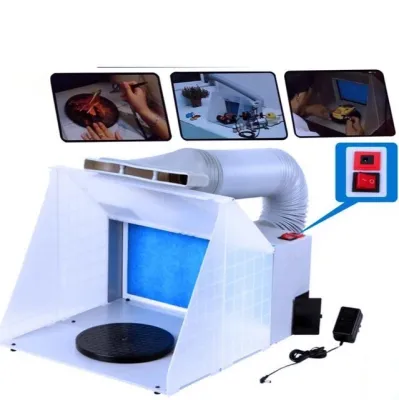
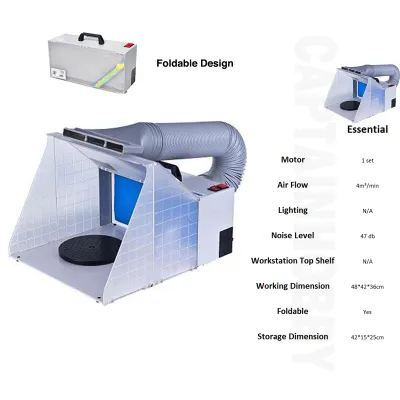
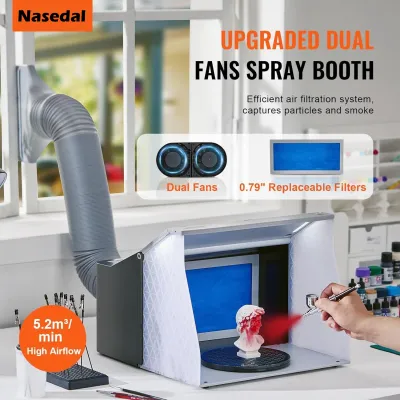
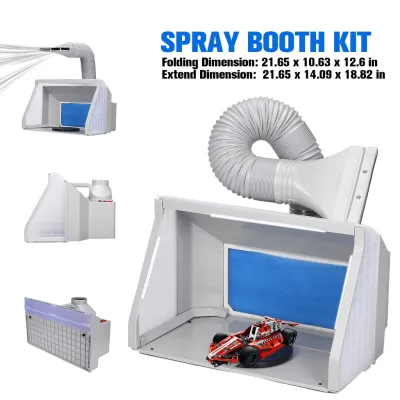
Prices are valid at publication and may change. Please refer to the product page for the latest price.
Next, identify the nearest window or exterior opening and measure the direct distance from your work surface. This distance determines the required length of your exhaust hose. Most portable booths come with a flexible, accordion-style duct, but stretching a hose to its absolute limit can restrict airflow and create awkward tension across your workspace. Keeping the booth as close to the window as possible ensures the most efficient extraction.
Window frame designs in Singapore apartments significantly influence how you route your exhaust. Sliding windows allow you to use a simple vertical or horizontal foam board insert to hold the exhaust nozzle in place. Casement windows, which push outward, require a different approach, such as a temporary fabric window seal with a zipper interface to prevent backdrafts of humid air and paint fumes from returning indoors.
Finally, consider where the booth will go when you are not painting. If your crafting table doubles as a home office desk or a dining surface, a permanent desktop installation is rarely practical. Look for units that fold down into a self-contained suitcase shape, allowing you to store the booth in a closet, under a bed, or on a utility shelf when it is not in active use.
Key Features for Space-Constrained Environments
When space is limited, the design and structural features of the airbrush spray booth dictate how easily it integrates into your daily routine. Foldable or collapsible booths are highly advantageous for apartment dwellers. These units feature hinged plastic walls that unfold to create a hood and snap back down into a compact carrying case, protecting the internal fan and filter from dust during storage.

While portability is essential, you must balance the external footprint with the internal workspace volume. A booth that is too small will restrict your ability to paint larger model kits or comfortably rotate pieces on a turntable. Look for a model that offers a wide front opening but tapers toward the back, which maximizes your usable internal workspace while keeping the rear fan housing relatively compact.
Exhaust hose flexibility is another critical factor. High-quality hoses are made of durable, lightweight plastics that can bend around corners without collapsing or kinking. Ensure the hose kit includes a flat, low-profile exhaust nozzle. This flat attachment fits easily into narrow window openings, allowing you to vent fumes outside while keeping the window mostly closed to block out heat, humidity, and rain.
Integrated LED lighting is a highly valuable feature for compact setups. Working inside a deep booth hood can cast shadows over your model, making precise paint application difficult. Choosing a booth with built-in LED light strips along the top and sides eliminates the need for bulky external desk lamps, saving precious table space and reducing cord clutter around your workstation.
Managing Noise and Airflow in Shared Living Spaces
Operating an extraction fan in a quiet apartment can quickly become disruptive to family members or next-door neighbors, especially during late-night crafting sessions. The key is finding a balance between airflow volume—measured in cubic meters per hour or cubic feet per minute (CFM)—and the noise level produced by the motor. While higher airflow clears fumes faster, it also generates more decibels.
To keep your workspace peaceful, review the manufacturer’s decibel (dB) ratings before buying. A booth operating between 45 dB and 55 dB is generally comparable to a household refrigerator or a gentle household fan, making it suitable for indoor use. Anything exceeding 60 dB can feel intrusive in a small room and may require you to limit your painting to daytime hours.
Structure-borne noise is another common issue in apartments with concrete floors. The vibration of the booth’s fan motor can travel through your desk and down into the floorboards, creating a low-frequency hum in the room below. Placing a thick silicone mat, a neoprene sheet, or anti-vibration foam pads under the booth’s feet can significantly dampen these vibrations and isolate the sound.
If your booth’s fan is louder than expected, you can manage the noise by planning your painting schedule around household activities. Alternatively, setting up temporary sound-absorbing foam panels on the wall behind your desk can help prevent high-frequency fan noise from echoing off hard concrete walls, keeping the sound contained within your immediate work area.
Setup, Exhaust Routing, and Safety Checks
Setting up your airbrush spray booth correctly is vital for ensuring that paint overspray and solvent fumes are completely removed from your living space. To route the exhaust hose without making permanent modifications to your rental or HDB flat, construct a temporary window insert using lightweight materials like high-density foam board or acrylic sheet. Cut a hole matching the diameter of your exhaust nozzle, slide the insert into the window track, and close the window firmly against it to create a seal.
When positioning the exhaust hose, ensure there are no sharp 90-degree bends or tight kinks along its path. Sharp bends create air resistance, which reduces the fan’s extraction efficiency and can cause fumes to back up into the booth. Keep the hose run as straight and short as possible to maintain a strong, consistent pull of air away from your face.
Regular filter maintenance is essential for keeping the extraction system working safely. Dry filtration systems typically use a dual-stage fiberglass or polyester filter pad to trap airborne paint particles before they reach the fan blades. Check the filter pad before every painting session; a clogged filter restricts airflow and forces the motor to work harder, increasing noise and reducing suction. Replace the filter pad immediately if it is heavily discolored or caked with dry paint overspray.
Always place your spray booth on a stable, level surface well away from the edges of your desk. The vibration of the fan, combined with accidental bumps while reaching for tools, can cause a lightweight booth to slide. Ensuring the unit is secure prevents tipping hazards, protecting your models, your airbrush equipment, and your living space from messy paint spills.
Frequently Asked Questions (FAQ)
Can I vent an airbrush spray booth into a bathroom exhaust fan?
No, you should never vent an airbrush spray booth into a bathroom exhaust fan or any shared building ventilation shaft. Bathroom vents in high-density residential buildings are designed solely for moisture extraction and often connect to shared ductwork. Routing paint particulates and flammable solvent fumes into these systems creates a serious fire hazard and can cause toxic fumes to migrate directly into neighboring units, violating building safety regulations. Always vent your spray booth directly to the outdoors through an open window or a dedicated external wall duct.
Do portable spray booths need a water curtain or just dry filters?
For small apartments, dry filter systems are generally much more practical than water curtain systems. Water curtain booths use a continuous flow of water to trap paint particles, which is highly effective for heavy painting but adds significant weight, bulk, and complexity to the setup. They also carry a risk of water spills on multi-purpose desks and require regular reservoir cleaning to prevent mold and odors. Dry fiberglass or paper filters are lightweight, easy to replace, and highly efficient for the typical paint volumes used in hobby airbrushing.
Community discussion
Share your experience or ask a question. Comments are reviewed before publication.