
Equipping your child for the school year involves more than just notebooks and pencils. Stamps offer a highly efficient way to label belongings, organize homework, and streamline note-taking across different academic stages. By matching the right stamp type to your child’s grade level, you can save time, prevent lost items, and support their developing organizational skills.
For lower primary students, the priority is keeping track of personal belongings with durable name stamps. As students transition to upper primary, date and organization stamps help them manage homework deadlines. By secondary school, specialized utility stamps assist with complex note-taking and laboratory diagrams. Selecting the right stamp requires understanding mechanisms, ink types, and school guidelines.
Lower Primary: Name Stamps for Labeling Belongings
In the early years of primary school, children frequently misplace their stationery, water bottles, and uniform jackets. Name stamps provide a rapid, legible alternative to hand-writing labels on dozens of individual items. When selecting a name stamp, parents must choose between self-inking and pre-inked mechanisms.
Products mentioned in this guide
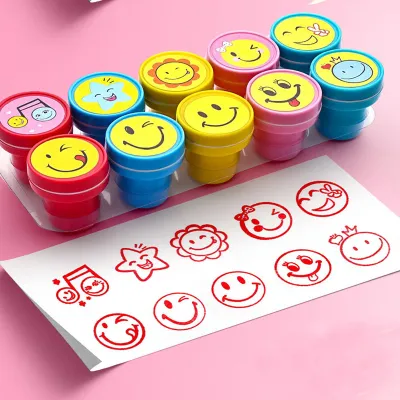
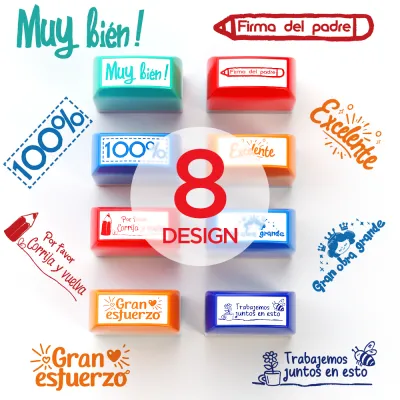
Prices are valid at publication and may change. Please refer to the product page for the latest price.
Self-inking stamps feature a built-in ink pad that automatically re-inks the rubber plate after each press, making them highly durable and easy for young hands to operate. Pre-inked stamps hold oil-based ink directly within the stamp design itself, producing exceptionally crisp, high-contrast impressions, though they may require more careful handling to avoid accidental smudges.
Ink compatibility is a critical factor when labeling diverse school gear. Standard water-based inks work beautifully on paper textbooks and exercise books but will quickly wash out of school uniforms or smear on plastic lunchboxes. For clothing, look for specialized textile inks that bond with fabric fibers and resist repeated washing machine cycles. For plastic items, ensure the ink is formulated to dry quickly on non-porous surfaces without rubbing off during daily use.
For younger children who are still learning to read their own names, visual cues are incredibly helpful. Many customizable name stamps allow you to include a small, simple icon—such as an animal, star, or vehicle—alongside the text. This visual symbol enables pre-readers to identify their personal property instantly among a pile of identical school items.
Before stamping every item in your child’s school kit, verify the school’s specific policies regarding label placement and ink colors. Some schools require labels to be placed in discreet locations, such as the inner hem of uniforms or the inside cover of textbooks. Standard black or dark blue inks are generally accepted, while bright neon colors might be restricted to teacher use or specific grading activities.
Upper Primary: Date and Organization Stamps for Assignments
As students enter upper primary, their academic workload increases, requiring them to track multiple homework assignments, project deadlines, and test dates. Introducing a date stamp into their daily routine fosters independence and time-management skills. Parents can choose between adjustable date bands and fixed-date utility stamps.

Adjustable date stamps feature rotating rubber bands that allow the student to change the day, month, and year manually, providing long-term usability across several academic terms. Fixed stamps, while simpler to use, lack this flexibility and are better suited for repetitive, non-dated labeling tasks.
To make organization more engaging and visual, consider multi-color or color-coded stamp options. Assigning specific ink colors to different subjects or urgency levels helps students prioritize their tasks at a glance. For example, a red stamp can denote urgent homework deadlines, while a green stamp indicates completed assignments or approved drafts. This visual system reduces cognitive load and helps students plan their study sessions more effectively.
Pencil case space is at a premium in upper primary, so stamp dimensions are an important practical consideration. Look for compact, lightweight designs that slide easily into standard zippered pencil cases alongside pens and rulers. Heavy, bulky desk stamps are impractical for daily transport and are likely to be left behind at home, defeating their organizational purpose.
Before committing to a specific stamp and ink combination, establish an observable testing method to check drying speed on standard notebook paper. School exercise books often use lightweight paper that can easily smudge if the ink remains wet for too long. Have your child stamp a scrap piece of notebook paper, wait five seconds, and gently run a finger across the impression. If the ink smears, the drying time is too slow for fast-paced classroom environments, and you should consider a faster-drying water-based ink formulation.
Secondary School: Subject-Specific and Utility Stamps
Secondary school subjects demand more advanced note-taking, structured layouts, and precise diagrams. Specialized utility stamps can significantly speed up preparation during mathematics, science, and geography classes. Grid, lined, or margin stamps allow students to instantly print small coordinate planes, graph templates, or structured tables directly onto their notebook pages. This eliminates the need to draw tedious grids by hand, keeping notes neat and allowing the student to focus entirely on the lesson content.
The physical demands on school supplies increase dramatically in secondary school, as heavy textbooks and laptops crowd student backpacks. Stamps carried in these environments require robust casing materials to prevent cracking or accidental ink leakage. High-impact plastic casings or reinforced metal frames offer the necessary durability to withstand daily transport and accidental drops on classroom floors.
Long-term study notes and laboratory reports need to remain legible for months or even years as students prepare for major examinations. Standard water-based inks can fade over time when exposed to light or bleed if a water bottle leaks inside a school bag. For archival purposes, select stamps compatible with water-resistant, fade-resistant pigment inks. These inks sit on the surface of the paper rather than soaking through, ensuring the notes remain sharp and readable throughout the academic year.
While specialized stamps offer clear benefits, it is important to balance their utility against the physical bulk of carrying multiple tools. Encourage your student to select one or two multi-functional stamps—such as a combined grid and ruler stamp—rather than a large collection of single-purpose designs. This keeps their school bag light while still providing the necessary tools for structured note-taking.
Key Buying Checks: Ink Types and Stamp Mechanisms
Selecting the right stamp involves understanding how different ink formulations interact with various paper types. Water-based inks are the most common choice for school use because they dry quickly on standard paper and rarely bleed through to the back of the page. Solvent-based inks are necessary for non-porous surfaces like plastic folders or metal rulers, but they will bleed heavily through thin school worksheet paper. Pigment-based inks offer a middle ground, providing rich color and excellent water resistance without the severe bleed-through associated with solvent inks.
Maintenance requirements vary significantly across stamp mechanisms, impacting their long-term cost and convenience. Self-inking stamps are highly convenient because their internal ink pads can be easily slid out, re-inked with a few drops of liquid ink, and reinserted. Pre-inked stamps require specialized, brand-specific gel or oil-based refills, which can be more difficult to source. Traditional wooden handle stamps require a separate ink pad, which offers great flexibility in ink colors but introduces a high risk of ink stains inside a school bag if the pad lid pops open. A reliable self-inking stamp typically costs between S$10 and S$25, making it a cost-effective addition to your back-to-school budget.
To avoid ruining expensive school textbooks or worksheets, always perform a pre-use testing protocol on a scrap piece of similar paper. Press the stamp firmly onto the test paper using even pressure, then observe the results. Check the reverse side of the paper to ensure there is no ink bleed-through, and examine the edges of the stamped impression to verify that the ink does not feather or spread along the paper fibers.
Because children handle these stamps regularly, safety certifications are a vital consideration. Look for products that carry recognized non-toxic labels, such as the AP (Approved Product) seal or compliance with EN71 safety standards. These certifications ensure that the plastic casings, rubber dies, and ink formulations are free from harmful chemicals, providing peace of mind for daily classroom use.
Frequently Asked Questions (FAQ)
How do I clean a clogged self-inking stamp used on school paper?
To clean paper fibers and dried ink from a self-inking stamp, slide out the ink pad to prevent accidental staining. Dampen a lint-free microfiber cloth with lukewarm water and a drop of mild dish soap, then gently dab the rubber die surface. Avoid using harsh chemical solvents, alcohol, or acetone, as these substances can degrade the rubber, warp the plastic casing, and permanently ruin the stamp’s impression quality. Allow the stamp to air-dry completely face down on a clean paper towel before reinserting the ink pad.
Can I use a standard paper name stamp on my child's school uniform?
No, standard water-based paper ink is not formulated to bond with fabric fibers and will wash out completely during the first laundry cycle, often leaving unsightly smudges on surrounding fabric. If you want to stamp school uniforms, you must purchase a stamp specifically loaded with textile or laundry-safe ink, which is designed to withstand hot water washes and tumble drying. If textile ink is unavailable, alternative labeling methods such as iron-on name labels or sew-in fabric tags are highly reliable options for dark or textured school garments.
Community discussion
Share your experience or ask a question. Comments are reviewed before publication.