
Selecting the correct envelope size is a matter of matching the dimensions of your document to standard international envelope formats. If you are mailing an unfolded A4 document, you will require a C4 envelope. Folding that same A4 sheet in half once converts it to A5 size, which fits perfectly into a C5 envelope. If you fold it into thirds, a DL envelope is the industry standard, while folding it twice into quarters (A6 size) requires a C6 envelope.
Matching these standard relationships ensures your mail looks professional and prevents costly postage errors. Choosing the wrong envelope can result in damaged documents, unprofessional creases, or unexpected surcharges at the post office. Understanding how standard paper sizes interact with envelope dimensions is the easiest way to streamline your mailing process.
Decoding Envelope Specs: C-Series and DL Explained
The international standard for envelope sizes is governed by ISO 269, which works in tandem with the ISO 216 standard for A-series paper sizes. This systematic framework ensures that paper of a specific size fits neatly into its corresponding envelope without the need for complex calculations.
Products mentioned in this guide
Prices are valid at publication and may change. Please refer to the product page for the latest price.
C-series envelopes are designed with dimensions that are geometrically scaled to be slightly larger than their A-series paper counterparts. This intentional sizing difference provides a few millimeters of clearance on all sides, allowing you to slide documents in and out smoothly without bending or tearing the edges. For instance, a C4 envelope is sized to hold an A4 sheet, while a C5 envelope is sized to hold an A5 sheet.
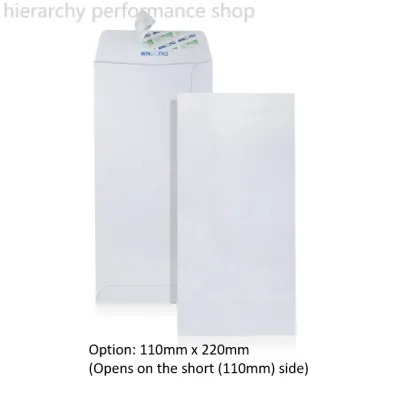
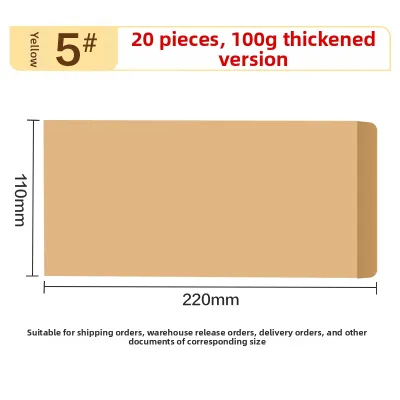
In addition to the C-series, the DL (Dimension Long) format is a widely recognized standard in business correspondence. Measuring 110 mm by 220 mm, the DL envelope does not follow the standard C-series scale. Instead, it is specifically engineered to hold a standard A4 sheet that has been folded horizontally into three equal sections. This format is highly optimized for automated mail-sorting equipment and is the primary choice for corporate letters, invoices, and direct marketing.
Matching Envelope Sizes to A4 Documents by Fold
How you choose to fold your documents dictates the envelope size you must purchase. Standardizing your folding methods helps maintain a consistent, professional presentation.

Unfolded A4
An unfolded A4 document requires a C4 envelope, which measures 229 mm by 324 mm. This pairing is essential for certificates, legal contracts, official reports, and high-quality marketing materials that must remain entirely flat and free of creases. Presenting documents unfolded projects a high level of professionalism and compliance.
A4 Folded in Half
Folding an A4 sheet in half parallel to its shorter side reduces its footprint to A5 dimensions (148 mm by 210 mm). This requires a C5 envelope (162 mm by 229 mm). This option is highly practical for multi-page letters, catalogs, and detailed newsletters, as it keeps the overall mailing dimensions compact while minimizing the number of folds.
A4 Folded in Half Twice
Folding an A4 sheet in half once, and then in half a second time, results in an A6 size (105 mm by 148 mm). This folded document fits into a C6 envelope (114 mm by 162 mm). The C6 format is a classic choice for personal letters, compact flyers, and standard greeting cards, offering a traditional and personal feel.
A4 Folded into Thirds
Folding an A4 sheet twice horizontally to create three equal panels yields a size of 99 mm by 210 mm. This requires a DL envelope (110 mm by 220 mm). This is the absolute standard for utility bills, formal business letters, and transactional mail, fitting easily into standard letterboxes.
| Fold Type | Resulting Paper Size | Paper Dimensions (mm) | Required Envelope | Envelope Dimensions (mm) | Common Use Case |
|---|---|---|---|---|---|
| Unfolded (No Fold) | A4 | 210 x 297 | C4 | 229 x 324 | Certificates, contracts, reports |
| Folded in half once | A5 | 148 x 210 | C5 | 162 x 229 | Business letters, catalogs |
| Folded in half twice | A6 | 105 x 148 | C6 | 114 x 162 | Greeting cards, RSVP cards |
| Folded into thirds | DL (approximate) | 99 x 210 | DL | 110 x 220 | Invoices, corporate letters |
Sizing Envelopes for Letters and Invitations
While business correspondence relies heavily on standard A4 paper, personal letters and formal event invitations often utilize distinct dimensions that require careful envelope matching.
Standard Letters
Everyday personal and business letters written on standard pads or printer paper are most commonly sent in DL or C6 envelopes. DL envelopes are highly favored for formal business communications due to their clean, elongated appearance. C6 envelopes are typically preferred for casual, handwritten correspondence, as the square-like shape feels more personal.
Invitations
Event invitations, RSVP cards, and greeting cards are often printed on thick A5 or A6 cardstock. These cards map directly to C5 and C6 envelopes, respectively. Using standard A-series dimensions for your custom invitations makes it much easier to source high-quality, matching envelopes in various colors and finishes.
Square and Custom Invitations
Square invitations are a popular choice for weddings and milestone celebrations, but they do not conform to the standard ISO C-series dimensions. If you design a square invitation, you must measure the card precisely and purchase dedicated square envelopes, such as 130 mm by 130 mm or 160 mm by 160 mm. Keep in mind that non-standard shapes and square envelopes often require manual sorting at postal facilities, which can incur higher postage rates.
Factoring in Paper Thickness and Mailing Limits
Selecting an envelope based solely on length and width can lead to issues if you do not account for the physical thickness of your documents and local postal regulations.
Paper Thickness and Capacity
Standard C-series envelope dimensions assume you are mailing a few sheets of standard 80 GSM printer paper. If you are mailing a thick multi-page manuscript, a booklet, or heavy 300 GSM cardstock, the thickness of the contents will pull the sides of the envelope inward, reducing its effective width and length. For bulky documents, you should step up to a larger envelope size (such as using a B4 envelope instead of a C4) or select a gusseted envelope that features expandable sides designed to accommodate depth.
Mailing Regulations
In Singapore, Singapore Post (SingPost) categorizes mail based on dimensions, weight, and thickness. Standard Regular mail must not exceed 240 mm by 162 mm by 6 mm, and must weigh 40g or less; this category comfortably accommodates standard DL, C5, and C6 envelopes containing a few sheets of paper. Standard Large mail accommodates dimensions up to 324 mm by 229 mm by 14 mm and weights up to 500g, which fits a standard C4 envelope. Exceeding these limits reclassifies your mail as Non-Standard or a package, which carries higher postage rates. Always verify the weight and thickness of your sealed envelope to avoid delivery delays.
Frequently Asked Questions (FAQ)
Can I fit an unfolded A4 document into a C5 envelope?
No, an unfolded A4 document will not fit into a C5 envelope. A C5 envelope measures 162 mm by 229 mm, which is designed specifically to hold an A5-sized sheet of paper. To mail an A4 document without folding it, you must use a C4 envelope, which measures 229 mm by 324 mm.
What is the difference between C4 and B4 envelopes?
A C4 envelope (229 mm by 324 mm) is designed to hold a standard unfolded A4 sheet of paper. A B4 envelope (250 mm by 353 mm) is significantly larger. B4 envelopes are typically used to hold thick stacks of A4 documents, heavy catalogs, folders, or even a C4 envelope itself, providing the extra volume needed for bulky items.
Do I need a larger envelope if my document has many pages?
Yes, thick document stacks require extra physical space. As the thickness of your document increases, the envelope’s flat dimensions are stretched, which can cause the paper to bunch or the envelope seams to burst. For documents containing more than 15 to 20 pages of standard paper, it is highly recommended to step up to a larger envelope size or use an expandable gusseted envelope to ensure safe transit.
Community discussion
Share your experience or ask a question. Comments are reviewed before publication.