
Quick Answer: Choosing Between Cross-Cut and Strip-Cut Shredders
When deciding how to dispose of your documents, selecting the right paper shredder machine depends on the sensitivity of your data and the volume of paper you handle. Cross-cut shredders are the standard choice for most homes and offices because they offer a high level of security by cutting documents into tiny, unreadable confetti. Strip-cut shredders are designed for rapid, high-volume disposal of non-confidential papers, slicing pages into long, parallel ribbons.
To help you decide which system fits your workflow, consider this simple decision framework:
- Choose a strip-cut shredder if: You primarily process non-sensitive paperwork, such as junk mail, public newsletters, or rough drafts, and you prioritize fast processing speeds and a higher sheet capacity per pass.
- Choose a cross-cut shredder if: You regularly handle documents containing personally identifiable information (PII), such as bank statements, medical records, tax forms, utility bills, or client contracts that must be securely destroyed to prevent identity theft.
- Verify first if: You handle highly classified government, military, or top-secret corporate data. In these specialized scenarios, standard cross-cut models may not offer enough security, and you should instead look for a high-security micro-cut (DIN P-5 or higher) machine.
Understanding Paper Shredder Security Levels
To make an informed decision, it is helpful to understand how paper shredder security is classified globally. The international standard DIN 66399 governs the destruction of data media, categorizing paper shredding into seven distinct security levels, from P-1 (lowest security) to P-7 (highest security). These levels are determined by the physical size of the shredded particles, directly correlating to how difficult it is for someone to reconstruct the document.
Products mentioned in this guide
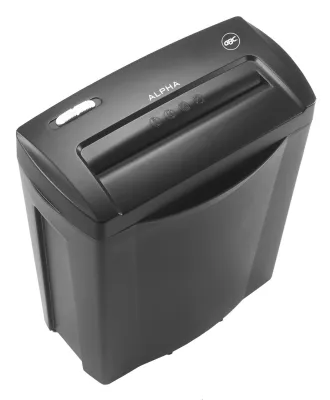
![[SG] A4 Multi-Functional Electric Paper Shredder with Built-in Basket](https://img.lazcdn.com/g/p/e13a5b4a0cd7800074c9a408a1f0b8e7.jpg_400x400q80.jpg_.webp)
Prices are valid at publication and may change. Please refer to the product page for the latest price.

Strip-cut machines typically fall under the P-1 and P-2 security levels. A P-1 shredder produces strips that are less than or equal to 12mm wide, while a P-2 shredder produces strips less than or equal to 6mm wide. Because a single sheet of A4 paper is sliced into only 30 to 40 long strips, anyone with sufficient time or basic reconstruction software can piece the document back together. Consequently, strip-cut machines are not recommended for confidential business or personal data.
Cross-cut machines generally span the P-3 and P-4 security levels, which represent the baseline for standard data protection compliance. A P-3 machine cuts paper into particles smaller than 320 square millimeters, while a P-4 machine reduces a single sheet of paper into roughly 400 tiny confetti-like pieces, each smaller than 160 square millimeters. This dramatic reduction in particle size makes reconstruction exceptionally difficult and time-consuming, satisfying the regulatory requirements for handling personal data under modern privacy laws.
For highly regulated industries, security levels P-5, P-6, and P-7 define the micro-cut category. These machines reduce a single sheet of paper into thousands of tiny, microscopic particles. While micro-cut machines offer near-impenetrable security, they operate at much slower speeds and require significant maintenance, making them less practical for everyday home or standard office environments unless strict compliance mandates it.
Strip-Cut Shredders: High Volume, Lower Security
Strip-cut shredders operate using a relatively straightforward mechanical design. The machine features a single set of rotating steel blades that slice paper vertically as it passes through the feed slot. This process results in long, continuous, spaghetti-like ribbons that run the entire length of the original page. Because the cutting mechanism only slices in one direction, the motor experiences minimal resistance, allowing for highly efficient performance metrics.
The primary advantage of a strip-cut machine is its processing speed and sheet capacity. Because the blades only make vertical cuts, these machines can pull multiple sheets of paper through the feed slot simultaneously without straining the motor. This makes them highly resistant to paper jams, as there are no horizontal cutting actions to slow down the feed rate. Additionally, strip-cut models are generally the most budget-friendly options on the market, with entry-level units typically priced between S$40 and S$120.
However, the trade-off for this speed and affordability is a significant reduction in security and waste efficiency. Because the resulting paper strips are long and intact, they do not compress well when they fall into the waste basket. The rigid ribbons create large air pockets and behave like springs, quickly filling the bin to its physical capacity. This means you will find yourself emptying the waste bin far more frequently than you would with a cross-cut model, even if you are shredding the same volume of paper.
These characteristics make strip-cut shredders ideal for specific, low-risk environments. They are highly suited for school classrooms disposing of non-sensitive drawing paper, large mailrooms handling bulk envelopes and non-confidential packaging materials, or homes where the primary goal is to reduce the bulk of junk mail and outdated newsletters before recycling.
Cross-Cut Shredders: The Balance of Security and Efficiency
Cross-cut shredders utilize a dual-axis cutting assembly to achieve a much higher level of security. Instead of a single set of straight blades, these machines feature two counter-rotating shafts with interlocking, notched steel rollers. As paper passes through, the blades slice the sheet both vertically and horizontally. This two-dimensional cutting action transforms a single sheet of paper into hundreds of tiny diagonal or rectangular particles, resembling confetti.
The foremost benefit of a cross-cut shredder is the peace of mind it provides when handling sensitive information. Because the document is broken down into tiny, scattered pieces, reconstructing the original text is virtually impossible without specialized forensic equipment. Furthermore, the small, flat particles settle densely within the waste bin, compacting naturally under their own weight. This efficient waste compaction means a cross-cut bin can hold up to three to five times more shredded paper than a strip-cut bin of the same physical volume, drastically reducing your trips to the recycling bin.
Despite these clear advantages, cross-cut machines do come with operational limitations. The complex dual-axis cutting action places a higher load on the motor, which generally results in a slower shredding speed and a lower sheet capacity per pass compared to strip-cut models. The increased friction between the interlocking blades also generates more heat, requiring the machine to take more frequent cooling breaks. Additionally, because paper dust can accumulate quickly in the tight tolerances of the blades, these machines require regular maintenance and carry a higher upfront cost, typically ranging from S$100 to S$350.
For most users, however, these trade-offs are well worth the investment. Cross-cut shredders are the ideal choice for home offices, human resource departments, medical clinics, and small businesses. They ensure that sensitive documents—such as employee records, payroll slips, customer invoices, tax filings, and medical histories—are destroyed in compliance with modern data protection standards.
Beyond the Cut: Key Features to Compare Before Buying
While choosing between a strip-cut and cross-cut mechanism is the most critical decision, several secondary specifications will directly impact how easily the machine integrates into your daily routine. Understanding these technical details will help you avoid common frustrations, such as frequent motor overheating or constant bin emptying.
Sheet Capacity and Continuous Run Time
When evaluating a shredder, the advertised sheet capacity indicates how many pages the machine can safely process in a single pass. It is important to note that manufacturers typically test this capacity using standard 80gsm paper. If you frequently shred thicker materials, such as 100gsm letterheads, heavy cardstock, or textured envelopes, the actual sheet capacity of the machine will decrease by roughly 20% to 30%. Forcing too many sheets into the feed slot at once will strain the motor and can lead to immediate paper jams.
Equally important is the machine’s continuous run time, also known as its duty cycle. This specification refers to how long the motor can run continuously before its internal thermal sensors trigger an automatic shutoff to prevent overheating. Entry-level models designed for light home use often have a run time of just 2 to 5 minutes, requiring a 20 to 30-minute cooling period afterward. In contrast, heavy-duty office models can run continuously for 10 to 45 minutes, making them far more suitable for bulk archival cleanups.
Waste Bin Capacity and Footprint
The physical size of the waste bin, typically measured in liters, determines how often you will need to empty the machine. However, as noted previously, the cut type dramatically influences how efficiently this space is used. Because cross-cut particles compress tightly, a 15-liter cross-cut shredder can often hold more shredded paper than a 25-liter strip-cut shredder, which fills up quickly with loose, springy ribbons.
When selecting a model, you must also consider the physical footprint of the unit and how it fits into your workspace. In space-constrained environments, such as a compact Singapore HDB flat or a shared office cubicle, a smaller footprint is highly desirable. Additionally, pay attention to the bin design: some models feature a lift-off head, where you must physically lift the heavy motor unit off the top to empty the bin, which can be messy. Models with a pull-out drawer bin are generally much easier and cleaner to empty in tight spaces.
Noise Levels and Space Constraints
The acoustic output of a paper shredder is measured in decibels (dB), and this rating can vary widely between different models. Most standard shredders operate within a range of 55 dB to 75 dB. Because the decibel scale is logarithmic, a machine operating at 70 dB will sound twice as loud to the human ear as one operating at 60 dB.
In shared environments, such as open-plan offices or residential apartments where walls and partitions are thin, noise travel can be a significant concern. A loud, grinding shredder can easily disrupt family members, neighbors, or colleagues during phone calls and virtual meetings. If you plan to use the machine in a quiet home environment or a shared workspace, prioritizing a model with a quiet-operation rating (ideally under 60 dB) will ensure a much more comfortable environment.
Maintenance and Safety Rules for Shredder Machines
Operating a paper shredder machine safely and maintaining it properly are essential steps to ensure the longevity of the device and prevent accidental damage or injury. Because shredders contain high-speed, sharp steel blades, implementing a few consistent habits will keep the machine running smoothly for years.
- Routine Maintenance: Due to the high friction generated by interlocking blades, cross-cut shredders require regular lubrication to function efficiently. You can oil the blades by applying specialized, non-aerosol shredder oil directly onto a sheet of paper in an "S" pattern and feeding it through, or by using pre-saturated lubricant sheets. Never use aerosol lubricants, WD-40, or standard household oils, as these can ignite under the high heat generated by the motor, creating a severe fire hazard.
- Clearing Jams Safely: If the machine experiences a paper jam, your first step should always be to turn off the power and unplug the unit from the wall outlet. Most modern machines feature a manual or automatic reverse function that can back the jammed paper out of the feed slot. If you must pull paper out manually, ensure the machine is completely disconnected from power, and never use metal tools, scissors, or screwdrivers to pry paper loose, as these can permanently chip or dull the steel cutting blades.
- Media Handling: Before attempting to shred non-paper items, always consult the manufacturer's instruction manual to verify the machine's capabilities. While many office-grade shredders can easily handle small staples and paperclips, feeding thick plastic credit cards, cardboard, or CDs into a standard paper slot can cause severe blade wear. If your machine is rated for these materials, utilize the designated media slot, which routes plastic and optical discs through a separate, heavy-duty cutting path.
- Safety Boundaries: Always keep the shredder unplugged when it is not in use, particularly in households with children or pets. When operating the machine, ensure that loose clothing, lanyards, ties, jewelry, and long hair are secured and kept far away from the feed slot. Position the machine on a flat, stable surface away from direct moisture or heat sources to maintain electrical safety.
Frequently Asked Questions (FAQ)
Can I upgrade a strip-cut shredder to cross-cut later?
No, it is not possible to upgrade a strip-cut shredder to a cross-cut model. The cutting mechanism, including the steel shafts and blade configurations, is a fixed, precision-engineered hardware assembly integrated directly into the motor housing. To change the cut type or increase your security level, you must purchase a completely new shredder machine designed with cross-cut or micro-cut blades.
How often should I oil my paper shredder?
As a general rule, you should oil a cross-cut shredder every time you empty the waste basket, or after approximately 30 minutes of cumulative shredding time. For light household use, lubricating the blades once a month is typically sufficient to maintain smooth operation. Strip-cut shredders require much less frequent oiling due to their simpler blade design, but they still benefit from occasional lubrication to reduce motor strain. Always refer to your specific manufacturer’s manual for model-specific guidelines.
Is a micro-cut shredder necessary for home use?
For the vast majority of home users, a standard P-4 cross-cut shredder provides more than enough security to protect against identity theft. It reduces sensitive personal documents, such as bank statements, utility bills, and medical records, into unreadable confetti that is virtually impossible to reconstruct. A micro-cut (P-5 or higher) shredder is generally only necessary if you regularly work from home handling highly classified government documents, proprietary corporate trade secrets, or legal discovery files subject to strict regulatory compliance.
Community discussion
Share your experience or ask a question. Comments are reviewed before publication.