
Japanese notebooks are highly regarded in the stationery community, but there is no single “best” paper for every user. The ideal choice depends entirely on your primary writing instruments, note-taking habits, and preference for tactile feedback. Rather than relying solely on brand reputation, evaluating paper quality requires understanding how weight, coating, and texture interact with different inks. This guide breaks down the core characteristics of popular Japanese paper types and provides a practical framework to help you match the right notebook to your specific writing needs.
Key Dimensions for Evaluating Notebook Paper Quality
To find the perfect notebook, you must look beyond brand names and marketing claims. Evaluating paper quality objectively requires analyzing several physical and chemical characteristics. By understanding these dimensions, you can predict how a notebook will handle your favorite pens before you even touch a pen to the page.
Weight (GSM)
Grams per square meter (GSM) measures the weight and density of the paper. While higher GSM often correlates with thicker, more opaque sheets, it is not the sole indicator of quality. In Japanese stationery, you will find highly engineered papers that range from an ultra-light 52 GSM to a substantial 100 GSM or more. The weight directly affects the overall thickness of the notebook, the page count, and how the paper feels in hand.
Products mentioned in this guide
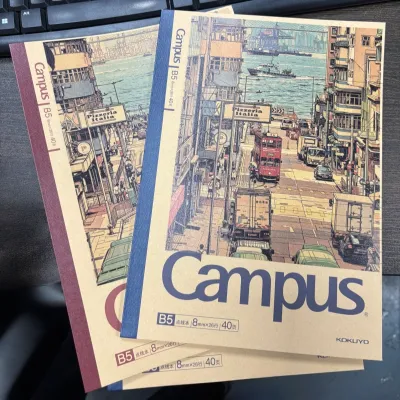
Prices are valid at publication and may change. Please refer to the product page for the latest price.
Surface Sizing and Coating
Sizing refers to the chemical treatments applied to paper fibers during manufacturing to control absorbency. Unsized paper acts like a sponge, pulling ink deep into the fibers and causing it to spread. Well-sized Japanese papers feature specialized coatings that keep liquid ink on the surface. This treatment prevents feathering—where ink bleeds outward in tiny branches—and preserves the crisp lines of your writing.
Texture and Tooth
The physical texture of the paper, often referred to as its “tooth,” determines the level of friction you feel when writing. Some papers are polished to a glassy smoothness, allowing pens to glide effortlessly. Others retain a slight roughness that provides tactile feedback. Your preference here depends on whether you enjoy a fast, slick writing experience or a controlled, tactile sensation.
Opacity and Show-Through
Opacity determines how much of your writing is visible from the reverse side of the page. Show-through, or “ghosting,” occurs when the shadow of your ink is visible on the back of the sheet, even if the ink has not physically broken through the fibers. True bleed-through occurs when the ink actually penetrates to the other side. Understanding the difference helps you decide if you can comfortably write on both sides of a page.
Common Japanese Paper Types and Their Typical Traits
Japanese paper manufacturing is renowned for its diversity, offering distinct categories of paper tailored to different writing styles. These categories are defined by their structural traits, fiber composition, and surface treatments.

Ultra-Thin High-Performance Paper
Engineered to maximize page capacity without adding bulk, ultra-thin high-performance paper typically ranges from 52 GSM to 68 GSM. Despite its lightweight nature, this paper is highly resistant to bleed-through due to advanced surface sizing. It is exceptionally smooth, allowing fountain pens to glide without catching. However, because the ink sits on top of the coated surface rather than soaking in, you must observe longer drying times to prevent accidental smudging. Ghosting is common with these thin sheets, which some users find charming and others find distracting.
Premium Textured and Archival Paper
Designed for distinct tactile feedback and longevity, premium textured paper often features a slightly higher GSM and a more pronounced tooth. These papers are crafted with high-quality wood pulp or cotton blends, offering excellent archival properties. The subtle texture provides resistance and control, making it highly satisfying for those who write with deliberate strokes. This paper handles dry media beautifully and resists feathering, though highly saturated inks may show less sheen compared to ultra-smooth alternatives.
Standard Everyday Woodfree Paper
Standard everyday woodfree paper is a highly versatile, cost-effective option optimized for rapid note-taking. Typically falling in the 70 GSM to 90 GSM range, this paper balances durability with standard notebook thickness. It is designed to absorb ink relatively quickly, making it highly compatible with ballpoint and gel pens. While it offers a reliable everyday writing experience, it may show limitations when paired with exceptionally wet fountain pens, broad nibs, or alcohol-based markers, which can overwhelm the fibers.
Matching Paper to Your Primary Writing Instruments
Selecting the right Japanese notebook requires matching the paper’s physical properties to the specific characteristics of your writing tools. Different inks and tips interact uniquely with various paper surfaces.
Fountain Pens
Fountain pens require paper with excellent surface sizing to prevent the liquid ink from feathering or bleeding through the page. If you prefer fine or extra-fine nibs, ultra-thin high-performance papers are excellent, as they showcase ink properties like shading and sheen beautifully. However, you must remain patient with drying times, especially when using wet inks or broader nibs. For everyday fountain pen use where quick drying is essential, look for moderately sized, smooth papers that balance absorption with bleed resistance.
Gel and Rollerball Pens
Gel and rollerball pens deposit a generous amount of water-based or gel ink onto the page. To prevent this ink from transferring to the opposite page when you close your notebook, prioritize papers with moderate absorption rates. Standard woodfree papers and slightly textured premium papers are ideal here, as they pull the ink into the fibers quickly enough to dry within seconds while maintaining clean, sharp lines without feathering.
Pencils and Mechanical Pencils
If your primary writing instrument is a graphite pencil or a mechanical pencil, ultra-smooth, highly coated papers can feel slippery and cause your writing to look faint. Instead, seek out paper with a slight tooth or texture. The physical friction of a textured paper shaves off microscopic amounts of graphite, resulting in darker, more legible lines. This texture also helps lock the graphite in place, reducing the risk of smearing when pages rub together.
Markers and Highlighters
Markers and highlighters, particularly those containing alcohol-based solvents, are highly prone to bleeding through standard paper. When using these tools, look for notebooks with a higher GSM or those specifically labeled as marker-friendly. If you are using standard or thin Japanese papers, you may need to restrict your writing to one side of the page or place a protective sheet behind your active page to prevent ink from ruining subsequent sheets.
Decision Framework: Choosing the Right Japanese Notebook
To finalize your choice, consider how your daily routine, writing tools, and tactile preferences align with the different paper types available.
Choose Ultra-Thin Paper If…
You prioritize high page counts, portability, and a lightweight notebook that can accompany you anywhere. This option is ideal if you primarily use fine-nib fountain pens, gel pens, or fine liners, and do not mind a bit of page ghosting or waiting a few extra seconds for your ink to dry. It is perfect for detailed journaling, planning, and long-form writing where notebook thickness matters.
Choose Premium Textured Paper If…
You prefer a tactile, controlled writing experience with physical feedback. This is the best choice if you write with pencils, mechanical pencils, or ballpoint pens, or if you enjoy the deliberate feel of a toothy surface under a fountain pen. It is highly suited for sketching, mixed-media journaling, and archival records where paper longevity and minimal ghosting are priorities.
Choose Standard Woodfree Paper If…
You need an affordable, reliable, and highly practical notebook for rapid note-taking, lectures, or office tasks. This paper is optimized for everyday ballpoint pens, standard gel pens, and highlighters. It offers fast drying times and a familiar feel, making it the most convenient option for quick, daily writing where you cannot afford to wait for ink to dry.
Verify First If…
You plan to use heavy wet inks, broad calligraphy nibs, or alcohol-based markers. These demanding media can easily overwhelm standard and thin papers, leading to significant bleed-through. In these cases, you will need to check the manufacturer’s specifications for high-density sheets or accept that you may need to use only one side of each page.
Practical Checks Before You Buy
Before committing to a new notebook, performing a few simple checks can save you from a disappointing writing experience.
First, read the manufacturer’s label or online product description carefully. Look for specific details such as the exact GSM, the paper composition (such as woodfree or cotton blend), and any explicit compatibility notes regarding fountain pens or specific ink types. Reliable stationery brands often provide detailed specifications about their paper’s performance characteristics.
Second, evaluate the binding style of the notebook. Whether a notebook is thread-sewn, wire-bound, or glue-bound directly impacts your writing comfort. For maximum usability, look for thread-sewn bindings that allow the notebook to lay completely flat on your desk. This ensures you can write comfortably across the entire page without fighting a curved spine.
Finally, consider purchasing a single notebook or a small paper sample pack—often costing under S$5—before buying in bulk or investing in an expensive planner. Testing your specific pens, inks, and writing pressure on a sample sheet is the only foolproof way to ensure the paper meets your personal standards and writing habits.
Frequently Asked Questions (FAQ)
Does higher GSM always mean better paper for fountain pens? (FAQ)
No, a higher GSM does not automatically guarantee that a paper will perform well with fountain pens. While thicker paper is less likely to show ghosting, its resistance to feathering and bleed-through depends almost entirely on surface sizing and coating. A highly engineered, well-sized 52 GSM paper can easily outperform an unsized 100 GSM paper, which may absorb ink like blotting paper and cause severe feathering.
How can I test a notebook's paper quality without ruining it? (FAQ)
To test a new notebook safely, use the very last page or an inconspicuous corner of a back page. Write a few test lines using your wettest pens, gel pens, and highlighters. Observe how quickly the ink dries, check for any feathering along the edges of the lines, and turn the page to inspect the reverse side for ghosting or physical bleed-through under direct light. This allows you to evaluate the paper’s limits without spoiling your main pages.

Community discussion
Share your experience or ask a question. Comments are reviewed before publication.