
Quick Answer: Finding the Best B5 Loose Leaf Paper for Your Needs
Selecting the ideal B5 loose leaf paper is not a matter of finding a single, universally superior brand. Instead, the best choice depends entirely on the specific writing instruments you use and your personal preference for tactile feedback. The B5 format (typically 176mm by 250mm) has become highly popular in Singapore as a practical middle ground, offering more writing space than a compact A5 notebook while remaining far more portable than a bulky A4 binder.
Premium stationery refills often feature highly calendered, heavily treated surfaces that offer an ultra-smooth writing experience designed to prevent wet inks from feathering or bleeding. Conversely, standard student refills and eco-friendly options prioritize quick drying times and physical grip, making them excellent for high-volume note-taking with standard gel pens, ballpoints, or pencils. Understanding these physical trade-offs will help you select a refill that keeps your notes neat, legible, and comfortable to read.
Core Dimensions for Evaluating Loose Leaf Paper Quality
To make an informed decision when comparing B5 loose leaf refills, you must look past marketing buzzwords and focus on verifiable physical specifications. The way a sheet of paper behaves under a pen tip is determined by several measurable characteristics that dictate its texture, thickness, and chemical treatment.
Products mentioned in this guide
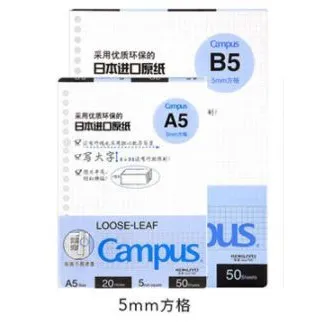
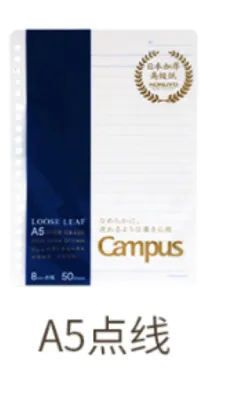
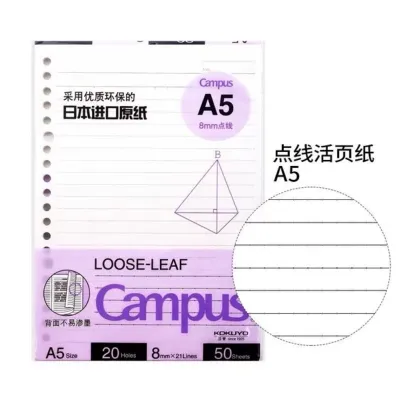
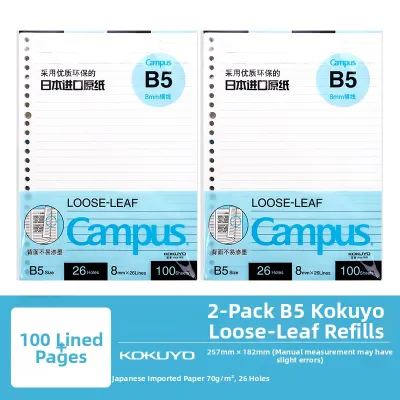
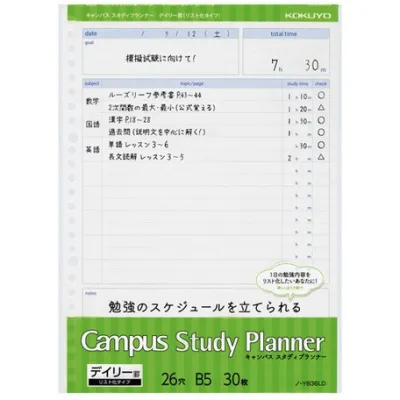
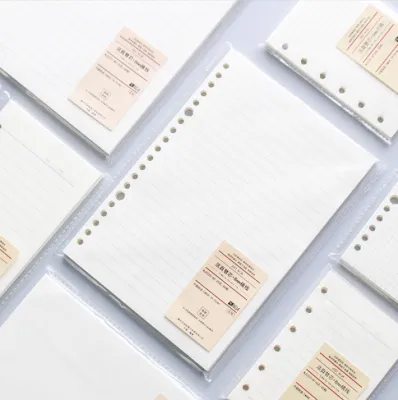
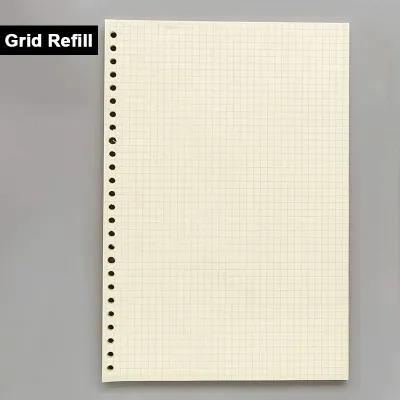
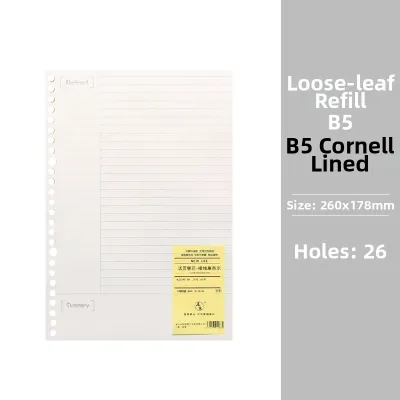
Prices are valid at publication and may change. Please refer to the product page for the latest price.

Weight and Thickness (GSM)
Weight and thickness are measured in grams per square meter (GSM), which is the standard metric used to evaluate paper density. Most B5 loose leaf refills available in the market range from 70 GSM to 100 GSM. A higher GSM indicates a thicker, heavier sheet that feels more substantial and resists tearing at the binder rings when pages are turned rapidly. However, a higher GSM also means your notebook will be heavier and bulkier, reducing the total number of sheets you can comfortably carry in a single binder. For daily use, a weight of 75 to 80 GSM is generally considered the optimal balance between durability and portability.
Surface Texture (Smoothness vs. Tooth)
The physical texture of a page ranges from glass-like smoothness to a rougher, more fibrous texture known as “tooth.” Highly smooth paper is achieved through a manufacturing process called calendering, where the paper is pressed between heavy metal rollers to flatten any surface irregularities. This minimizes friction, allowing pens to glide effortlessly across the page. Toothy paper, which is less heavily pressed, retains the natural texture of the plant fibers. This texture provides physical resistance that stabilizes your pen tip, giving you greater control over your handwriting and making it highly suitable for pencils and ballpoint pens.
Ink Resistance (Bleed-through and Feathering)
Ink resistance refers to a paper’s ability to hold wet ink on its surface without allowing it to spread or soak through the sheet. Bleed-through occurs when ink penetrates completely to the reverse side of the page, rendering it unusable for further writing. Feathering happens when ink spreads horizontally along the paper fibers, turning sharp lines into fuzzy, distorted shapes. A paper’s resistance to these issues depends heavily on “sizing,” a process where chemical agents are added to the pulp or applied to the surface to control absorbency. If you use wet writing tools, you must look for papers that feature robust sizing treatments.
Opacity and Show-through
Show-through, often called ghosting, is the optical shadow of your writing visible from the opposite side of the page, even when the ink has not physically bled through the fibers. High opacity is crucial for students and professionals who utilize both sides of a B5 sheet to maximize their notes and reduce paper waste. Opacity is determined by the density of the paper fibers and the presence of mineral fillers that block light. You can easily test this by placing a written sheet over a printed page; a high-quality, high-opacity refill will keep the writing on the reverse side virtually invisible under normal reading light.
Visual Comfort (Tint and Brightness)
The color of loose leaf paper can range from high-brightness stark white to warm, off-white cream and ivory tones. Stark white paper utilizes optical brightening agents (OBAs) to reflect a high amount of blue light, which provides high contrast for vibrant ink colors but can cause rapid eye fatigue during long sessions. Cream and ivory papers lack these heavy brighteners, absorbing more light and providing a softer contrast that is much gentler on the eyes. When selecting a refill for intensive studying or long-form journaling, the visual comfort of a warm cream tint is often superior to a bright white background.
How Leading B5 Brands Formulate Their Paper
Stationery manufacturers use different pulp mixtures, pressing methods, and sizing formulas to target specific writing styles and user preferences. Understanding how these formulations are categorized will help you identify the right product type for your daily routine.
Premium High-Smoothness Refills
Premium B5 refills, often manufactured using advanced Japanese paper-making technology, are engineered for an exceptionally smooth, low-friction writing experience. These papers undergo intensive calendering, resulting in a dense, polished surface that allows fountain pens, fine-liners, and liquid ink rollerballs to glide with almost zero resistance. The high fiber density and advanced surface sizing ensure that wet inks remain crisp and sharp, preventing any hint of feathering or bleed-through. This formulation is ideal for showcasing the unique properties of premium inks, such as color shading and metallic sheen.
However, this ultra-smooth, non-porous surface comes with a distinct trade-off: significantly longer ink drying times. Because the paper does not absorb liquid rapidly, water-based inks sit on the surface before drying. In Singapore’s humid climate, this can lead to accidental smudging if you close your binder too quickly or rest your hand on the page while writing. Writers who work quickly, take rapid lecture notes, or write left-handed should exercise caution and consider pairing these refills with fast-drying inks or utilizing blotting paper to prevent messy smudges.
Balanced Everyday and Student Refills
Balanced everyday refills represent the workhorse of the B5 loose leaf market, designed to provide reliable performance across a wide variety of common writing tools. Typically formulated at a weight of 75 to 80 GSM, these papers offer a moderate amount of surface texture that provides comfortable feedback without feeling rough. This slight grip helps control the pen tip, making it easier to maintain neat handwriting during fast-paced lectures or meetings. The paper is designed to absorb ink slightly faster than premium smooth options, which dramatically reduces drying times and minimizes the risk of smudging.
These refills are highly cost-effective and are usually sold in large bulk packs, making them the practical choice for high-volume note-taking. While they handle standard gel pens, ballpoints, and highlighters beautifully, they may struggle when subjected to extremely wet fountain pens or broad-nibbed markers, which can cause minor ghosting or feathering. For the vast majority of academic and professional tasks in Singapore, these balanced formulations provide the most versatile and reliable daily writing surface.
Eco-Friendly and Textured Options
Eco-friendly B5 refills are designed with sustainability in mind, utilizing recycled post-consumer waste, bamboo fibers, or agricultural byproducts such as bagasse. Because these alternative fibers are shorter and less uniform than virgin wood pulp, the resulting paper naturally possesses a highly tactile texture with a noticeable “tooth.” Writing on these sheets provides a distinct physical feedback and a satisfying acoustic hum, making the writing process feel organic and highly engaging.
The primary challenge with eco-friendly formulations is their high absorbency. Because these papers generally feature minimal chemical sizing and a more open fiber structure, they tend to act like a sponge when they come into contact with liquid. Wet inks, such as those from fountain pens or liquid rollerballs, will quickly feather along the fibers and bleed through to the other side. As a result, these sustainable options are best reserved for dry writing instruments, including graphite pencils, mechanical pencils, and standard oil-based ballpoint pens, where they offer outstanding control and a unique tactile experience.
Matching Paper Characteristics with Your Preferred Pens
To avoid frustration and wasted stationery, it is essential to align the physical characteristics of your B5 loose leaf paper with the ink delivery systems of your favorite pens.
Fountain Pens and Wet Inks
Fountain pens deposit a relatively large volume of water-based ink onto the page, requiring a paper that can handle liquid without allowing it to spread or soak through. To achieve clean, crisp lines, you must pair these pens with high-density, heavily sized, or coated papers. Look for refills that are explicitly labeled as fountain pen friendly or feature a high GSM combined with a smooth, calendered finish. These papers prevent the ink from penetrating the sheet, allowing it to dry slowly and display its full color depth, shading, and sheen without any feathering.
Gel Pens and Rollerballs
Gel pens and rollerballs utilize water-based or gelled inks that flow smoothly but require a paper that offers a moderate rate of absorption. If you write on an ultra-smooth, non-porous surface, the gel ink will pool on top of the page and remain wet for a long time, leading to frequent smudging. Conversely, if the paper is too absorbent, the ink will spread, causing fine-point pens to write with a much thicker line than intended. A balanced, medium-smoothness 80 GSM refill is the ideal partner for gel pens, providing a sharp, bleed-free line while allowing the ink to dry quickly enough for active note-taking.
Ballpoint Pens and Pencils
Ballpoint pens use a thick, oil-based ink paste that is transferred to the page through the physical rotation of a tiny metal ball, while pencils rely on the physical abrasion of graphite against the paper fibers. Both of these instruments require a certain amount of surface friction, or “tooth,” to function correctly. On an exceptionally smooth, coated page, a ballpoint pen may slip without the ball rotating, resulting in annoying blank spots and uneven ink delivery. Pencils will feel slippery and produce faint, light lines. For these dry writing tools, textured, eco-friendly, or standard everyday refills are actually superior, providing the necessary grip to ensure dark, consistent lines and effortless control.
Decision Framework: Which B5 Refills Should You Buy?
To simplify your purchasing decision, use the following conditional framework to match your writing style, tools, and environment to the correct B5 loose leaf refill.
- Choose Premium Smooth Refills if: You primarily write with fountain pens, broad gel pens, or wet liquid ink rollerballs and want to prevent feathering and bleed-through. These are ideal if you prioritize high opacity for double-sided notes and prefer a luxurious, low-friction writing feel where the pen glides effortlessly across the page.
- Choose Balanced Everyday Refills if: You are a student or professional who relies on standard gel pens, ballpoints, and highlighters for high-volume note-taking. These are best if you need a cost-effective, fast-drying paper that won't smudge when you turn the page quickly, and you want to maximize the number of sheets you can carry in your binder.
- Choose Eco-Friendly/Textured Refills if: Your primary writing tools are graphite pencils, mechanical pencils, or oil-based ballpoint pens. These are perfect if you enjoy a highly tactile writing experience with physical feedback from the page and want to support sustainable manufacturing practices.
- Verify First if: You are purchasing B5 refills in bulk from online marketplaces. Always check the exact hole-punch configuration; standard Japanese B5 loose leaf utilizes a 26-hole system, which is highly common in Singapore, but some binders use different regional spacing (such as 2-hole or 4-hole systems) that will not fit. Additionally, verify the manufacturer's stated GSM and paper color (cream versus stark white) to ensure the sheets match your visual preferences and binder capacity.
Frequently Asked Questions (FAQ)
Can I use standard A5 loose leaf paper in a B5 binder?
While the hole spacing of some multi-ring A5 papers may physically align with the center rings of a 26-hole B5 binder, using A5 paper in a B5 binder is highly impractical. The physical dimensions of A5 paper are significantly smaller than B5, leaving excessive empty space inside the binder cover and causing the pages to shift unevenly during use. This misalignment makes the pages difficult to turn and leaves the smaller sheets prone to bending, creasing, or tearing at the edges when the binder is carried in a bag. To maintain a neat, functional, and protective notebook setup, always match the paper size designation precisely to your binder size.
Does higher GSM always mean better paper quality for writing?
No, a higher grams per square meter (GSM) rating does not automatically guarantee a superior writing experience. While high-GSM paper is thicker and more opaque—making it excellent for reducing optical show-through—it also adds significant weight and bulk to your binder, reducing the total number of pages you can carry. For writing performance, surface treatments, internal sizing, and fiber density are far more critical than raw thickness. A well-sized 80 GSM paper can easily outperform an untreated 100 GSM paper by preventing ink feathering and bleed-through while keeping your binder light and highly portable.
Community discussion
Share your experience or ask a question. Comments are reviewed before publication.