
Selecting the right loose-leaf paper in Singapore involves looking beyond brand names and focusing on the physical characteristics of the paper itself. Because writing instruments interact uniquely with different paper fibers, a sheet that feels incredibly smooth under a ballpoint pen might cause a fountain pen to smudge or feather. Furthermore, Singapore’s tropical climate and high relative humidity can significantly alter how paper behaves over time, making factors like surface sizing and paper weight critical to your daily writing experience. By understanding the structural differences in paper manufacturing, you can easily identify which loose-leaf refills will perform reliably in your binders.
Rather than relying on subjective brand marketing, you can evaluate loose-leaf paper using objective, measurable criteria. The weight of the paper, the chemical treatments applied to its surface, and its visual brightness all play distinct roles in how your notes look and feel. Balancing these three dimensions allows you to match your paper to your specific academic or professional workload.
Key Dimensions for Evaluating Loose Leaf Paper
Paper weight is measured in grams per square meter, commonly abbreviated as GSM. This metric directly indicates the density and thickness of the paper sheet. Standard loose-leaf paper typically ranges from 70 GSM to 100 GSM. Lower-weight papers, such as 70 GSM, are thinner and lighter, making them highly portable for carrying large volumes of notes in a single binder. However, they are more prone to ghosting—where writing on one side is visible on the reverse—and may tear easily under heavy pressure. Heavier papers, ranging from 80 GSM to 100 GSM, offer greater opacity and structural integrity, allowing you to write on both sides of the page without distracting ink show-through.
Products mentioned in this guide
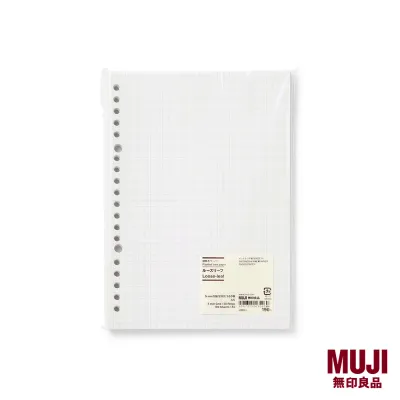
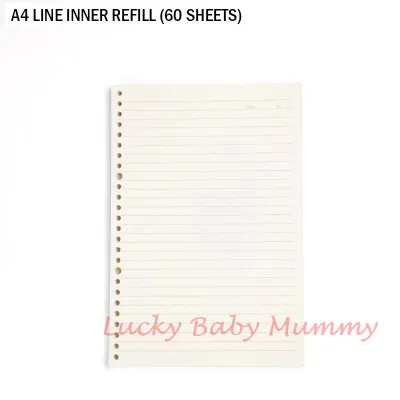
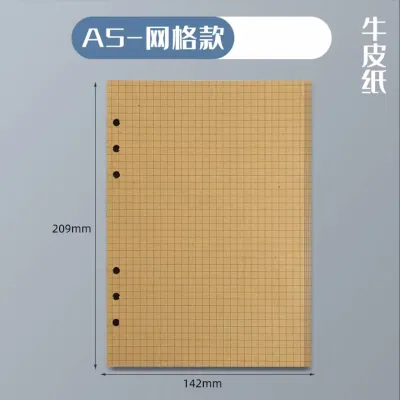
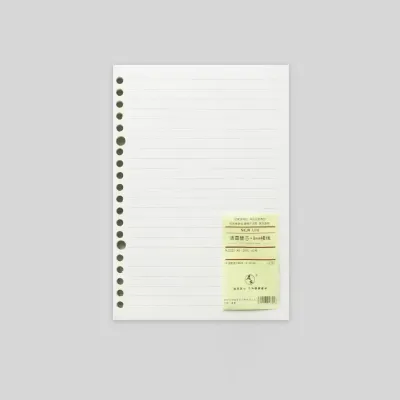
Prices are valid at publication and may change. Please refer to the product page for the latest price.
Surface sizing and coating represent the chemical treatments applied to paper during the manufacturing process. Sizing controls how water-resistant the paper is, which directly dictates how quickly it absorbs liquid ink. Highly sized papers have a protective barrier that keeps ink on the surface, resulting in sharp, crisp lines with minimal spreading. Uncoated or lightly sized papers allow ink to penetrate deeper into the fibers, which speeds up drying times but can cause the ink to spread outward, a phenomenon known as feathering. The level of surface coating also determines the paper’s texture, ranging from glass-like smoothness to a tactile, toothy grip.
Visual brightness and the use of optical brightening agents affect eye comfort during long study or writing sessions. Many standard white papers are treated with these chemical agents to reflect more blue light, making the paper appear brilliantly white. While this provides high contrast for black or blue inks, it can lead to significant eye strain under bright fluorescent classroom or office lights. Off-white, cream, or ivory-colored loose-leaf sheets bypass these heavy chemical treatments, offering a softer contrast that is much gentler on the eyes over extended periods of reading and writing.
Matching Paper Properties to Your Ink and Pen Type
Gel and rollerball pens utilize water-based or gelled inks that require a careful balance of paper properties. Because these inks are highly fluid, writing on extremely smooth, heavily coated paper can result in slow drying times, leading to accidental smudging as your hand moves across the page. This issue is often compounded by humid environments, where moisture in the air slows evaporation. For gel pens, look for moderately sized paper around 80 GSM that offers a slightly faster absorption rate while maintaining enough surface smoothness to prevent the pen tip from catching on the paper fibers.

Fountain pens and wet ink markers demand high-quality, heavily sized paper to perform correctly. When wet ink is applied to poorly sized paper, the capillary action of the wood fibers pulls the ink outward, creating fuzzy, distorted lines. To preserve the crispness of your handwriting and showcase advanced ink properties like shading or metallic sheen, you need a dense paper—ideally 80 GSM to 100 GSM—with a high level of surface sizing. This keeps the ink pooled on top of the sheet as it dries, preventing both feathering and bleed-through to the back of the page.
Ballpoint pens and graphite pencils require a completely different paper profile, relying on surface friction to function. Ballpoint pens use a thick, oil-based ink that is transferred via a rotating tiny ball at the tip, which requires a certain amount of physical resistance to spin smoothly. Pencils rely on the abrasive texture of the paper to shave off microscopic particles of graphite. If the paper is too slick or heavily coated, ballpoint pens will skip, and pencils will struggle to leave a dark, legible mark. For these dry writing tools, a standard, uncoated 70 GSM to 80 GSM paper with a natural, slightly toothy texture is the most effective and economical choice.
Before purchasing a large quantity of loose-leaf paper, you can perform simple, observable tests at home to verify compatibility with your favorite pens. Draw a series of heavy lines and solid shapes on a single sheet, then check the reverse side for any signs of ink bleeding through the paper fibers. To test drying speed, write a quick sentence and swipe your finger across the ink at intervals of three, five, and ten seconds. Finally, hold the written page up to a window or a bright light source to evaluate the level of ghosting, ensuring that double-sided note-taking will remain perfectly legible.
Verifying Punch Patterns and Binder Compatibility
Physical compatibility with your binder system is just as important as ink performance. Loose-leaf paper is manufactured in several distinct hole-punch configurations, and choosing the wrong standard will prevent the sheets from fitting into your binder. The most common multi-hole standards found in local stationery shops are designed for A5, B5, and A4 paper sizes. Typically, A5 loose-leaf sheets feature 20 holes, B5 sheets feature 26 holes, and A4 sheets feature 30 holes. These multi-ring systems distribute the mechanical tension of page-turning across dozens of points, significantly reducing the risk of the paper tearing out of the binder.
You must also pay close attention to the margin widths and the physical diameter of the punched holes. If the holes are punched too close to the outer edge of the paper, the thin strips of paper remaining can easily tear under the weight of a full binder. Conversely, if the holes are too small or misaligned with the binder rings, the pages will bind and crumple when you try to turn them. Ensure that the paper you select leaves a comfortable margin of blank space on the inner edge so that your written notes are not obscured or crowded by the binder rings themselves.
Always verify that the physical dimensions of the loose-leaf paper match the regional standards of the binder you own. While international ISO sizes like A4 and A5 are universally standardized, some proprietary binder systems use unique hole spacings or non-standard sheet dimensions. For example, certain smart-ring binders or disc-bound systems require specialized punch shapes that are incompatible with standard round-hole refills. Checking the exact specifications of your binder rings before buying refills prevents the frustration of owning paper that cannot be securely bound.
Decision Framework: Selecting the Best Loose Leaf Option
To simplify your purchasing decision, you can categorize your needs into three primary writing profiles. If you are a fast-paced note-taker who relies heavily on gel pens, your priority should be a balance of smoothness and quick drying times. Look for 80 GSM paper with light surface sizing. This specification allows the water-based ink to set quickly enough to prevent smudging during rapid writing, while still providing a smooth surface that allows your pen to glide effortlessly across the page.
If you write with fountain pens, liquid rollerballs, or wet ink highlighters, you should prioritize heavy, highly sized paper. Seek out options labeled as 90 GSM to 100 GSM that explicitly mention bleed resistance or high-density fibers. This premium paper structure ensures that wet inks remain crisp and vibrant on the surface without seeping through to the other side, allowing you to utilize both sides of every sheet for detailed, long-term archiving.
For high-volume, everyday writing using standard ballpoint pens or mechanical pencils, a budget-friendly, uncoated paper is the most practical choice. Standard 70 GSM to 80 GSM uncoated sheets provide the necessary surface friction for reliable pigment transfer without skipping. These packs are highly economical, often costing only a few S$ for a large bundle, making them ideal for rough drafts, mathematical calculations, and temporary study notes.
Regardless of which category you fall into, the safest approach is to purchase a single refill pack to test with your specific writing tools before committing to a bulk purchase. Set up your binder, write a few test pages under your typical working conditions, and observe how the paper handles your writing pressure and ink flow. This hands-on verification ensures that your final stationery setup is perfectly tailored to your personal writing habits.
Frequently Asked Questions (FAQ)
Can I use standard hole-punchers to convert regular paper into loose leaf?
Standard office hole-punchers typically create two or three large holes designed for traditional ring binders, which do not align with the 20, 26, or 30-ring multi-hole binders popular for loose-leaf systems. Attempting to manually punch multi-hole patterns with a single-hole punch is highly inefficient and often results in misaligned pages that bind or tear. If you want to convert custom paper, you should invest in a dedicated multi-hole puncher designed specifically for A5, B5, or A4 standards, and ensure you do not exceed the puncher’s sheet capacity to maintain clean, tear-resistant edges.
How should I store loose leaf paper to prevent curling or moisture damage?
In Singapore’s humid climate, loose-leaf paper can easily absorb moisture from the air, causing the edges to curl, the paper to sag, and ink to feather more severely over time. To prevent this, store your unused loose-leaf sheets inside their original plastic packaging or transfer them to a sealed, moisture-resistant plastic folder. Keep your storage boxes away from open windows, air conditioning vents, and direct sunlight, as rapid temperature fluctuations can warp the paper fibers. Adding a few food-safe silica gel packets to your paper storage drawer is also an effective way to absorb excess ambient moisture and keep your sheets perfectly flat.

Community discussion
Share your experience or ask a question. Comments are reviewed before publication.