
Selecting the right Casio calculator for your child in Singapore depends entirely on their current educational stage and the specific requirements of the national curriculum. For primary school students in Primary 5 and 6, a basic scientific or approved simple calculator is introduced to assist with complex problem-solving. As students progress to secondary school, a robust scientific calculator becomes mandatory for handling algebraic, trigonometric, and statistical functions in O-Level and N-Level examinations. For those entering Junior College (JC) or pursuing advanced mathematics in polytechnics, a high-performance graphing calculator is required to plot functions, analyze matrices, and solve complex equations.
By understanding the specific mathematical demands of each academic level, parents can make informed purchasing decisions that support their child’s learning journey. Choosing the correct device ensures compliance with school regulations and national exam guidelines while providing students with the exact tools they need to succeed in their assessments.
Calculator Expectations Across Singapore's Education Levels
The Singapore education system introduces calculators gradually to ensure students first build a strong foundation in mental arithmetic and manual calculation. In primary schools, calculators are strictly prohibited in lower primary levels (Primary 1 to Primary 4). This policy encourages younger students to master basic operations, place values, and mental sums before relying on electronic aids. Calculators are officially introduced in the Primary 5 and Primary 6 mathematics curriculum, where they are permitted for specific papers in school assessments and the Primary School Leaving Examination (PSLE).
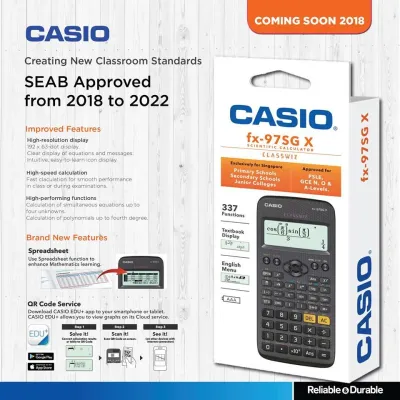
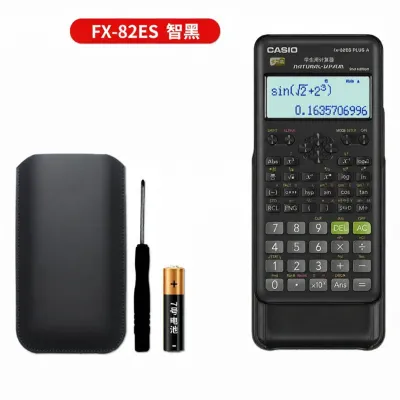
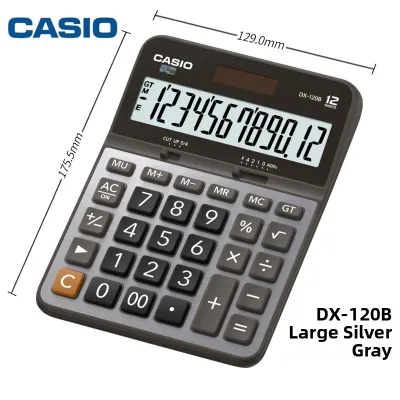
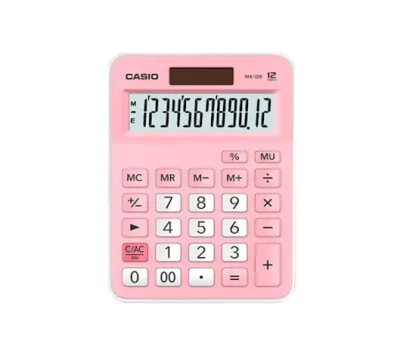
Products mentioned in this guide
![[SG] Casio Mini Desk MX-12B Calculator LIMITED QTY [Evergreen Stationery]](https://img.lazcdn.com/g/p/7b0ac9aa73e963c084acea482721b3bc.png_400x400q80.png_.webp)
![[SG] DDD Casio SL-310UC Portable 10-Digits Calculator [Evergreen Stationery]](https://img.lazcdn.com/g/p/f47d3a10d227ffd65191ecab57f45e6b.jpg_400x400q80.jpg_.webp)
Prices are valid at publication and may change. Please refer to the product page for the latest price.
At the primary level, the objective of using a calculator is to allow students to focus on mathematical logic, problem-solving strategies, and heuristic concepts rather than spending excessive time on tedious, multi-digit computations. The calculators used at this stage are basic scientific models that handle standard arithmetic, fractions, and simple decimals. Parents should avoid purchasing overly complex devices for primary students, as unnecessary features can confuse young learners and may not be permitted in the exam hall.
Upon entering secondary school, the mathematical landscape changes significantly. From Secondary 1 through Secondary 4 or 5, students encounter algebra, geometry, trigonometry, and data analysis. A scientific calculator is an absolute necessity for daily lessons, homework, and national examinations such as the GCE N-Level and O-Level exams. These calculators must support a wide range of functions, including trigonometric ratios, logarithms, exponential functions, and statistical calculations.
For students progressing to Junior College or pursuing specific diploma courses in polytechnics, the mathematical requirements become highly advanced. The GCE A-Level curriculum, particularly for H1 and H2 Mathematics, mandates the use of a graphing calculator. These sophisticated devices feature large screens capable of plotting coordinate graphs, solving systems of linear equations, and performing complex matrix calculations. Standard scientific calculators remain useful for quick calculations, but they cannot replace the graphing capabilities required for pre-university mathematics.
Verifying SEAB-Approved Models for National Exams
The Singapore Examinations and Assessment Board (SEAB) maintains strict regulations regarding the use of calculators in national examinations. To maintain exam integrity and fairness, only specific, pre-approved calculator models are allowed into the examination halls for the PSLE, GCE N-Level, O-Level, and A-Level exams. Using an unapproved, modified, or programmable calculator with prohibited features can lead to severe penalties, including disqualification from the paper.

Parents and students must verify their calculator’s eligibility by consulting the official SEAB website, which publishes an updated list of approved calculator models annually. When purchasing a device, it is critical to match the exact model number printed on the calculator’s casing or packaging with the registry. Even minor variations in model suffixes, such as letters indicating regional editions or minor feature updates, can determine whether a device is compliant or banned.
During national examinations, invigilators conduct physical inspections of all calculators before the papers begin. Approved calculators must not have any unauthorized writing, formulas, or notes written on their protective covers or bodies. Furthermore, any calculator brought into the exam hall must be in its original, unmodified state, with no external communication capabilities or unauthorized software installed.
For graphing calculators used in Junior College exams, the rules are even more stringent. Students are required to clear the device’s user memory and reset the calculator to its default factory settings before entering the examination room. Many approved graphing calculators feature a specific “exam mode” that temporarily disables access to stored files, programs, and custom applications. Invigilators verify this status by checking for a specific flashing LED light or an on-screen indicator on the device during the exam.
Comparing Casio Calculator Types for Different Math Syllabuses
To choose the right tool for your child, it is helpful to compare the core functional tiers of Casio calculators and match them to the specific demands of the Singapore mathematics syllabuses.
Basic and Entry-Level Scientific Calculators
These models are designed with a simple, user-friendly layout featuring large buttons and clear, easy-to-read displays. They are highly suitable for upper primary students who are learning to integrate technology into their math problem-solving. These devices focus on standard arithmetic operations, percentage calculations, and basic fraction-to-decimal conversions. They provide a gentle introduction to digital calculation without overwhelming young students with advanced scientific keys that they do not yet understand.
Advanced Scientific Calculators
This tier represents the standard workhorse for secondary school students. These calculators feature multi-line displays, often utilizing natural textbook display technology. This feature allows fractions, square roots, exponents, and algebraic expressions to appear on the screen exactly as they are written in textbooks, significantly reducing input errors. These models support advanced functions such as prime factorization, coordinate conversions, trigonometric equations, and basic statistical distributions, making them perfect for the O-Level and N-Level syllabuses.
Graphing Calculators
Designed for pre-university and tertiary education, graphing calculators feature high-resolution screens and powerful processors. They allow students to input multiple equations simultaneously, plot detailed graphs, find intersection points, and analyze functions dynamically. These devices also handle advanced matrix algebra, complex numbers, and in-depth statistical regressions. While they represent a larger financial investment, their advanced capabilities are indispensable for mastering the rigorous H1 and H2 Mathematics syllabuses in Junior College.
Practical Purchasing and Setup Tips for Students
Acquiring the correct calculator is only the first step; preparing the device for daily classroom use and high-stakes examinations is equally important for a smooth academic year.
- Purchase from Reliable Sources: To ensure you are buying an authentic, SEAB-compliant device with a valid local warranty, purchase calculators from official school bookshops, authorized local stationery retailers, or official brand stores on reputable online marketplaces. Avoid buying parallel imports or unverified models online, as they may feature different firmware versions that are not approved for use in Singapore exams.
- Engrave or Label the Device: In a classroom environment where dozens of students use identical Casio models, calculators are frequently misplaced, lost, or accidentally swapped. It is highly recommended to engrave the student's name and class on the back of the calculator casing or use a durable, heat-resistant label maker. Avoid using paper stickers that can easily peel off or smudge over time.
- Manage Power and Batteries: Different calculator models rely on different power sources. Many scientific calculators use a combination of solar power and a backup button cell battery, while graphing calculators typically require AAA batteries or rechargeable lithium-ion battery packs. Ensure your child carries a fresh set of spare batteries in their pencil case, especially during examination periods, and knows how to replace them quickly if needed.
- Learn the Initial Settings: Students should familiarize themselves with the basic settings of their calculator as soon as they receive it. This includes knowing how to adjust the screen contrast for different lighting conditions, switching between degree and radian modes for trigonometry, and performing a hard reset to clear temporary memory errors. Teachers will often guide students through these settings during the first week of school.
Frequently Asked Questions (FAQ)
Can a Secondary School Scientific Calculator Be Used in Junior College?
While a secondary school scientific calculator is still permitted and highly useful for quick, basic arithmetic in Junior College, it cannot replace the graphing calculator required for the A-Level curriculum. The H1 and H2 Mathematics syllabuses specifically require students to plot functions, analyze graphs, and solve complex matrix equations, which can only be done on an approved graphing calculator. Therefore, JC students will need to acquire a graphing calculator while keeping their scientific calculator as a handy secondary device.
When Should Parents Buy a New Calculator for the School Year?
The best time to purchase a new calculator is during the year-end school holidays, typically between November and January. This period aligns with the distribution of official school booklists, ensuring you receive the exact model recommended by your child’s school. Additionally, authorized stationery retailers and school bookshops often run back-to-school promotions during this time, making it a cost-effective window to secure the necessary equipment before classes commence.
Community discussion
Share your experience or ask a question. Comments are reviewed before publication.