
Determining if the Casio fx-97SG X is the right calculator for your child depends on their specific secondary school grade and the exact requirements of their mathematics syllabus. While it is a popular choice among students in Singapore, parents and students must verify its suitability against the school’s curriculum and the Singapore Examinations and Assessment Board (SEAB) regulations before making a purchase. This guide will help you evaluate whether this model meets your child’s academic needs and exam compliance standards.
Choosing the correct scientific calculator is a critical step in preparing your child for the academic rigours of secondary school. In Singapore, the mathematics curriculum transitions rapidly from basic arithmetic to complex algebraic, trigonometric, and statistical concepts. Having a tool that aligns perfectly with these classroom demands ensures your child can focus on learning mathematical principles rather than struggling with an incompatible device.
The Casio fx-97SG X is specifically designed with the local curriculum in mind, but its utility varies depending on whether your child is entering Lower Secondary or preparing for national examinations in Upper Secondary. By understanding how to match the calculator’s features with syllabus milestones, you can make an informed decision that supports your child’s academic journey without unnecessary upgrades.
Products mentioned in this guide
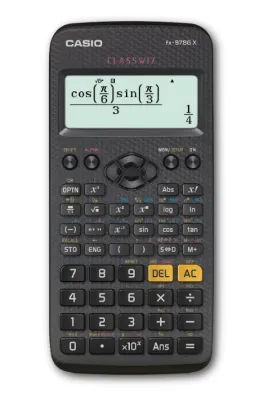
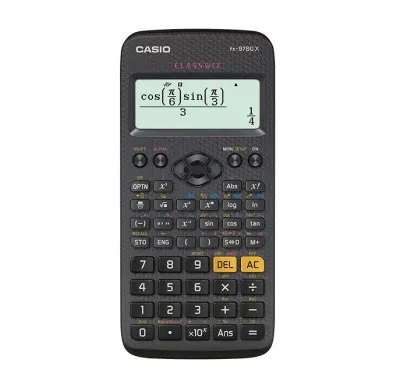
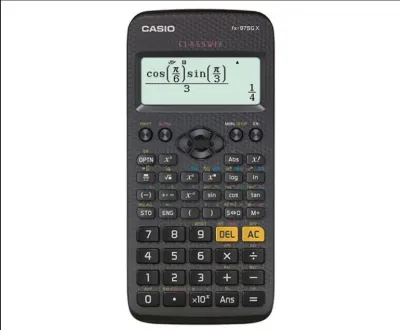

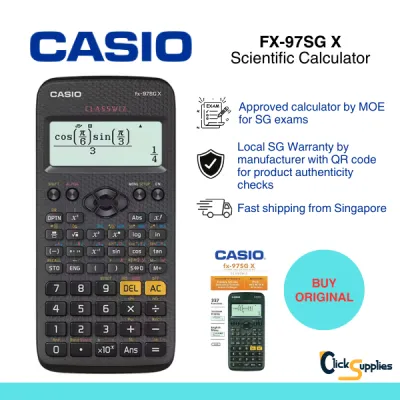
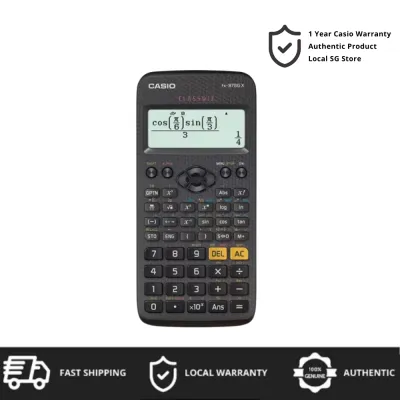
Prices are valid at publication and may change. Please refer to the product page for the latest price.
Understanding Secondary School Math Requirements in Singapore
The transition from primary to secondary school mathematics introduces a significant shift in the complexity of topics covered. In Lower Secondary (Secondary 1 and 2), students move beyond basic arithmetic to explore fundamental algebraic manipulation, linear equations, basic geometry, and introductory trigonometry. At this stage, a reliable scientific calculator must handle basic fraction-to-decimal conversions, square roots, and trigonometric functions like sine, cosine, and tangent.
As students progress to Upper Secondary (Secondary 3 to 5), the mathematical demands branch into more specialized pathways, such as Additional Mathematics (A-Math) and Elementary Mathematics (E-Math). These subjects require advanced capabilities, including quadratic equation solvers, simultaneous equations, statistical regression, probability distributions, and matrix calculations. If your child’s calculator lacks these advanced functions, they will face severe disadvantages during timed assessments and daily homework.
To determine the exact requirements for your child’s grade, parents should carefully review the school’s specific mathematics syllabus and booklist. Schools often distribute a detailed stationery list at the start of the academic year, which specifies the approved calculator models for each stream. Checking these documents early prevents the mistake of purchasing a basic model when an advanced scientific calculator is required.
It is also essential to distinguish between standard scientific calculators and advanced graphing calculators. Standard scientific calculators, like the Casio fx-97SG X, display mathematical expressions in a non-graphical format and are the standard requirement for secondary school national exams. Graphing calculators, which feature large screens capable of plotting curves and analyzing functions visually, are typically reserved for Junior College (A-Level) students and are generally not permitted in secondary school classrooms unless explicitly stated by the school.
Evaluating the Casio fx-97SG X Against Grade-Level Needs
When evaluating whether the Casio fx-97SG X matches your child’s academic level, the first step is to inspect the official product packaging and user manual. Look for a comprehensive list of built-in functions to verify that the device supports equation solving, statistical calculations, and matrix operations. These features are particularly vital for Upper Secondary students who must solve complex algebraic equations quickly during exams.

The interface and display capabilities of the calculator play a major role in how easily a student can digest complex mathematical problems. Modern scientific calculators often feature a high-resolution display that presents fractions, surds, and formulas exactly as they appear in standard textbooks. This natural display format helps students verify their inputs at a glance, reducing simple entry errors that can lead to incorrect answers in high-pressure exam environments.
Another critical factor to evaluate is whether the calculator supports the specific mathematical notation and modes required by classroom teachers. For instance, students must frequently toggle between degree and radian modes when solving trigonometric problems in Additional Mathematics. Confirming that the device has intuitive menu navigation for these settings allows your child to transition smoothly between different topics without losing valuable time searching through complex submenus.
For Lower Secondary students, a highly advanced calculator might feature more menus than they currently need, but it offers room to grow. Purchasing a model that covers both Lower and Upper Secondary requirements means your child will not have to learn a completely new keyboard layout and menu system when they transition to more advanced topics in Secondary 3. Familiarity with a single device over four to five years builds speed and confidence.
Verifying Exam Compliance and School Policies
Before your child brings any calculator into a classroom or examination hall, you must verify its compliance with national guidelines. The Singapore Examinations and Assessment Board (SEAB) maintains a strict list of approved calculators for use in national examinations, including the GCE O-Level, N-Level, and A-Level exams. Using a non-approved model can result in disqualification, making it imperative to cross-reference your purchase with the official SEAB website.
School-specific policies can sometimes be even stricter than national guidelines. Some schools may restrict certain models in Lower Secondary to encourage students to master mental calculations and manual algebraic steps first. Additionally, any calculator with programmable memory, wireless communication capabilities, or computer algebra systems (CAS) is strictly prohibited in standard secondary school mathematics examinations to maintain academic integrity.
During major examinations, invigilators follow standard protocols to inspect every student’s calculator before they are allowed to begin writing. This process typically involves clearing the device’s temporary memory to ensure no pre-saved formulas or notes are stored. Students must know how to perform this memory-reset function quickly, as invigilators will often ask them to demonstrate the reset sequence or perform it on their behalf prior to the start of the paper.
To ensure your child is prepared for these checks, encourage them to practice the memory-clearing key sequence at home. This sequence is usually printed on the back of the calculator casing or detailed in the user manual. Familiarity with this procedure prevents unnecessary anxiety on the day of the exam, allowing the student to focus entirely on the test questions.
Practical Tips for Buying and Setting Up the Calculator
To ensure you are purchasing an authentic and fully compliant calculator, always buy from authorized stationery retailers, official brand stores, or established school bookstores. Counterfeit calculators are common on unauthorized online marketplaces, and they often suffer from poor build quality, inaccurate calculation algorithms, or missing functions that can fail during critical school assessments.
When shopping, pay close attention to the exact model designation, specifically looking for the “SG” suffix in the model name. This suffix indicates that the calculator has been customized and approved for the Singapore educational market, aligning with the local syllabus and meeting SEAB requirements. Purchasing an international version of the same model series might mean missing specific localized features or failing to meet exam compliance standards.
Once you have purchased the calculator, complete a basic pre-school setup checklist with your child. First, verify the battery status; many modern scientific calculators utilize a dual-power system combining solar panels with a backup button battery. Ensure the display contrast is adjusted correctly for classroom lighting, and have your child write their name clearly on the protective slide-on cover using a permanent marker to prevent accidental mix-ups with classmates.
Finally, give your child time to familiarize themselves with the physical keypad layout before the school term begins. Let them practice basic operations, locate the fraction key, and understand how to access secondary functions using the shift or alpha keys. This early hands-on practice ensures they can keep pace with the teacher’s instructions from the very first day of class.
Frequently Asked Questions (FAQ)
How can I confirm if the Casio fx-97SG X is approved for national exams?
To confirm if the Casio fx-97SG X is approved, visit the official SEAB website and download the latest list of approved calculators for national examinations. This list is updated periodically to reflect new models and regulatory changes. Additionally, you should consult your child’s school mathematics department or check the school’s internal handbook, as teachers can provide immediate confirmation regarding classroom and local assessment rules.
What should I do if the school requires a different calculator model?
If your child’s school requires a different calculator model, check the recommended stationery list before unboxing or using the device. Keep the original packaging, receipt, and warranty card completely intact. Most authorized stationery retailers and school bookstores will allow an exchange for a different approved model within their specified return window, provided the item is in pristine, resalable condition.
Community discussion
Share your experience or ask a question. Comments are reviewed before publication.