
Finding the right bubble wrap in Singapore requires balancing physical protection with cost efficiency. While many buyers focus solely on brand names or the cheapest roll on the shelf, true value depends on your specific shipping volume, item fragility, and storage constraints. In Singapore’s compact urban environment, where storage space is at a premium and humidity levels regularly exceed 80%, buying the largest bulk roll is not always the smartest financial or operational decision.
For lightweight, non-fragile items like books, apparel, or cosmetics, standard small-bubble rolls (typically 10mm bubble diameter) offer the most cost-effective cushioning. Conversely, high-value electronics, fragile glassware, and heavy industrial components require large-bubble rolls (25mm diameter) or heavy-duty, high-micron films to prevent bottoming out during transit. Bulk purchasing from industrial packaging distributors in areas like Ubi or Jurong significantly reduces the per-meter cost, but you must weigh these savings against the physical space required to store bulky rolls and the risk of material degradation in non-air-conditioned spaces. Always verify the manufacturer’s technical specifications—such as film thickness and bubble height—before purchasing, rather than relying on generic marketing terms like “extra strong.”
What Determines Protection Quality: Bubble Size, Thickness, and Material
To objectively compare bubble wrap brands, you must look past branding and understand the underlying physical specifications that dictate performance. The protective capability of any bubble wrap is governed by three primary factors: bubble size, film thickness, and material composition.
Products mentioned in this guide
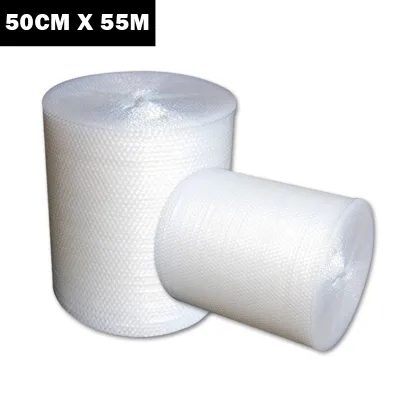
Prices are valid at publication and may change. Please refer to the product page for the latest price.
Bubble Diameter and Cushioning Depth
The physical size of the bubble determines its cushioning depth and shock-absorption capacity.
- Small Bubbles (10mm diameter, 3mm to 4mm height): These are designed for surface protection and light cushioning. They excel at wrapping tightly around small, intricate items, preventing scratches, and providing basic impact resistance. However, because the air volume in each bubble is low, they can easily pop or compress fully under heavy loads.
- Large Bubbles (25mm to 30mm diameter, 10mm to 12mm height): These provide substantial void fill and drop protection. They are ideal for lining shipping boxes, wrapping heavy items, and absorbing high-impact shocks. However, they are less flexible, making them difficult to wrap around small or oddly shaped objects.
Film Thickness and Puncture Resistance
The thickness of the plastic film—measured in microns (µm) or mils—directly influences the wrap’s tear strength and puncture resistance. Standard-grade bubble wrap typically uses a film thickness of 30 to 40 microns, which is suitable for general retail shipping. Heavy-duty grades utilize 50 to 80 microns or more. Thicker films resist popping when subjected to sharp corners or high pressure, but they also require more force to wrap and secure, which can slow down high-volume packing lines.
Material Composition: Virgin vs. Recycled Polymers
Most bubble wrap is manufactured from Low-Density Polyethylene (LDPE).
- Virgin LDPE: Provides maximum elasticity, clarity, and air retention. The plastic is highly uniform, allowing the bubbles to retain their air pressure over long transit times or extended storage periods.
- Recycled LDPE: Many brands now offer eco-friendly options containing 30% to 100% recycled content. While excellent for sustainability goals, recycled plastic can sometimes have minor structural inconsistencies, slightly lower puncture resistance, and a more opaque appearance. If you choose recycled options, verify that the manufacturer uses high-quality co-extruded barrier films to prevent premature air loss.
Practical Verification Method
Do not rely on visual estimates when comparing brands. Request a technical data sheet from the supplier or check the product packaging for explicit metrics. Look for the “gsm” (grams per square meter) rating, which indicates the density of the material, alongside the bubble dimensions. A higher gsm rating at the same bubble size indicates a thicker, more durable film. Remember that protection is highly situational; a premium, high-micron small-bubble wrap may protect a metal tool from scratching but will fail to protect a ceramic vase from a drop, whereas a standard-grade large-bubble wrap would succeed.
How Pricing Works: Roll Length, Width, and Bulk Options
Navigating the pricing of packaging materials in Singapore requires a shift from looking at the “price per roll” to calculating the “price per usable unit.” Suppliers use various roll lengths, widths, and bulk packaging structures that can easily obscure the true cost of the material.

Calculating Price per Meter and Square Meter
Bubble wrap rolls are sold in various standard lengths, such as 30 meters, 50 meters, and 100 meters. A roll priced at S$12 might seem like a bargain compared to one priced at S$25, but if the cheaper roll is only 30 meters long and the more expensive one is 100 meters, the latter is significantly more cost-effective. To compare options accurately, use these simple formulas:
- Price per Linear Meter = Total Roll Price / Roll Length (in meters)
- Price per Square Meter = Total Roll Price / (Roll Length x Roll Width in meters)
For example, a roll measuring 0.5 meters wide and 100 meters long yields 50 square meters of material. If it costs S$20, the price is S$0.40 per square meter. A smaller retail roll measuring 0.3 meters wide and 10 meters long costing S$5 yields only 3 square meters, resulting in a much higher rate of S$1.67 per square meter.
Width Variations and Operational Efficiency
Standard roll widths in Singapore typically range from 300mm (ideal for small parcels and cosmetics) to 500mm (the most versatile size for general e-commerce) and up to 1000mm or 1500mm (used for large furniture, artwork, or industrial machinery). While buying wider rolls and cutting them down manually can sometimes offer a lower square-meter price, it increases labor time and packaging waste. If your workflow involves wrapping items of consistent sizes, purchasing pre-slit rolls (e.g., a 1000mm roll slit into two 500mm rolls) can optimize both material cost and packing speed.
Bulk Pricing Tiers and Storage Trade-offs
Stationery shops and packaging distributors across Singapore offer tiered pricing, where the cost per roll drops dramatically when buying in quantities of five, ten, or more. While commercial logistics operations can easily justify bulk purchases, home-based e-commerce sellers and small businesses must consider the hidden costs of storage. A single 100-meter roll of 1-meter-wide bubble wrap has a diameter of approximately 60cm to 80cm. Storing multiple rolls in a space-constrained Singapore HDB flat or a small office can quickly crowd out valuable workspace.
Furthermore, Singapore’s high humidity can affect the storage life of packaging materials. While LDPE itself is highly resistant to moisture, cheap adhesives on self-adhesive bubble wraps or the tape used to secure standard wrap can degrade, lose tackiness, or leave sticky residues if stored in hot, humid, non-air-conditioned warehouses for several months. Align your purchase volume with your average monthly shipping volume to ensure you do not store material longer than three to six months.
Step-by-Step: How to Compare Brands on the Shelf or Online
To establish a reliable, data-driven packaging workflow, stop relying on brand loyalty and use this systematic process to evaluate bubble wrap options from local stationery shops, industrial suppliers, or online marketplaces.
Step 1: Identify Your Item Profile
Before looking at products, define the physical characteristics of the items you ship. Note their weight, fragility, surface sensitivity, and presence of sharp edges. For example, sensitive electronic circuit boards require anti-static (ESD) bubble wrap to prevent electrostatic discharge, while polished metal or glass surfaces require clean, residue-free virgin plastic to avoid surface marking.
Step 2: Read the Specification Label
When browsing online or examining rolls in-store, locate the technical specifications. Ignore marketing adjectives like “premium,” “super strong,” or “industrial grade.” Search for concrete numbers:
- Bubble diameter (e.g., 10mm)
- Film thickness (e.g., 40 microns) or sheet weight (e.g., gsm)
- Exact roll dimensions (width in millimeters, length in meters)
If these specifications are missing, treat the product as a low-grade utility wrap suitable only for non-critical, lightweight applications.
Step 3: Calculate the True Cost Efficiency
Convert all candidate rolls to a standard unit cost of S$ per square meter using the formulas detailed in the pricing section. Keep a simple spreadsheet or use a mobile calculator to compare local industrial suppliers against online retail listings. Factor in any local delivery fees or GST (Goods and Services Tax), as bulky rolls often incur high shipping surcharges that can erase any initial price advantages.
Step 4: Check Material Consistency and Inflation Quality
If you are evaluating a sample in-store or reviewing a small trial order:
- Inspect Bubble Inflation: Squeeze several bubbles firmly between your fingers. They should resist compression and require significant force to pop. If the bubbles feel soft, under-inflated, or pop with minimal pressure, the film has poor air retention or thin walls.
- Examine the Seal Lines: Check the heat-sealed grid pattern that isolates each bubble. The seals should be uniform and continuous. Poorly sealed rolls will allow air to transfer between bubbles when compressed, destroying their cushioning ability.
- Assess Odor and Texture: High-quality virgin LDPE is virtually odorless and has a smooth, non-sticky feel. Cheap recycled plastics or low-grade imports may exhibit a strong chemical odor or a greasy, tacky texture that can transfer onto your products.
Step 5: Verify Compatibility with Packaging Equipment
If your packing station utilizes manual dispensers, vertical roll stands, or automated wrapping machines, verify that the roll’s physical dimensions are compatible. Check the inner core diameter (typically 50mm or 75mm) and the maximum outer roll diameter that your dispenser can accommodate. Using an incompatible roll size can cause tension issues, tearing, or operational bottlenecks during peak packing hours.
Choosing the Right Bubble Wrap: A Decision Framework
Selecting the correct bubble wrap is not about finding the single “best” product, but rather matching the material specifications to your operational constraints and product requirements. Use this structured decision framework to guide your next purchase.
When to Choose Small-Bubble, Standard-Thickness Rolls
Opt for standard small-bubble rolls (10mm diameter, ~35-40 microns) if you meet the following criteria:
- Your products are lightweight (under 2kg), such as books, clothing, cosmetics, or plastic housewares.
- The primary risk during transit is surface abrasion, scratching, or minor scuffing rather than severe drops.
- You are operating on a tight budget and need to minimize packaging cost per package.
- Storage space is highly limited, as small-bubble rolls are more tightly wound and take up less physical volume than large-bubble alternatives.
When to Choose Large-Bubble or Heavy-Duty Films
Upgrade to large-bubble rolls (25mm diameter) or high-micron (50+ microns) small-bubble films if:
- You are shipping fragile, high-value, or brittle items such as ceramics, glassware, musical instruments, or precision electronics.
- The items are heavy (2kg to 10kg) and risk compressing small bubbles completely, leaving no cushioning barrier.
- The shipping boxes contain significant empty space (voids) that must be filled to prevent items from shifting during transit.
- The products have sharp corners, protruding screws, or metal edges that would easily puncture standard-grade plastic.
When to Choose Specialty or Alternative Packaging
Standard bubble wrap is not a universal solution. Consider these specialized variants or alternative materials under specific conditions:
- Anti-Static (ESD) Bubble Wrap: If you are packaging bare electronic components, graphics cards, hard drives, or motherboards, standard plastic will generate static electricity that can destroy sensitive circuitry. You must use pink-tinted anti-static bubble wrap, which is treated to dissipate static charges safely.
- Adhesive-Backed or Cohesive Wrap: If your packing speed is a major bottleneck and your team spends too much time applying packaging tape, cohesive bubble wrap (which sticks only to itself) or adhesive-backed wrap can streamline the process. However, always check the treated item's manufacturer instructions first. The adhesive can react with certain varnishes, paints, or delicate surfaces, leaving a permanent residue.
- Heavy Items (>10kg) or Highly Irregular Shapes: If your shipment is extremely heavy or has highly irregular contact points, bubble wrap alone will not provide sufficient protection. You must combine it with molded pulp corners, polyethylene foam planks, or double-wall corrugated cardboard boxes to distribute the weight safely.
Always conduct a trial run before committing to a high-volume order. Wrap a sample item using your chosen brand and specifications, place it in your standard shipping box, and perform a simulated drop test from a height of approximately one meter onto a hard surface. Inspect both the packaging material and the item for damage to verify that your selection provides the necessary protection in real-world shipping scenarios.
Frequently Asked Questions (FAQ)
Does thicker bubble wrap always mean better protection?
No, thickness alone does not guarantee superior cushioning. While a thicker plastic film (measured in microns) increases puncture resistance and prevents the wrap from tearing on sharp corners, actual shock absorption depends heavily on bubble height, air volume, and air retention. A thinner film with large, fully inflated 25mm bubbles will provide much better drop protection for fragile items than a very thick, heavy-duty film with tiny, flat 10mm bubbles. For optimal results, match the film thickness to the sharpness and weight of your item, and the bubble size to the required drop cushioning and void fill.
How can I tell if a roll is worth the price?
To determine if a roll offers genuine value, calculate its price per square meter rather than comparing retail price tags directly. Inspect the roll to ensure that the bubbles are fully and consistently inflated, and that the heat-sealed borders around each bubble are intact to prevent air from leaking under pressure. A cheaper roll that features flat, under-inflated bubbles or tears easily will require you to use multiple layers to achieve the same level of protection, ultimately costing you more in material, labor, and return shipping fees for damaged goods.
Can I reuse bubble wrap for multiple shipments?
You can reuse bubble wrap for subsequent shipments provided the material is in good physical condition. Before reusing, inspect the wrap to ensure that the majority of the bubbles remain fully inflated and that there are no significant tears, punctures, or thinned areas. Keep in mind that repeated compression, stretching, and exposure to heat during transit naturally degrade the plastic and reduce its elasticity over time. For highly fragile, high-value, or heavy items, it is always recommended to use fresh, unused bubble wrap to guarantee reliable protection and maintain professional presentation.
Community discussion
Share your experience or ask a question. Comments are reviewed before publication.