
Choosing the right sticker book for a primary school student in Singapore requires matching the product’s physical design and complexity with the child’s developmental milestones. In the early years of Primary 1 and 2, children benefit most from tactile reward charts and foundational learning workbooks that refine fine motor skills. As they enter Middle Primary (Primary 3 and 4), their academic scope widens to include formal science and humanities, making thematic and diagram-focused sticker sets excellent tools for active study. By Upper Primary (Primary 5 and 6), the focus shifts toward self-management, where functional planner stickers and aesthetic journaling kits help students navigate heavy workloads and exam-related stress. Selecting the appropriate format ensures stickers serve as constructive learning aids rather than classroom distractions.
How Sticker Books Support Learning from Primary 1 to Primary 6
A child’s relationship with stationery evolves significantly over their six years of primary education. In the lower primary grades, children respond strongly to immediate visual feedback. Stickers at this stage act as tangible markers of achievement, helping transition young learners from the play-based environment of kindergarten to the structured routines of primary school. The physical act of peeling and placing stickers also serves a critical developmental purpose, strengthening the small hand muscles required for proper pencil grip and neat handwriting.
As students progress to Primary 3 and 4, their cognitive abilities expand, allowing them to process more abstract concepts. Sticker books during this transitional phase move away from simple reward systems and toward interactive learning. By using stickers to label diagrams, map out historical timelines, or categorize scientific classifications, students engage in active recall. This kinesthetic learning style helps reinforce classroom lessons in a highly visual format, making complex subjects like the primary science syllabus more approachable.
Products mentioned in this guide
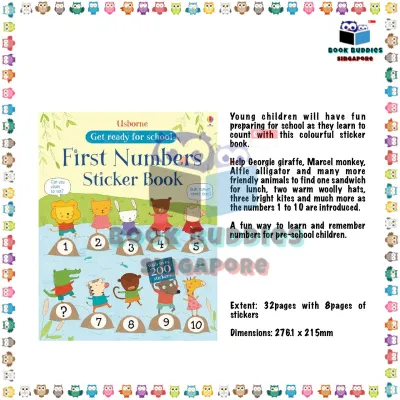
![[SG] 2025 LATEST NEW USBORNE Little First Sticker Book Educational Activity Books Gifts Presents Ideas](https://img.lazcdn.com/g/p/35672ab495bc6041b87eae4b4417ff6e.jpg_400x400q80.jpg_.webp)
![[SG LOCAL STOCK] USBORNE Sticker & Colouring Book Educational Activity Books Gifts Presents Ideas](https://img.lazcdn.com/g/p/b8dd97867f8f969aadbcaa6ef43f609c.jpg_400x400q80.jpg_.webp)
Prices are valid at publication and may change. Please refer to the product page for the latest price.
In Upper Primary, the academic environment becomes increasingly demanding as students prepare for key milestones like the Primary School Leaving Examination (PSLE). Here, sticker books mature into tools for executive functioning and emotional regulation. Instead of decorative play, older students utilize specialized planner stickers to organize their revision timetables, track homework deadlines, and prioritize tasks. Simultaneously, creative journaling with high-quality stickers offers a screen-free, meditative outlet for self-expression, allowing students to decompress after long study sessions.
Lower Primary (Primary 1 & 2): Building Habits and Basic Skills
The first two years of primary school represent a major transition period where establishing daily routines is paramount. For seven- and eight-year-olds, sticker books and sticker-based systems are highly effective in transforming abstract expectations into concrete, achievable goals.

Reward and Routine Chart Stickers
Introducing routine charts adorned with vibrant stickers can significantly ease the daily transition into school life. Parents can establish simple visual charts for morning routines, homework completion, packing school bags, and reading logs. When a child completes a task independently, allowing them to select and apply their own sticker provides immediate positive reinforcement, reinforcing the habit loop.
When selecting stickers for this age group, opt for high-contrast shapes, bright colors, and encouraging phrases like “Great Job!” or “Keep It Up!”. Character-based designs featuring familiar animals or friendly figures are particularly motivating. It is crucial to choose stickers with an easy-peel backing or a slightly raised edge, as the fine motor skills of Primary 1 and 2 students are still developing. Frustration with hard-to-peel stickers can quickly derail their enthusiasm for the routine.
While sticker charts are exceptional for building initial habits, parents should remain mindful of their limitations. Over-reliance on external rewards can sometimes overshadow the development of intrinsic motivation. To prevent this, use sticker charts as a temporary scaffolding tool. As a routine becomes second nature, gradually transition the reward system from daily stickers to weekly verbal praise, ensuring the child learns to take pride in their personal progress rather than just collecting physical tokens.
Early Learning and Phonics Sticker Workbooks
Sticker workbooks designed for early literacy and numeracy offer an interactive alternative to traditional drill-and-practice sheets. For Lower Primary students, workbooks that focus on phonics, basic sight words, sentence construction, and simple counting are highly beneficial. These books turn abstract language and math concepts into a physical matching game, keeping young minds actively engaged.
The primary cognitive benefit of these workbooks lies in “match-the-sticker” activities. A child must scan the page, identify the correct word or number sticker from the appendix, peel it, and align it precisely within a designated boundary. This sequence of actions coordinates visual perception with motor output, directly supporting hand-eye coordination and spatial awareness. This physical interaction makes learning dynamic and helps solidify memory retention.
Before purchasing an early learning sticker workbook, parents should carefully inspect the paper quality and adhesive properties. The pages should consist of thick, high-gsm paper that can withstand repeated handling. Because young children frequently make mistakes, the stickers must be repositionable. High-quality workbooks feature low-tack adhesives that allow a sticker to be peeled off and adjusted multiple times without tearing the underlying page or destroying the sticker itself.
Middle Primary (Primary 3 & 4): Exploring Interests and Reinforcing Subjects
By Primary 3 and 4, students are introduced to more specialized subjects, including the formal science syllabus. Their curiosity about the natural world expands, and sticker books can be leveraged to bridge the gap between classroom textbooks and creative, self-directed exploration.
Subject-Specific and Science Exploration Stickers
The introduction of science in Primary 3 brings a wealth of new terminology and processes, from the life cycles of plants and animals to the states of matter. Thematic sticker books focusing on the solar system, human anatomy, ecosystems, and geography serve as excellent supplementary resources. These visual aids make abstract scientific systems tangible and easier to comprehend.
Students can actively use these stickers to enhance their school science notebooks or create personalized study posters. For instance, rather than drawing a complex digestive system from scratch, a student can place detailed organ stickers onto a diagram, labeling each part as they study. This hands-on method of creating visual summaries helps translate passive reading into active learning, making study sessions more productive and memorable.
When selecting educational stickers, parents should prioritize factual accuracy and clarity. Look for sets that feature realistic, scientifically correct illustrations rather than overly cartoonish representations. The text on the stickers should be highly legible, using standard fonts and correct terminology. This ensures that the visual associations the student forms during their creative study sessions align perfectly with the expectations of their school curriculum.
Creative Scrapbooking and Storytelling Sets
Primary 3 and 4 students are also at an age where they enjoy expressing their unique personalities and narratives. Creative scrapbooking sticker sets provide a structured yet open-ended outlet for this creative drive. These sets often feature cohesive themes, such as natural landscapes, historical eras, or architectural wonders, allowing children to construct elaborate scenes.
To enrich the sensory experience, look for mixed-media sticker books that incorporate diverse textures and finishes. Sets containing puffy stickers, metallic foil accents, holographic details, or textured paper stickers add a tactile dimension to scrapbooking. This variety keeps the activity engaging and encourages students to explore different artistic compositions, layouts, and storytelling techniques in their personal journals.
However, parents must ensure that these creative stickers are compatible with the paper types used in school art projects and personal sketchbooks. Heavy, textured, or highly dimensional stickers (like thick puffy or wooden stickers) require stronger adhesives that can warp thin paper. For standard drawing blocks or school notebooks, lightweight paper or thin vinyl stickers are preferred, as they lie flat and will not cause the pages to bunch up or tear when the book is closed.
Upper Primary (Primary 5 & 6): Planning, Journaling, and Stress Relief
As students enter the final years of primary school, the academic pace accelerates dramatically. With the PSLE on the horizon, Upper Primary students must develop strong organizational skills while finding healthy ways to manage increased academic pressure.
Academic Planner and Time-Management Stickers
Transitioning to self-directed study requires robust time-management tools. Functional sticker kits designed for academic planners are highly effective in helping ten- to twelve-year-olds take ownership of their schedules. These kits typically include calendar icons, priority flags, subject-specific labels, and distinct deadline markers that make schedule tracking highly visual.
Color-coding is a proven organizational strategy that stickers make incredibly easy to implement. By assigning specific colors to different subjects—such as blue for Mathematics, green for Science, and red for Mother Tongue—students can scan their weekly planner and instantly understand their daily commitments. Using priority stickers like “Urgent” or “Exam” helps them allocate their study time efficiently, ensuring crucial tasks are never overlooked.
When choosing planner stickers, prioritize matte, paper-based, or writable vinyl materials. Glossy stickers are difficult to write on, often causing pen ink to smear or bead up. Writable stickers allow students to jot down specific details directly on the sticker, such as “Chapter 3 Quiz” or “p. 45-50”, using standard ballpoint pens or gel liners. This flexibility turns a simple decorative item into a highly customized, functional planning tool.
Mindfulness and Aesthetic Journaling Kits
Beyond academic organization, emotional well-being is critical during the high-pressure Upper Primary years. Aesthetic journaling and bullet journaling have emerged as popular, constructive hobbies for older primary students. These activities combine creative writing with visual design, offering a peaceful space for self-reflection and mindfulness.
Sticker books designed for aesthetic journaling typically feature minimalist, vintage, or nature-inspired designs, such as dried pressed flowers, subtle watercolor washes, and motivational quotes. The deliberate, quiet process of selecting, cutting, and arranging these stickers on a page acts as a form of active meditation. It encourages students to step away from digital screens and academic worries, focusing their minds on a calming, low-stakes creative task.
Upper Primary students often appreciate premium materials that feel more sophisticated than standard children’s stickers. Washi paper stickers, which are semi-transparent and blend seamlessly into journal pages, and durable matte vinyl decals are highly popular. These materials allow for layering and sophisticated layouts, appealing to the refined aesthetic preferences of older children while providing a satisfying tactile experience.
What to Check Before Buying: Material, Adhesive, and Paper Compatibility
To ensure sticker books remain a positive addition to a student’s routine, parents should evaluate several technical and physical specifications before making a purchase. Choosing the wrong type of sticker can lead to damaged school property, messy residues, or ruined notebook pages.
- Adhesive Type and Residue: The primary technical specification to verify is the adhesive type. Look for labels explicitly marked as "removable," "repositionable," or "acid-free." These adhesives are designed to peel off cleanly without tearing the paper or leaving a sticky residue. This is particularly important if students plan to use stickers on school-issued textbooks, library books, or high-quality planners. Avoid stickers with permanent or industrial-strength adhesives for temporary school projects, as they will permanently bond to paper fibers and cause tearing if removal is attempted.
- Paper Compatibility and Bleed-Through: Sticker books often come with integrated activity pages or require the use of markers and pens to write on or around the stickers. Parents should check the thickness and finish of the paper within the sticker book. Thin, low-gsm paper is highly susceptible to ink bleed-through and feathering, especially when using gel pens, felt-tip markers, or fountain pens. If the sticker book includes its own coloring or writing sections, ensure the paper is thick enough (ideally 100 gsm or higher) to handle various writing mediums without ruining the reverse side of the page.
- Size, Format, and Storage: Consider how and where the stickers will be used. For school use, portability is key. Sticker books that are bound in a compact A5 or A6 booklet format are highly practical, fitting easily into school bags or the pockets of a binder without bending. Loose sticker sheets, while convenient for home crafts, are easily crumpled or lost in a chaotic school bag unless stored in a dedicated folder. Sticker rolls are excellent for quick dispensing at a study desk but are too bulky to carry in a standard pencil case. Choose the format that matches the student’s daily environment.
- Safety and Compliance: Because primary school stationery involves prolonged skin contact, verifying safety standards is essential. Parents should check product packaging for recognized safety certifications, such as the European EN71 standard or ASTM D-4236. These certifications guarantee that the adhesives, inks, and materials used in the sticker book are non-toxic, acid-free, and free from harmful phthalates or heavy metals. This is especially critical for younger children in Primary 1 and 2, who may still occasionally touch their mouths or faces while handling stationery.
Frequently Asked Questions (FAQ)
Can sticker books help with exam stress in Primary 6?
Yes, sticker books can play a valuable role in managing exam stress during the demanding Primary 6 year. From an organizational perspective, using functional planner stickers to map out study schedules gives students a clear visual roadmap. This breaks down overwhelming exam preparation into manageable, daily steps, reducing the anxiety of the unknown. Psychologically, the creative process of aesthetic journaling with stickers offers a structured mental break. Engaging in a tactile, screen-free creative activity for just fifteen minutes can lower cortisol levels, allowing the brain to rest and recharge before resuming revision.
How do I remove stubborn sticker residue from school planners?
Removing stubborn adhesive residue from school planners requires gentle, non-destructive methods to avoid tearing the paper or damaging the cover. If the cover is hard and non-porous (such as plastic or laminated cardboard), you can gently rub the residue with a clean finger or a soft vinyl eraser, which often rolls the adhesive away. For persistent residue on non-porous covers, apply a tiny drop of mild oil, such as baby oil or olive oil, to a microfiber cloth and rub the area in a gentle circular motion, followed immediately by a damp cloth to clean the oil. Always test any liquid cleaning method on a small, inconspicuous area first. Never use harsh chemical solvents like acetone, sharp metal blades, or intense heat from a hair dryer, as these can easily melt plastic covers, dissolve book-binding glue, or permanently warp paper pages.
Community discussion
Share your experience or ask a question. Comments are reviewed before publication.