
Selecting the right stationery for primary school is more than just checking items off a booklist; it is about equipping your child with tools that match their physical development and academic needs. A child’s ruler needs evolve from a simple, durable 15cm plastic tool in Lower Primary (Primary 1 and 2) to a standard 30cm ruler and basic geometry tools (protractor, set squares) in Middle Primary (Primary 3 and 4), and finally to a complete, high-precision geometry set (including a compass and divider) in Upper Primary (Primary 5 and 6). Matching the tool to the grade level ensures the child can complete math tasks accurately without being hindered by an overly complex or physically unwieldy instrument.
Understanding How Math Curriculum Dictates Ruler Choices
Primary school mathematics curricula are structured progressively, moving from concrete, hands-on learning to abstract geometric problem-solving. In the early years, children focus on basic measurement concepts, such as identifying the length of objects in centimeters and understanding the physical representation of units. As they progress to Middle Primary, the syllabus introduces angles, parallel and perpendicular lines, and the calculation of perimeter and area. By Upper Primary, students are expected to construct complex geometric shapes, bisect angles, and draw precise circles. Each of these milestones requires a different level of tool precision and capability.
Physical development also plays a critical role in tool selection. Younger children in Primary 1 and 2 are still developing their fine motor skills and hand-eye coordination. Holding down a long, flexible ruler while drawing a straight line requires bilateral coordination that many seven-year-olds are still mastering. Conversely, older students in Primary 5 and 6 have developed the dexterity required to manipulate fine adjustment wheels on compasses and read tiny millimeter markings on high-precision instruments.
Products mentioned in this guide
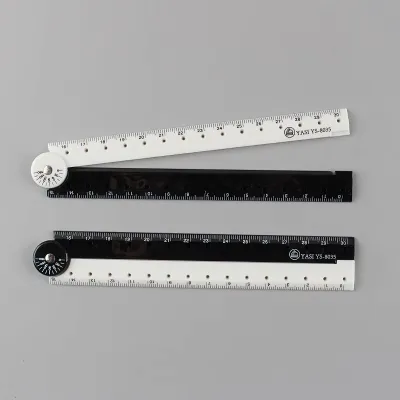
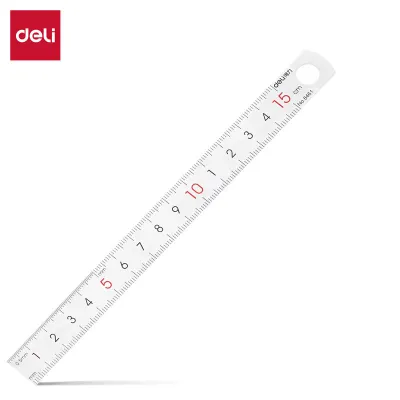
Prices are valid at publication and may change. Please refer to the product page for the latest price.
While this guide provides a comprehensive overview of typical requirements across grade levels, parents should always cross-reference these recommendations with their child’s specific school booklist. Individual schools, and sometimes even different math teachers within the same school, may have specific preferences or requirements regarding the types of stationery allowed in the classroom.
Lower Primary (Primary 1 & 2): Rulers for Basic Measurement
In the first two years of primary school, math lessons focus on introducing the concept of length. Students learn to align the start of an object with the zero mark on a ruler and read the corresponding measurement. The tools used during this stage should minimize frustration and build confidence.

Recommended Sizes and Materials
For Primary 1 and 2 students, a 15cm ruler is the ideal size. This length matches the physical span of a young child’s hand, allowing them to place their palm or fingers across almost the entire length of the ruler to anchor it securely on the paper. A shorter ruler also fits easily into standard zippered pencil cases, reducing the likelihood of it being left loose in a school bag where it could easily be lost or damaged.
Material selection is equally important for this age group. Parents should look for thick, shatter-resistant plastic, such as high-impact polystyrene or PET. Young children frequently drop their stationery, and brittle plastics can snap into sharp, hazardous shards. A slightly flexible but thick plastic ruler offers the perfect balance of safety and durability.
Additionally, clear or translucent ruler bodies are highly recommended. When a ruler is transparent, children can see the line, shape, or object they are measuring underneath the tool. This transparency helps them verify that the ruler is aligned parallel to the object, preventing diagonal measurement errors that are common among beginners.
Key Features for Young Learners
To support early learning, look for rulers with large, bold, and high-contrast numbers. Millimeter and centimeter markings should be clearly distinguished, ideally with different line lengths or color-coded indicators. This visual separation helps prevent children from confusing the two units of measurement when reading scales.
Another common hurdle for young learners is understanding the zero point. Many children naturally align the physical edge of the ruler with the start of an object, failing to realize that the “0” mark is often slightly offset from the edge. Rulers designed for early learners often feature a highly visible, colored line at the zero mark, or conversely, have the zero mark aligned exactly with the physical edge of the ruler to simplify the process.
Ergonomic features can also greatly reduce frustration. Rulers with raised center ridges, finger grooves, or non-slip silicone backings prevent the tool from sliding across the page while the child is drawing. Finally, ensure the ruler has rounded corners rather than sharp, square edges to prevent accidental pokes and minor scratches during daily handling.
Middle Primary (Primary 3 & 4): Transitioning to Geometry Tools
As students enter Primary 3 and 4, the mathematical landscape shifts. They begin to explore 2D shapes, measure angles, and draw parallel and perpendicular lines. The simple 15cm ruler is no longer sufficient for these more complex drawing and measurement tasks.
Stepping Up to 30cm Rulers
A standard 30cm ruler becomes a necessity at this stage. Students are required to draw larger diagrams, construct longer graph axes in data representation topics, and measure larger objects in science practical lessons. Attempting to draw a 25cm line with a 15cm ruler requires shifting and realigning the tool, which almost always introduces alignment errors.
When choosing a 30cm ruler, look for flexible but sturdy materials. While rigid acrylic rulers offer excellent transparency, they are prone to cracking when stuffed into a tightly packed school bag. Flexible plastic rulers that can bend without snapping are highly durable options for active middle primary students.
Readability remains crucial, especially under classroom fluorescent lighting. Look for rulers with a matte or non-glare finish. High-gloss plastics can reflect overhead lights directly into a child’s eyes, making it difficult to read the fine millimeter markings accurately and causing unnecessary eye strain during long lessons.
Adding Protractors and Set Squares
Primary 3 and 4 math curricula introduce the measurement of angles in degrees, requiring the use of a protractor. A standard 180-degree semi-circular protractor is perfect for this stage. Ensure the protractor features a clear, distinct center point marker—such as a small circle, crosshair, or physical hole—which is essential for aligning the vertex of the angle correctly.
This stage also introduces set squares, which are triangular rulers used in pairs (typically a 45-45-90 degree triangle and a 30-60-90 degree triangle). Set squares are fundamental for drawing precise parallel and perpendicular lines. By sliding one set square along the edge of another, students can easily construct accurate geometric grids and shapes.
Because these tools are handled frequently and slid across paper surfaces, they should be made from high-quality, scratch-resistant plastic. Over time, cheap plastics accumulate fine scratches that obscure the degree and millimeter markings, making it difficult for students to read measurements accurately during timed class exercises.
Upper Primary (Primary 5 & 6): Precision Tools for Advanced Math
In the final years of primary school, students prepare for major national examinations. The math curriculum demands high precision, where a discrepancy of even a single millimeter or degree can result in a lost mark. This stage requires a complete, professional-grade geometry set.
Essential Components of a Geometry Set
A complete mathematical geometry set for Upper Primary should contain the following essential components:
- A 30cm ruler: For drawing long, straight lines and general measurements.
- A 180-degree protractor: For measuring and constructing angles.
- A pair of set squares: For drawing parallel and perpendicular lines.
- A compass: For drawing precise circles, arcs, and constructing triangles.
- A divider: For measuring and transferring precise distances between two points.
These tools work in tandem for complex geometric constructions. For example, to construct a triangle with specific side lengths and angles, a student must use the ruler to establish the base, the protractor to mark the angle, and the compass to sweep an arc that determines the third vertex. Keeping these tools organized in a dedicated tin or hard plastic case is highly recommended to prevent loss and protect the delicate components from damage.
Material and Precision Upgrades
For Upper Primary students, upgrading to higher-quality materials can significantly improve their accuracy and performance. Metal-edge rulers or full aluminum rulers are excellent choices because they provide a perfectly straight, unyielding edge. Unlike plastic rulers, which can develop tiny nicks and chips along the edge from pencil points or utility knives, metal edges remain perfectly smooth over years of use.
Look for tools with etched or engraved markings rather than surface-printed ones. Printed markings on cheap plastic tools tend to rub off over time due to friction and contact with natural skin oils. Etched markings are physically cut into the material, ensuring they remain perfectly legible even after years of heavy use.
Furthermore, pay close attention to the quality of the compass. A high-quality compass must have a tight, secure hinge or a thumbwheel locking mechanism. A loose hinge will allow the compass legs to spread or collapse under slight pressure, resulting in distorted circles and inaccurate geometric constructions. Safety is also a key consideration; look for compasses with self-retracting needles or safety caps to prevent accidental finger pricks.
Practical Tips for Labeling and Storing School Rulers
Stationery is among the most frequently lost property in primary schools. Because many students use identical items from the standard school booklist, labeling is essential. Use a fine-tip permanent marker or a durable, waterproof name sticker to label every tool. Place the label on a non-measuring edge or the center grip area so that it does not obscure the scale markings or block the transparency of the tool.
Parents must also ensure that their child’s stationery complies with official examination regulations. Rulers with built-in calculators, digital displays, conversion tables, or overly distracting decorative elements are strictly prohibited in national examinations. It is best to establish a habit of using standard, plain, and transparent tools early on so that students are fully comfortable with exam-compliant stationery.
Proper storage is key to extending the lifespan of these precision tools. Storing loose geometry tools in a soft pencil case alongside sharp metal scissors, metal pencil sharpeners, or compass points will quickly scratch the plastic surfaces and dull the markings. Encourage your child to keep their protractor, set squares, and compass in their dedicated hard-shell case, and store their 30cm ruler in a pencil case with elastic loops or a separate protective sleeve.
Frequently Asked Questions (FAQ)
Can my child use a 30cm ruler from Primary 1?
While it might seem cost-effective to buy a single 30cm ruler to last all six years of primary school, it is highly impractical for a Primary 1 student. A 30cm ruler is physically too long for a seven-year-old’s hands, making it difficult for them to hold steady without the ruler wobbling or sliding. Additionally, a 30cm ruler does not fit inside standard small pencil cases, meaning it often gets left loose in the school bag where it is easily bent, snapped, or lost. A 15cm ruler is far more developmentally appropriate and manageable for the first two years.
Are folding or digital rulers allowed in school?
No, folding rulers and digital rulers are generally not permitted in primary school classrooms or examinations. Folding rulers, which are typically designed for carpentry, do not provide a stable, continuous straight edge, making them highly impractical for precise desk work. Digital rulers or rulers with embedded electronic displays and calculators are strictly banned during examinations to ensure fair testing conditions. To avoid any issues, stick to standard, clear, non-electronic straight-edge rulers.
Community discussion
Share your experience or ask a question. Comments are reviewed before publication.