
Finding the perfect personalised gift in Singapore requires balancing aesthetic appeal with daily utility. A custom notebook serves as an intimate yet highly functional present, bridging the gap between artistic expression and structured organization. Whether the recipient is a student managing dense lecture schedules, a professional capturing key insights in corporate boardrooms, or a creative sketching fluid concepts, the choice of paper, binding, and custom detailing dictates how often the notebook will actually be used. By selecting a notebook tailored to their specific writing instruments and daily environment, you transform a simple stationery item into a cherished everyday companion.
What to Look for in a Personalised Gift Notebook
The foundation of any exceptional notebook is its paper weight, which is measured in grams per square meter (GSM). Standard office paper typically ranges from 70 to 80 GSM, which is adequate for basic ballpoint pens but highly susceptible to ink feathering and ghosting when paired with liquid ink. For recipients who prefer gel pens, rollerballs, or fountain pens, selecting a notebook with at least 100 GSM paper is advisable. Higher GSM ratings indicate denser fibers that resist ink penetration, ensuring that notes written on one side of a page do not bleed through and ruin the reverse side.
Binding styles dictate how a notebook behaves when placed on a flat surface, directly influencing writing comfort. Lay-flat binding, often achieved through section-sewn or thread-bound construction, allows the book to open completely flat without requiring constant manual pressure to hold the pages down. Spiral or wire-bound notebooks offer excellent flexibility, allowing the user to fold the cover entirely back to save desk space, though the central metal coil can sometimes obstruct the writer’s hand. Hardcover notebooks provide a rigid, built-in writing surface that is ideal for taking notes on the go, whereas softcover options offer lightweight portability at the expense of structural support.
Products mentioned in this guide
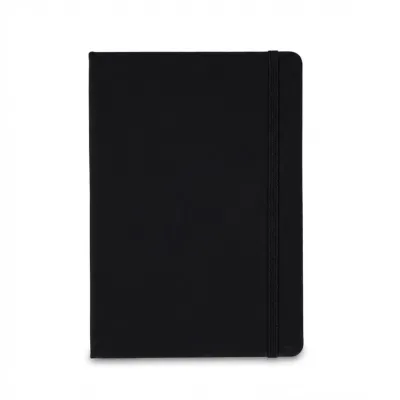
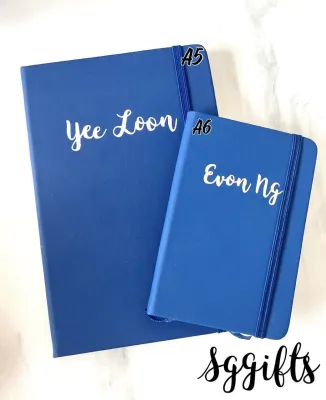
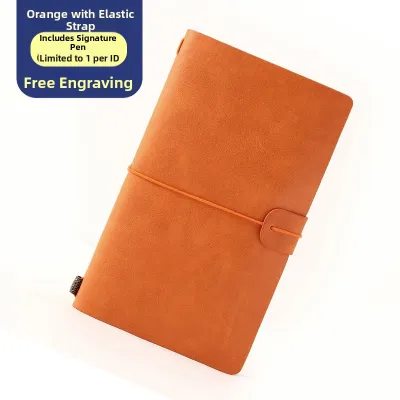
Prices are valid at publication and may change. Please refer to the product page for the latest price.
Personalisation techniques elevate a standard notebook into a premium personalised gift, and the choice of method determines the final aesthetic. Blind debossing presses a metal die directly into the cover material using heat and pressure, leaving a crisp, recessed, and understated mark without any added color. Foil stamping utilizes a similar heated die but introduces a thin layer of metallic or colored foil—such as gold, silver, or rose gold—into the indentation for a striking, reflective finish. Custom cover printing allows for full-color digital designs, offering maximum creative freedom but sometimes sacrificing the classic, tactile feel of traditional debossed leather or cloth.
Physical dimensions and weight are critical factors that determine whether a notebook becomes a daily companion or sits forgotten on a shelf. The international A5 standard (approximately 148mm by 210mm) is widely regarded as the sweet spot for general use, offering ample writing space while fitting easily into most backpacks, tote bags, and briefcases. Smaller pocket sizes like A6 are highly portable but limit the volume of information per page, while larger B5 or A4 sizes are excellent for desk-bound work but can prove cumbersome to carry daily. Consider the recipient’s typical bag size and daily commute when finalizing these physical specifications.
Top Personalised Notebook Features for Students
Academic success relies heavily on structured information, making ruled or grid paper formats the ideal choice for students. Ruled pages with standard 6mm to 8mm line spacing provide a clean framework for rapid, linear note-taking during fast-paced lectures. For science, technology, engineering, and mathematics (STEM) students, square grid or dot-grid patterns are far more beneficial, as they facilitate the precise drawing of geometric diagrams, chemical structures, and mathematical equations. These structured layouts help students maintain neatness, which is essential when reviewing complex study materials before major examinations.

The daily commute of a student in Singapore involves navigating crowded public transport and packing books into tightly stuffed bags, necessitating a highly durable cover. Scratch-resistant covers made from heavy-duty polypropylene, treated buckram cloth, or reinforced hardboard protect the inner pages from getting bent, torn, or stained by accidental spills. A sturdy elastic closure band is another invaluable feature, keeping the notebook securely shut inside a backpack and preventing loose sheets of paper from slipping out or getting crushed.
In shared academic environments like university libraries, study rooms, and lecture halls, stationery items are easily misplaced or accidentally swapped. Personalising a student’s notebook with a clear, prominent name stamping or initial embossing on the front cover serves as a practical safeguard against loss. Opting for high-contrast foil stamping or a distinct custom printed cover design makes the notebook instantly recognizable from a distance, ensuring it remains in the rightful owner’s possession throughout the academic year.
Students typically consume multiple notebooks over a single academic year, meaning that cost-effectiveness and volume are important considerations for gift-givers. When shopping on local online marketplaces or at specialty stationery stores in Singapore, look for multi-pack bundles or academic sets that offer several matching or coordinated notebooks at a lower unit price. You can often arrange for a single custom design or a set of initials to be applied across the entire batch, providing the student with a cohesive, professional-looking collection of study tools for the semesters ahead.
Ideal Personalised Notebooks for Professionals
In corporate boardrooms and client-facing meetings, the visual appeal of professional accessories speaks volumes before a single word is spoken. Notebooks featuring premium covers made from genuine leather, high-grade vegan leather, or textured bookbinding cloth project an image of polished organization and attention to detail. These materials not only feel luxurious to the touch but also develop a unique character over time, resisting the wear and tear associated with daily office transitions.
For a corporate setting, the personalisation should remain sophisticated and understated to align with professional decorum. Minimalist monogramming or blind debossing of initials in a clean, sans-serif typeface on the bottom corner of the cover is highly recommended. This subtle approach adds a distinct personal touch without drawing excessive attention, ensuring the notebook remains appropriate for high-level executive meetings, client pitches, and formal presentations.
Professional productivity is greatly enhanced by integrated design features that streamline organization during busy workdays. Built-in pen loops eliminate the frustration of searching for a writing instrument during an unexpected call, while dual ribbon markers allow users to bookmark their current daily planner page and their ongoing meeting notes simultaneously. Additionally, pre-numbered pages paired with a blank index section at the front of the notebook enable professionals to log and retrieve critical meeting minutes or project details in seconds.
The ergonomics of writing during long meetings or while multi-tasking at a desk require a notebook that cooperates with the user’s physical workspace. True lay-flat binding is essential for professionals who need to type on a laptop or review physical documents while referencing or updating their handwritten notes. A notebook that stays open on its own prevents the constant interruption of having to hold the pages down, allowing for a seamless workflow and a more comfortable writing posture throughout the workday.
Best Personalised Notebook Options for Creatives
Creatives, including designers, artists, and creative writers, require paper that can handle a wide variety of writing and sketching mediums without compromising structural integrity. Standard notebooks often fail when subjected to heavy ink flow, causing unsightly bleeding where the ink seeps through to the next page, or feathering where the ink spreads outward along the paper fibers. To prevent this, look for notebooks featuring premium paper with a weight of 100 GSM to 160 GSM, which provides the necessary density to support heavy gel pens, fine-liners, brush pens, and even light watercolor washes.
For artists and illustrators, the physical gutter of a notebook can be a significant barrier to creative expression. Thread-sewn bindings that allow the notebook to open completely flat across a two-page spread are indispensable, enabling uninterrupted sketching and panoramic designs that span both pages. This seamless transition across the center fold allows creatives to maximize their canvas space, making the notebook feel like an open sketchbook rather than a restrictive bound book.
The internal layout of a creative’s notebook should offer maximum freedom, which is why blank or dot-grid formats are highly preferred over traditional ruled lines. Blank pages remove all visual constraints, allowing for freehand sketching, rapid mind mapping, and uninhibited brainstorming sessions. Alternatively, a subtle dot-grid pattern offers a faint guide that assists with scale and alignment when drawing wireframes or lettering, without being visually intrusive in the final creative piece.
Gift-givers should also pay close attention to the specific texture, or “tooth,” of the paper, as this dramatically affects how different drawing tools interact with the surface. Smooth, hot-pressed paper is excellent for technical drawing pens, calligraphy, and fine-line ink work because it allows the nib to glide effortlessly without catching. Conversely, paper with a slight tooth or texture is necessary if the recipient works with dry media like graphite pencils, charcoal, or pastels, as the rougher surface is required to grab and hold the pigment particles effectively.
Quick Guide to Paper Types and Binding Styles
Selecting the correct technical specifications for a notebook ensures that your gift aligns perfectly with the recipient’s daily habits. The following table outlines the primary paper formats and binding styles, mapping them to the most suitable user profiles and highlighting key structural considerations.
| Feature (Paper Type/Binding) | Best Suited For | Key Considerations |
|---|---|---|
| Lined Paper | Students and Professional Writers | Promotes neat, linear text; limits freehand sketching and diagramming. |
| Dot Grid | STEM Students and UI/UX Designers | Provides subtle alignment guides; less intrusive than solid grid lines. |
| Blank Paper | Artists, Illustrators, and Mind Mappers | Offers complete creative freedom; can lead to slanted handwriting for some. |
| Hardcover Binding | On-the-go Note-takers and Commuters | Provides a built-in writing surface; adds extra weight and bulk to bags. |
| Lay-flat Binding | Office Professionals and Sketch Artists | Allows hands-free writing and seamless two-page spreads; typically costs more than standard binding. |
How to Order Custom Notebooks in Singapore
When planning a personalised gift in Singapore, timing is crucial due to the manual labor involved in custom embossing, foil stamping, or bespoke printing. Standard off-the-shelf notebooks can be purchased instantly, but custom orders typically require a processing lead time of three to seven business days, which can extend to several weeks during peak gifting seasons like Christmas, graduation periods, or the start of the academic year. It is highly recommended to place your order at least two weeks in advance to account for both production time and local delivery schedules.
To avoid the disappointment of a misspelled name or an incorrectly aligned design, always request a digital proof from the vendor before they begin the physical customisation process. Most reputable local stationery boutiques and online customisation services will provide a digital mockup showing the exact placement, font style, and color of the personalisation. Carefully review this proof on a high-resolution screen, checking every letter and spacing detail, as once the metal die is pressed into the cover, the process cannot be undone.
Because personalised notebooks are custom-made to order, they are almost universally excluded from standard return and exchange policies on local e-commerce platforms and brand official stores. Unless the item arrives with a clear manufacturing defect or a mistake that deviates from the approved digital proof, you will not be able to secure a refund or replacement. This policy makes it doubly important to double-check all custom text inputs and specifications prior to submitting your final order payment.
Singapore’s tropical climate, characterized by high relative humidity levels that often exceed 80 percent, presents unique challenges for paper storage and transit. When ordering from online sellers, confirm that they use moisture-resistant packaging, such as sealed plastic sleeves or bubble wrap, to protect the notebook from absorbing atmospheric moisture during transit. Once the notebook arrives, store it in a cool, dry place away from direct sunlight and air conditioning drafts to prevent the cover from warping or the pages from becoming wavy before you present the gift.
Frequently Asked Questions (FAQ)
What is the best paper weight for fountain pens?
For fountain pen users, paper weighing between 90 GSM and 120 GSM is generally considered the optimal range to prevent ink bleed-through, feathering, and ghosting. However, paper weight alone does not guarantee compatibility; the paper’s coating and sizing also play a critical role in how the ink dries. Smooth, coated papers slow down ink absorption, which enhances the vibrant colors and shading of fountain pen inks but requires longer drying times to avoid accidental smudging.
How long does personalisation usually take?
The turnaround time for notebook personalisation depends heavily on the complexity of the chosen method and the vendor’s current order volume. Simple monogramming, such as blind debossing or foil stamping initials, is often completed within three to five business days by local Singaporean boutiques. For highly customized projects, such as full-cover digital printing, custom-dyed materials, or bulk corporate orders, the production process can take anywhere from two to four weeks.
Can I personalise a notebook after buying it?
Yes, it is entirely possible to add personal touches to a standard, off-the-shelf notebook after purchase if you did not order it pre-customised. While professional hot-foil stamping requires specialized machinery, you can achieve a unique look using high-quality vinyl decals, custom-inked rubber stamps, or hand-painted designs with acrylic markers. Alternatively, many local leather repair shops or specialized print boutiques in Singapore offer independent embossing services for customer-provided leather goods, though you should verify cover material compatibility beforehand.
Community discussion
Share your experience or ask a question. Comments are reviewed before publication.