
Choosing the right cards for writing is essential for creating durable, legible, and effective study tools. In Singapore’s humid climate, paper selection becomes even more critical, as moisture can affect ink drying times, paper stiffness, and overall durability. When building a physical flashcard system for active recall or spaced repetition, the physical properties of your index cards—such as paper weight, surface texture, size, and format—directly impact how well your study materials survive repeated shuffling and daily review sessions. Selecting the ideal card involves matching your writing instruments, study techniques, and storage solutions to the right paper specifications.
By understanding how different paper characteristics interact with your writing style, you can avoid common frustrations like ink bleeding through the page or smudging during rapid note-taking. Investing a little time in selecting the right physical features ensures that your study aids remain clear, organized, and intact throughout your entire preparation period.
Key Physical Features That Make a Great Study Card
Paper weight and thickness, measured in grams per square meter (GSM), represent the most critical factor when selecting cards for writing. Standard office printer paper typically ranges from 70 to 80 GSM, which is far too thin for double-sided flashcards because ink easily bleeds through to the other side. For effective study cards, look for cardstock with a weight of at least 150 GSM, though 200 to 250 GSM is ideal for maximum durability. A higher GSM ensures that when you write a question on the front, the answer on the back remains completely hidden, preventing accidental spoilers during active recall sessions.
Products mentioned in this guide
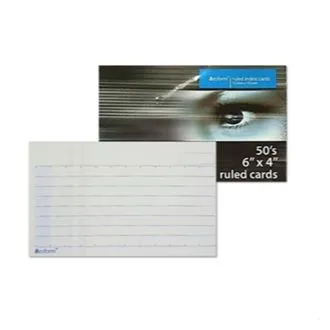
Prices are valid at publication and may change. Please refer to the product page for the latest price.
The surface finish of the card determines how smoothly your pen glides across the paper and how quickly the ink dries. Uncoated, matte-finish cards are highly popular because their slightly textured fibers absorb ink rapidly, making them compatible with a wide variety of writing instruments, including gel pens, ballpoints, and highlighters. Conversely, cards with a glossy or highly coated finish can cause water-based inks to pool, smear, or take an exceptionally long time to dry. In humid environments, these coated surfaces can also feel sticky or trap moisture, so a high-quality, uncoated matte card is generally the most reliable choice for daily study.
Ruling options play a significant role in how you organize information on your cards. Lined cards are the traditional choice, providing structured rows that help keep definitions, vocabulary lists, and historical facts neat and legible. Grid or dot-grid patterns offer a versatile alternative, allowing you to align mathematical equations, draw chemical structures, or sketch small diagrams with geometric precision. Blank cards provide complete creative freedom, making them the preferred option for visual learners who rely on mind maps, anatomical sketches, or large, centered keywords to trigger memory.
Matching Card Sizes to Your Active Recall Method
Selecting the right card dimensions is essential for tailoring your study materials to the complexity of the subject matter. Standard small index cards, typically measuring 3×5 inches (approximately A7 size), are the classic choice for rapid-fire active recall. Their compact size makes them highly portable, allowing you to slip a deck into your pocket or pencil case for quick review sessions during your daily commute on the MRT. Because space is limited, these small cards force you to condense information into single keywords, simple definitions, or foreign vocabulary words, which prevents cognitive overload and encourages focused memorization.

Medium-sized cards, such as 4×6 inches (approximately B6 size), offer a balanced canvas for concepts that require slightly more context. This size is particularly useful for writing out short mathematical formulas alongside a brief explanation of their variables, summarizing multi-step scientific processes, or listing historical events with their corresponding dates and significance. The additional space allows you to divide the card into clear visual zones, such as a dedicated header for the topic, a central area for the core concept, and a small footer for hints or category tags, without making the layout feel cramped.
Large index cards, measuring 5×8 inches (approximately A5 size), function more like portable summary sheets than traditional flashcards. This format is ideal for highly visual study methods, such as drawing detailed anatomical diagrams, mapping out complex flowcharts, or creating comprehensive mind maps that connect multiple sub-topics. While they are too large for quick shuffling or pocket storage, these cards are excellent for high-level synthesis and can be filed away in desktop boxes or binders to serve as quick-reference guides during intense exam preparation.
Choosing the Right Format for Spaced Repetition Workflows
The format of your index cards significantly influences how you manage your daily study routines and organize your learning materials over time. Loose-leaf index cards offer the highest level of flexibility, making them the essential foundation for physical spaced repetition systems like the Leitner box. In this workflow, cards are sorted into different compartments based on how well you recall the information, with mastered cards moving forward and forgotten cards returning to the first box. Loose cards allow you to shuffle your deck thoroughly, ensuring you memorize the actual content rather than the sequential order of the questions.
For students who prioritize portability and sequential order, bound or spiral-bound index card books are an excellent alternative. These formats keep your notes securely attached, preventing individual cards from getting lost in your bag or dropped during transit. Bound cards are ideal for studying chronological subjects, such as history timelines or legal case law, where maintaining a specific sequence is crucial for understanding the material. Many spiral-bound options feature micro-perforated edges, allowing you to keep your notes bound during lectures and tear them out later to convert them into loose flashcards for active recall practice.
To maintain an efficient physical study system, you should also consider the compatibility of your cards with various storage and organization accessories. Loose-leaf cards pair naturally with plastic or cardboard index card boxes, which can be fitted with alphabetical or color-coded dividers to keep different subjects separated. If you prefer to study on the go, cards with pre-punched holes can be bound together using metal binder rings, allowing you to flip through a specific deck easily without the risk of dropping them. Protective card sleeves and dedicated index card wallets can also shield your written notes from wear, tear, and humidity.
How to Test Card Quality Before Buying in Bulk
Before committing to a large bulk purchase of cards for writing at local stationery shops or online marketplaces, it is wise to perform a few simple quality tests on a sample pack. Start by conducting a bleed-through and feathering test using your preferred writing instruments, such as gel pens, fine liners, highlighters, or fountain pens. Write several lines on one side of the card and inspect the reverse side to ensure the ink does not soak through or leave a visible shadow. Examine the edges of the written lines under good lighting; if the ink spreads outward into the paper fibers, the paper lacks proper sizing and may cause your handwriting to look blurry.
Next, evaluate the drying time of the paper to ensure it matches your writing speed and study habits. Write a few words and immediately run your finger across the ink after intervals of one, three, and five seconds. In Singapore’s naturally humid climate, water-based inks can take longer to set, especially on smoother paper surfaces. If you find that the ink smudges easily after several seconds, you may need to switch to a more absorbent matte cardstock or transition to a faster-drying ballpoint pen to prevent messy smudges during rapid flashcard creation.
Finally, assess the physical durability and stiffness of the cardstock to ensure it can withstand weeks of constant handling. Hold a single card by one corner and gently flex it back and forth; a high-quality card should feel rigid and spring back into its original flat shape without creasing. Inspect the cut edges and corners of the cards to ensure they are clean and sharp, as poorly cut cards are highly prone to fraying, splitting, and dog-earing after only a few rounds of shuffling. Investing in structurally sound cards ensures that your hard work remains preserved and legible throughout your entire study journey.
Frequently Asked Questions (FAQ)
Can I use regular paper cut to size instead of pre-made index cards?
While cutting standard 80 GSM copy paper to size is a quick option for temporary notes, it is generally unsuitable for long-term study systems. Regular paper lacks the structural rigidity required for frequent shuffling and handling, causing the edges to fray and the corners to bend easily. Furthermore, thin paper is highly prone to ink bleed-through and ghosting, making it difficult to write questions on the front and answers on the back without revealing the solution. For a durable spaced repetition system, investing in dedicated cardstock or pre-made index cards of at least 150 GSM ensures your flashcards remain usable throughout your academic preparation.
How do I prevent ink from smudging when writing on both sides of a card?
To prevent smudging on double-sided cards, pair quick-drying writing instruments with an appropriate paper surface. Ballpoint pens and quick-dry gel pens are excellent choices as their inks dry almost instantly on standard matte index cards. Avoid using heavy liquid ink rollerballs, slow-drying gel pens, or highly saturated markers unless you are willing to wait several seconds before flipping the card. Additionally, plan your layout strategically: avoid placing heavy blocks of ink or dark highlighter strokes directly opposite each other on the front and back of the card, which minimizes both smudging and visual show-through.
Community discussion
Share your experience or ask a question. Comments are reviewed before publication.