
Choosing the best blank index cards for study flashcards requires balancing paper weight, surface texture, and dimensions to match your specific learning style. Unlike lined alternatives, blank cards offer an unrestricted canvas for diagrams, mind maps, and concise bullet points. The ideal card must be thick enough to prevent ink from bleeding through to the back—which would otherwise spoil the active recall process—while remaining smooth enough to write on quickly without smudging.
Core Criteria for Selecting Blank Index Cards
Defining your specific study requirements is the first step toward choosing the right flashcard medium. Different subjects demand different layouts; for instance, memorizing medical terminology or legal definitions requires a different approach than learning simple foreign vocabulary. Matching your card choice to the complexity of your study material ensures you have enough space without carrying unnecessary bulk.
Estimate the average amount of information you plan to place on each card before making a purchase. If you are drawing organic chemistry structures, writing out mathematical proofs, or mapping complex historical timelines, you will need a larger canvas. Conversely, if you are memorizing quick facts, dates, or vocabulary words, smaller cards are much more efficient and easier to handle.
Products mentioned in this guide
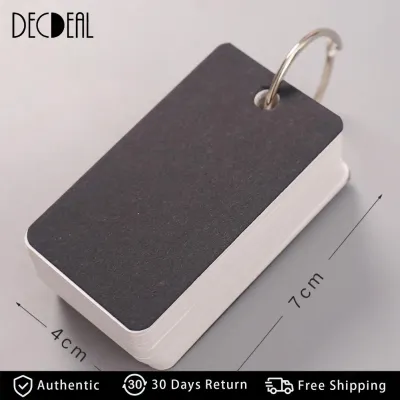
Prices are valid at publication and may change. Please refer to the product page for the latest price.
Portability and storage preferences should also influence your decision. In busy urban environments like Singapore, students frequently study during daily commutes on the MRT or while waiting at cafes. Compact cards that fit easily into a pocket, a small pouch, or a pencil case are highly practical for these on-the-go study sessions.
Consider how you plan to organize and store your completed decks over time. Some students prefer standard card boxes, while others use index card holders, binder rings, or color-coded dividers. If you prefer using binder rings to keep your decks organized, look for cards that are pre-punched or have enough margin space to punch holes without obscuring your notes.
Evaluating Size, Thickness, and Surface Quality
The physical properties of an index card directly impact its usability, durability, and overall writing experience. Size determines how much information you can comfortably fit, thickness prevents ink from showing through, and surface texture dictates how smoothly your pen glides. Understanding these attributes helps you avoid cards that tear, smudge, or warp under regular use.

Standard Sizes and Format Options
Standard index card sizes typically range from 3 x 5 inches (approximately 7.6 x 12.7 cm) to 4 x 6 inches (10.2 x 15.2 cm) or even 5 x 8 inches (12.7 x 20.3 cm). The 3 x 5 inch format is the classic choice for quick active recall, offering excellent portability for pocket storage. Larger sizes are better suited for complex diagrams, mind maps, or multi-step formulas that require a broader visual field.
Binding and organization styles also vary across different products. Some blank cards come loose in packs, while others are bound by a spiral wire or held together by a removable metal ring. Pre-punched cards are incredibly convenient for ring binding, allowing you to flip through your deck like a small book without risking dropped or scattered cards.
Edge quality is another critical factor to observe when selecting cards. Clean, precision-cut edges prevent the cardstock from fraying or splitting at the corners after repeated shuffling. When browsing options, inspect product images or user feedback to ensure the edges are sharp and uniform, rather than fuzzy or poorly sheared.
Cardstock Thickness and Durability
Cardstock thickness is usually measured in grams per square meter (gsm) or points (pt) of caliper thickness. For a durable flashcard that resists bending, look for a weight of at least 150 gsm, though 200 gsm or higher provides a much sturdier, premium feel. Thicker cardstock ensures the card remains flat and rigid even after hundreds of quick flips.
Opacity is directly tied to thickness and is vital for effective active recall. If you can see the answer shining through the back of the card under normal study lighting, the card fails its primary purpose. High-opacity cardstock prevents dark gel inks, fine liners, and markers from ghosting or bleeding through to the reverse side.
Stiffness also affects how easily you can shuffle your deck. Thin, flimsy cards tend to cling together, making rapid-fire self-testing frustrating. Stiffer cards slide past one another smoothly, allowing for efficient spaced repetition sessions where you quickly sort cards into “correct” and “incorrect” piles.
Surface Texture and Ink Compatibility
The surface texture of blank cards determines how different writing instruments behave. A completely smooth, coated surface might feel pleasant to the touch, but it often resists ink absorption, leading to slow drying times and frequent smudging. Conversely, a highly textured or toothy surface can cause ink to feather, making fine text look blurry and illegible.
To ensure compatibility with your favorite stationery, check the manufacturer’s specifications regarding paper finish. Uncoated, matte cardstock is generally the most versatile option, working exceptionally well with gel pens, ballpoints, fine liners, and graphite pencils. If you prefer using fountain pens or heavy ink markers, look for high-density paper specifically treated to resist feathering.
Before committing to writing out an entire deck of flashcards, always perform a quick, small-scale test on a single card. Write a few words using your preferred pens, then check for drying speed, bleed-through, and erasability if you use pencils. This simple trial prevents the frustration of discovering that your chosen ink smudges every time you flip a card.
How to Read Product Labels and Specifications
Navigating product listings and packaging requires looking past subjective marketing buzzwords. Terms like “super thick,” “premium quality,” or “professional grade” carry no standardized meaning and can often be misleading. Instead, focus on objective, measurable specifications such as the exact dimensions in millimeters or inches, the precise sheet count, and the paper weight in gsm.
Pay close attention to the paper composition listed on the label. Cards made from 100% wood pulp or cotton fibers generally offer superior durability and a more consistent writing surface than low-grade recycled paper, which may contain irregular fibers that cause ink to bleed. Additionally, check if the product is labeled as “acid-free” or “archival-quality.” Acid-free paper resists yellowing and degradation over time, ensuring your study materials remain pristine for years.
Verify the packaging details to understand how the cards are delivered. Loose cards are ideal if you already have a dedicated storage box, while shrink-wrapped packs help keep unused cards clean and dry. If you are purchasing online, cross-reference the listed dimensions with your existing storage containers or binder rings to avoid compatibility issues.
Best Practices for Creating and Maintaining Flashcards
To maximize the lifespan and effectiveness of your flashcards, match your writing instruments to the specific paper characteristics. If your cards have a slightly absorbent matte surface, use quick-drying gel pens or fine liners with water-resistant ink to prevent smudging during intense study sessions. For pencil users, a medium-grade graphite (such as HB or 2B) offers a clear mark that can be cleanly erased without tearing the cardstock.
Establish a consistent visual layout to enhance cognitive recall. Keep the front of the card minimal, featuring only a single question, term, or visual prompt. On the back, organize the answer using clear bullet points, bold keywords, or simple diagrams, leaving ample white space to avoid visual clutter. This structured approach helps your brain process and retain information much faster.
Proper storage is crucial, especially in humid environments like Singapore, where moisture in the air can cause paper to warp, lose its stiffness, or become limp. Store your completed decks in airtight plastic index card boxes or protective sleeves, and consider tossing a small silica gel packet inside to absorb excess humidity. Spending a few S$ on a durable plastic storage container can protect your hard work from moisture damage and keep your cards organized.
Frequently Asked Questions (FAQ)
Can I use standard printer paper cut to size instead of index cards?
While cutting standard printer paper (typically 70 to 80 gsm) is a low-cost alternative, it lacks the stiffness and opacity required for durable flashcards. Printer paper bends easily, wears out quickly at the edges, and is highly prone to ink bleed-through, which can compromise the active recall process by revealing answers prematurely.
Additionally, manually cutting paper to size requires a significant time investment and often results in uneven, frayed edges unless you use a professional paper trimmer. If you choose to cut your own cards, always exercise caution with sharp blades and cutting tools to prevent injury. While cut printer paper can serve as a temporary solution for short-term memorization, dedicated cardstock index cards offer a far superior handling experience for long-term study.
Are lined or grid index cards better than blank ones for studying?
The choice between blank, lined, or grid formats depends entirely on your study content and personal writing style. Lined cards provide helpful structural guidance for keeping text neat and aligned, making them excellent for long definitions or historical timelines. Grid or dot-grid cards are highly beneficial for mathematical equations, chemical structures, or precise technical drawings.
Blank cards, however, offer the ultimate flexibility for visual learners. Without the constraint of lines, you can freely draw diagrams, sketch mind maps, or write in varying sizes and orientations to emphasize key points. If you are unsure which format suits you best, consider purchasing a small multi-pack containing different styles to observe your natural writing habits before investing in a bulk supply.
Community discussion
Share your experience or ask a question. Comments are reviewed before publication.