
When searching for an envelope a4 documents can fit into, many buyers mistakenly look for packaging with the exact dimensions of A4 paper. However, if you purchase an envelope measuring exactly 210 x 297 mm, your standard A4 documents will not fit inside. To mail A4 sheets completely flat without folding them, you actually require a C4 envelope, which measures 229 x 324 mm.
This sizing difference is a deliberate design feature of international stationery standards. Envelopes must be manufactured slightly larger than the paper they are intended to hold to account for the physical thickness of the sheets and to provide enough clearance for easy insertion. Understanding how these measurements interact ensures your contracts, certificates, and letters arrive in pristine condition without bent corners or torn edges.
Understanding the Envelope A4 Sizing Misconception: Why You Need C4
The confusion surrounding “A4 envelopes” stems from the relationship between different international paper standards. The International Organization for Standardization (ISO) defines paper sizes under the ISO 216 standard, while envelope sizes are governed by the ISO 269 standard. These frameworks rely on a mathematical relationship where each series serves a distinct purpose.
Products mentioned in this guide
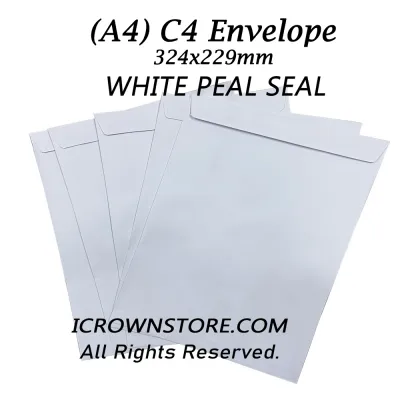
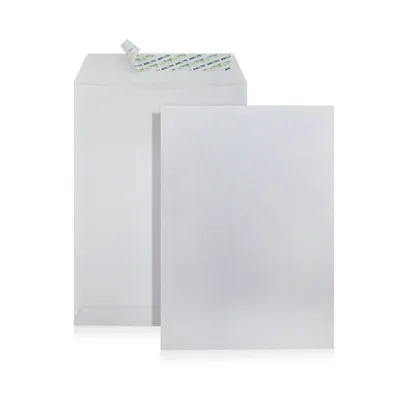
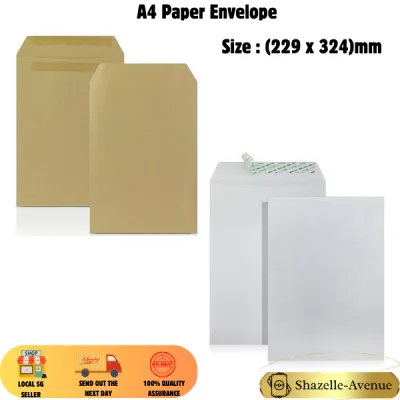
![White A4 Envelopes (Pack of 50) [Millen Stationery]](https://img.lazcdn.com/g/p/4a037762182e1e13032adbcc16c3be79.jpg_400x400q80.jpg_.webp)
Prices are valid at publication and may change. Please refer to the product page for the latest price.
The A-series dictates paper sizes, with A4 being the most common format for office printing, letters, and official documents, measuring exactly 210 x 297 mm. The C-series defines the envelopes designed to hold those corresponding A-series papers. Under this system, a C4 envelope is engineered specifically to hold an unfolded sheet of A4 paper. Because the C4 envelope measures 229 x 324 mm, it provides a comfortable margin of 19 mm on the short side and 27 mm on the long side.
If a manufacturer were to produce an envelope that matched the exact 210 x 297 mm dimensions of A4 paper, the internal usable space would be significantly smaller due to the paper seams and adhesive borders. Attempting to slide an A4 sheet into an identical-sized pocket would cause the paper to buckle, crease, or tear. Consequently, envelopes sold as “A4 size” in retail environments are almost always C4 envelopes, or they are smaller envelopes (like C5 or DL) intended for folded A4 sheets.
Recognizing this distinction before purchasing office supplies prevents the common frustration of receiving envelopes that are too small for your documents. Whether you are stocking up a corporate office in Singapore or preparing a single mailing, keeping the C-series standard in mind ensures you select the correct dimensions every time.
Standard Envelope Sizes and What Fits Inside
To simplify your selection process, it helps to review the standard envelope sizes available in the market alongside their precise dimensions and intended document capacities. Each size is optimized for a specific folding method or document format.

| Envelope Size | Dimensions (mm) | Best Document Fit |
|---|---|---|
| C4 | 229 x 324 mm | Unfolded A4 sheets, certificates, catalogs, or thin booklets |
| C5 | 162 x 229 mm | A4 paper folded in half once (A5 size), or flat A5 booklets |
| DL | 110 x 220 mm | A4 paper folded into thirds lengthwise (standard business letters) |
| C6 | 114 x 162 mm | A4 paper folded into quarters (A6 size), or standard greeting cards |
| B4 | 250 x 353 mm | Thick stacks of A4 paper, folder inserts, or backed certificates |
The concept of “fit allowance” is critical when analyzing these dimensions. Fit allowance is the extra clearance built into the envelope’s design. For standard flat items, a minimum clearance of 5 mm to 10 mm on all sides is recommended. When mailing thicker items, such as multi-page manuscripts or bound booklets, the document stack takes up vertical space, which pulls the front and back faces of the envelope closer together. This physical displacement reduces the effective width and length of the envelope, meaning you may need to step up to a larger size or choose an envelope with expandable sides.
Matching Envelopes to Certificates, Contracts, and Letters
Different documents require different levels of protection and presentation. Matching the physical characteristics of your paperwork to the right envelope format ensures professional delivery and minimizes postage costs.
Certificates and Diplomas
For high-value documents like graduation diplomas, professional certifications, or legal deeds, keeping the paper completely flat is essential. A standard C4 envelope is the baseline requirement for these items. However, if the certificate is printed on heavy cardstock or includes a protective cardboard backing board to prevent bending, a standard C4 pocket may prove too tight. In these scenarios, upgrading to a B4 envelope (250 x 353 mm) or utilizing a dedicated rigid cardboard mailer provides the necessary structural support to protect the corners from transit damage.
Multi-page Contracts and Reports
When dealing with multi-page documents, the weight of the paper—measured in grams per square metre (GSM)—plays a major role. Standard office paper is typically 80 GSM, while premium letterheads or contracts may use 100 GSM or 120 GSM paper. A contract consisting of 15 sheets of 100 GSM paper creates a thick stack that will stretch the seams of a standard flat C4 envelope. For these bulkier mailings, gusset envelopes—which feature pleated sides that expand up to 25 mm or more—are the safest choice to prevent seam failures during sorting.
Standard Business Letters
For day-to-day corporate correspondence, invoices, and statements, folding A4 paper is the industry standard. Folding an A4 sheet into three equal sections allows it to fit perfectly inside a DL envelope. This is highly efficient for mailing in Singapore, as SingPost categorizes DL and C5 envelopes under “Standard Regular” mail, provided they weigh under 240 grams and remain under 6 mm in thickness. Sending documents flat in a C4 envelope often shifts the postage category to “Standard Large,” which carries higher postage rates. Therefore, unless presentation requirements dictate otherwise, folding documents into a DL envelope is the most cost-effective option for high-volume business mailings.
How to Verify Fit and Usable Space Before Buying
Before purchasing envelopes in bulk, taking a few moments to verify the actual usable internal space can save time and resources. The dimensions printed on retail packaging almost always represent the external measurements of the envelope, not the internal capacity.
First, consider the seam construction. Envelopes with center seams have a slightly raised ridge down the middle of the back panel, which can catch on thick document edges. Side-seam or pocket-style envelopes offer a flatter interior pocket that maximizes usable space. Additionally, the sealing flap and closing mechanism can restrict how far a document can slide into the envelope. Heavy-duty clasp envelopes or those with thick peel-and-seal adhesive strips require a small amount of top clearance so the flap can fold over flat and seal securely without putting pressure on the contents.
To verify the fit of an unusual or thick document stack, perform a physical test using a dummy template:
- Stack the exact number of sheets you plan to mail, using paper of the same GSM weight.
- Measure the length, width, and height (thickness) of the stack using a ruler.
- Add the thickness of the stack to both the length and width measurements of your paper.
- Compare these adjusted measurements against the internal dimensions of the envelope to ensure a comfortable fit.
If the adjusted measurements are within 5 mm of the envelope’s listed dimensions, choose the next size up to ensure the envelope does not burst during transit.
Frequently Asked Questions (FAQ)
Will an A4 paper fit in a C5 envelope without folding?
No, a flat A4 sheet will not fit inside a C5 envelope. An A4 paper measures 210 x 297 mm, whereas a C5 envelope measures 162 x 229 mm. Because the C5 envelope is smaller than the paper in both directions, you must fold the A4 paper exactly in half along its longest edge to reduce it to A5 size (148 x 210 mm) so that it can fit comfortably inside.
Do listed envelope dimensions include the flap?
Standard envelope dimensions listed by manufacturers represent the external size of the envelope when the flap is closed and folded down. They do not include the extended length of an open flap. Because of the glued seams and paper thickness, the internal usable depth is always slightly shorter than the listed external height.
What size envelope do I need for an A4 certificate with a rigid backing?
For an A4 certificate paired with a rigid cardboard backing board, a standard C4 envelope will be too tight and may tear at the seams. You should use a B4 envelope (250 x 353 mm) or a specialized rigid cardboard mailer. The extra width and length of the B4 size accommodate the thickness of the backing board while keeping the edges of your certificate fully protected.
Community discussion
Share your experience or ask a question. Comments are reviewed before publication.